
For many returning students this fall, the start of the semester is accompanied by the absence of a fundamental part of their Tufts experience.
MyTERN, the Education and Reentry Network program run by the Tufts University Prison Initiative at Tisch College, brings formerly incarcerated students to the Tufts campus to learn alongside full-time Tufts students. In July, Joseph Auner, Tufts’ interim provost and senior vice president, sent an email announcing the suspension of the in-person MyTERN program for the 2026–27 school year. The decision followed a shooting in May that involved Tyler Brown, a student who had been previously enrolled in the program.
For students like Addy Samway, a junior who has been involved with TUPIT since her first year, the absence of the program feels particularly personal. Samway participated in the MyTERN program for two semesters before becoming one of the teaching assistants who supports the degree program inside Massachusetts Correctional Institution-Shirley, a prison roughly 50 minutes away from the Tufts campus. Last spring, she also became a student assistant for the program.
“It’s a year-long program, but reentry is a lifelong process. The way that MyTERN works is that people continue to come back to the space because the space exists,” Samway said. “When you take that away, that most recent cohort has no space to return to. All the decade of MyTERN students who would come back … lose this space too. It’s not just future students.”
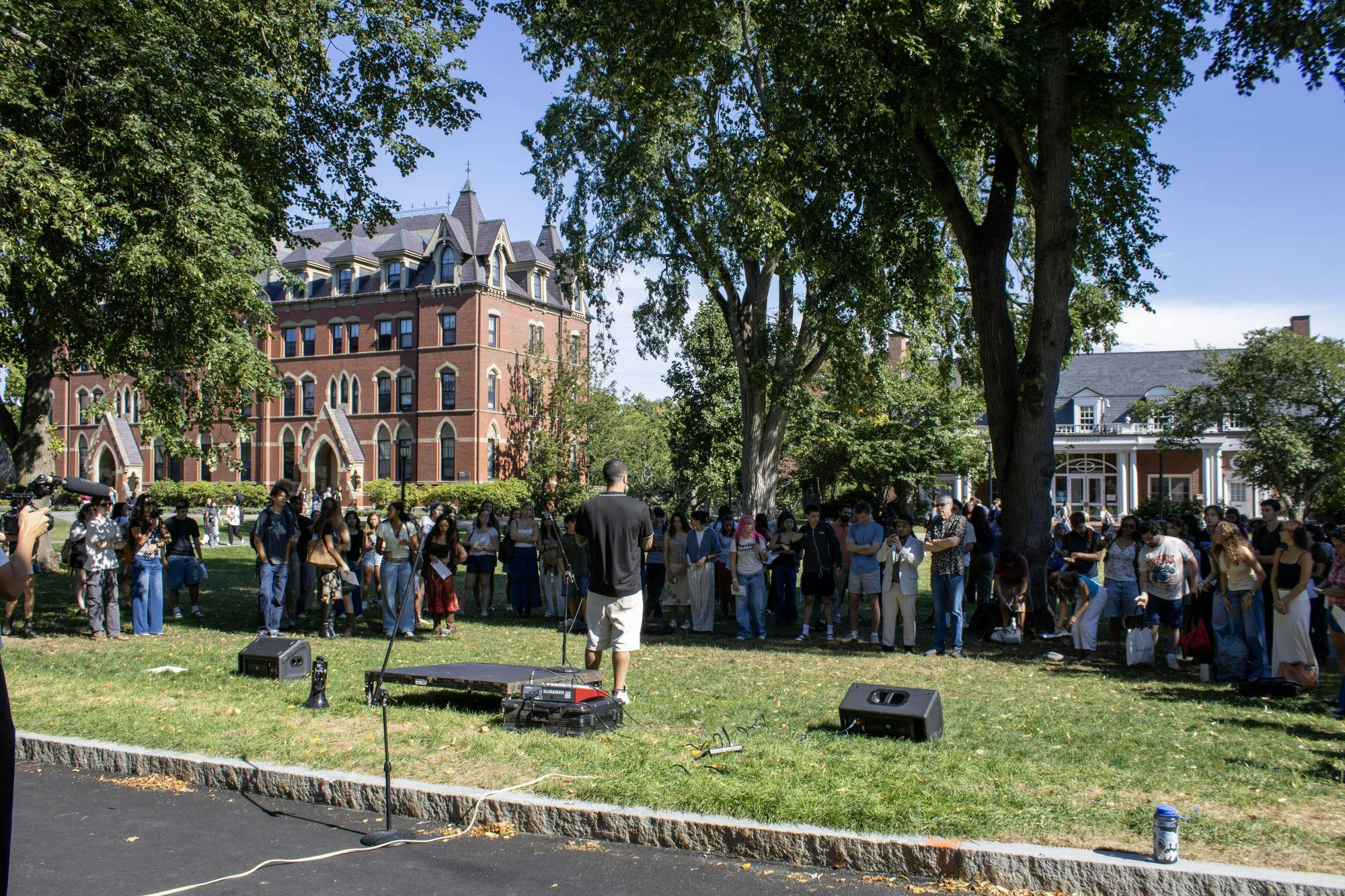
On the first day of classes this fall, Samway and seven other students involved in TUPIT organized the TUPIT Matters Speak-Out in front of Ballou Hall to address the impact of the MyTERN program’s suspension on the community. The speak-out included a rotating group of speakers who shared their connection to TUPIT and its influence.
Greta Steege, a junior who previously participated in MyTERN, attended the event.
“It was a little bittersweet, I would say, because I got to see a lot of MyTERN students that were in my class in the spring that I hadn’t seen in four months,” she said. “But it’s also hard knowing that this is one of the few opportunities that this group of people is going to be able to get together.”
No official announcements have been made about the program’s cancellation. The university maintains that it remains “paused” for an independent review to be conducted and for a working group of faculty and staff to assess the review.
“We understand the need to provide ongoing assistance to returning students and are working to connect them with partners and other sources of support,” Patrick Collins, executive director of media relations, wrote in a statement to the Daily. “The [working] group will continue engaging stakeholders, incorporating feedback from faculty and students, and developing strengthened administrative structures and processes to support the program moving forward.”
Many formerly incarcerated MyTERN students were present at the speak-out alongside full-time Tufts students and faculty.
“MyTERN means much more to me than simply being a program I graduated from,” Jamar Leaston, who graduated from MyTERN this past spring, wrote in a statement to the Daily. “That is why I felt it was important for me to be at the September 8th Speak Out. I wasn’t there simply to protest the loss of a program. I was there to stand up for the people who will come after me. The people who have already gone through MYTERN should not be the last people to have access to that kind of community.”
The MyTERN community has continued to find ways to come together since news broke of the shooting in May. Both Steege and Samway recalled the texts and calls that came in after the incident, as students gathered virtually to process their feelings of shock and grief.
Steege found out about the shooting from her spring MyTERN professor.
“The fact that our professor, a month after class ended, reached out to every single person individually and tried to see how everyone was doing and responding to the news speaks to the community built in that program,” she said.
Andrew West, a lecturer in the chemistry department who has taught classes at three different prisons as a part of TUPIT, attended part of the speak-out before teaching his first class of the semester.
“When things like this are cut or diminished, it’s not a typical academic cut,” he said. “This isn’t just a professional change for many of us. It is an emotional, guttural, to-our-core change. That is something you saw at [the speak-out].”
Samway expressed frustration toward the lack of information and transparency made available to the TUPIT student community during the summer, as uncertainty about the program’s future grew.
“There’s a lot of damage that was done that can’t be repaired. We need transparency and communication from [the university],” she said. “In my opinion, if there is a future to be built with the scraps of TUPIT that we have left, we need people in decision-making who understand the program.”
Collins added that conversations between the administration and students, faculty and teaching assistants had “provided opportunities to share additional information and context and to listen carefully to feedback, concerns, and suggestions.”
To show support throughout the summer, current and former full-time Tufts students, MyTERN students, alumni and faculty organized a letter-writing campaign directed towards the administration, including the working group.
“We were organizing all around the country, wherever we were, and trying to organize something that communicated to the administration that you can’t just do this and take this away from us and expect us not to do anything about it,” Samway said.
In a September update to the TUPIT community, Auner acknowledged concerns surrounding the program’s future and thanked students and faculty for writing to university leadership.
“I recognize that the temporary changes with TUPIT have created uncertainty and stress, particularly for our students, as well as for faculty and staff who have experienced the program’s impact firsthand,” Auner wrote.
He added that further steps would be contingent on the ongoing independent review process and that in-person prison education classes would continue as planned, with Melanie MacFarlane serving as interim director, replacing TUPIT founder and teaching professor Hilary Binda.
For some formerly incarcerated MyTERN students, the speak-out created a space to highlight their firsthand experiences with the program.
“I’d be alone if not for my beautiful community I found through TUPIT,” Shawn, a MyTERN student, said at the Sept. 8 event. “They stripped me of my reentry plans. … I planned on being involved in TUPIT for the entirety of my life, because it’s changed my life so much.”
“I hope the university will consider these perspectives of the Medford students and the MyTERN students, because that’s who the program is for, and that’s the people that are truly getting a ton out of it,” Steege said.
West echoed Steege’s desire. “I hope they will see that we can educate these incarcerated guys, but when they get out, they need resources. Education is one of many pathways to success,” he said. “What is beautiful about MyTERN is that it really helped people get on their feet.”
MyTERN classes were different from any traditional Tufts lecture. They often involved eating dinner together as a class, sharing personal details about the day and applauding each person’s wins.
Samway said that for her, the importance of the speak-out clicked when she saw all of the MyTERN students gathered together after a summer apart.
“It was in protest of the lack of space we had been given to grieve and process both what happened with Tyler and what has happened to the program. TUPIT is a very human, community-oriented organization. It functions only because we are face to face, working with each other, seeing each other and listening to each other, and we have been deprived of that all summer,” she said. “Being all together was so important to me, and also not the last step in what we need to do to continue fighting for this organization.”
The eight students responsible for organizing the event were granted a meeting with Auner and Dayna Cunningham, the dean of the Jonathan M. Tisch College of Civic Life, and have continued to meet with members of the working group to discuss changes being made to TUPIT and the future direction of MyTERN.
“Our shared goal is to ensure TUPIT receives the administrative support and resources it needs so that current and future participants can continue to benefit from its academic opportunities and coursework, as well as the non-academic supports that contribute to their success,” Collins said.
Samway says she plans to continue speaking out for TUPIT, and hopes to build space on campus for the MyTERN community to gather and process despite the program’s uncertain future.



