
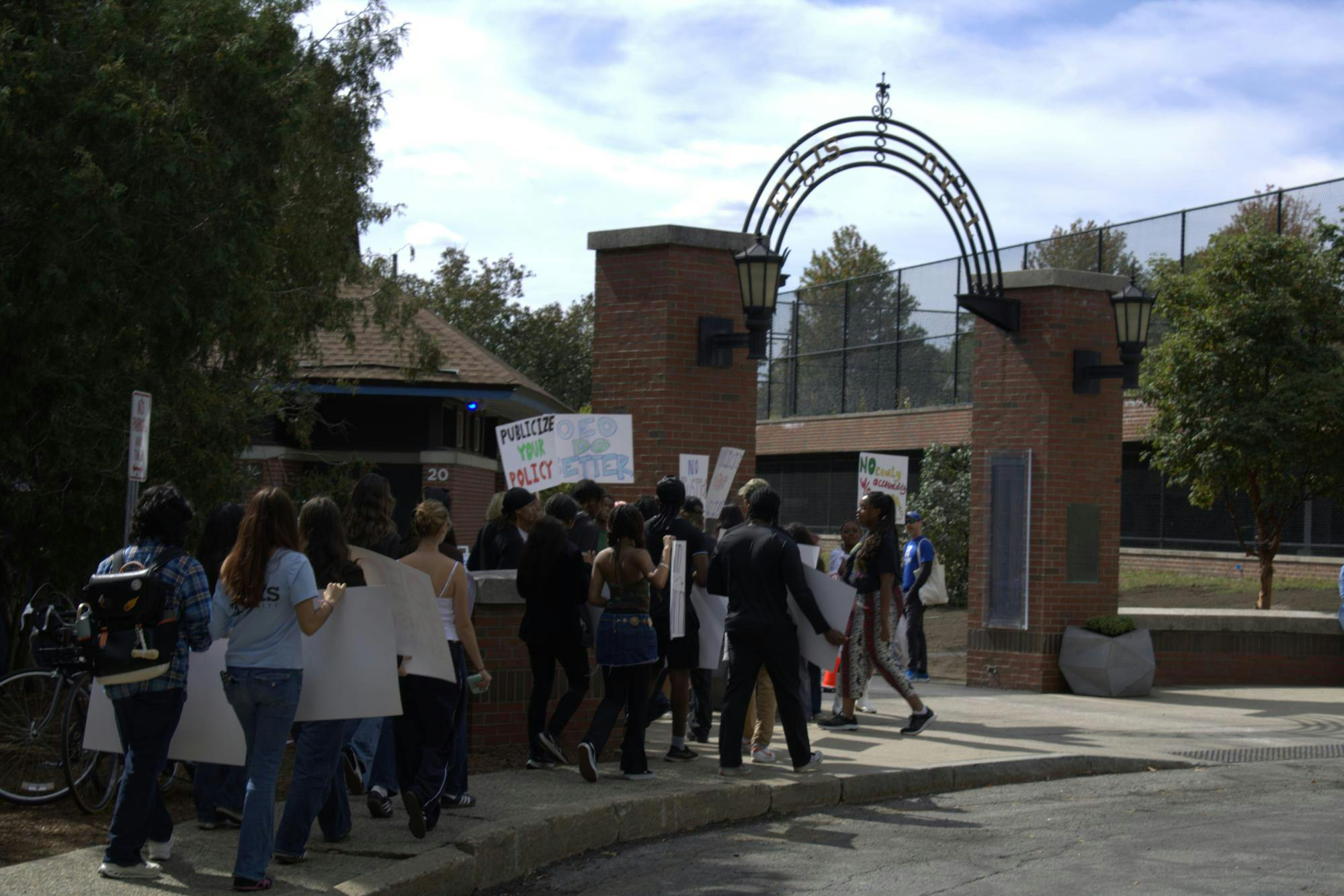
A protest, “Say No to OEO,” was held outside the Tufts University Africana Center on Saturday during Homecoming events as students demanded the Tufts Office of Equal Opportunity provide more support for marginalized students in light of alleged “indiscretion.”
The protest comes after an Instagram post made by Tufts senior Taisha Andre at the start of the semester, in which she argued that the OEO and program leadership did little to intervene when she experienced microaggressions and an unwelcoming environment for marginalized students as a peer leader for the pre-orientation program Students Heightening Actionable Political Engagement.
Andre described several incidents, including alleged negative comments made about various majority-black Boston neighborhoods and insensitivity around nepotism. Ultimately, Andre affirmed, SHAPE coordinators failed to “recognize when prejudice is normalized, to intervene when inappropriate comments were made, and to make sure that students and peer leaders feel safe speaking about their experiences.”
Kevin Kraft, associate dean of students and a SHAPE administrator, wrote in a statement to the Daily that it is possible for actions to be inappropriate without being policy violations and that the Office of Student Life offers ample training for peer leaders and coordinators.
“Regardless of any training, we also know that — as humans — we all will sometimes fall short,” Kraft wrote. “While conflict is inevitable in any community, we have choices in how we respond and, when given the opportunity, how we address the effects of our actions.”
The post also notes the OEO’s decision not to move forward with an investigation into the incidents, instead suggesting an “informal resolution.” Andre said she was “deeply disappointed that the school is choosing not to take more serious action or pursue a formal investigation into what happened.”
Patrick Collins, executive director of media relations, declined to comment about specific OEO cases but wrote in a statement to the Daily that every complaint is taken seriously to determine if conduct broke university policy.
“We can assure the community that OEO works exhaustively with the information available to its staff to hold accountable anyone found to have violated university rules, regulations, or policies,” he wrote. “It is also important to note that OEO is not the only forum available to students to address and resolve concerns and differences.”
After posting about both her SHAPE experience and the OEO protest, Andre said some students believed that the protest was a direct response to SHAPE incidents. Although her decision to protest the OEO was largely separate from her concerns about SHAPE, Andre acknowledged that the SHAPE incident may have influenced her decision to some extent.
“The SHAPE situation and this OEO protest are two separate entities,” she said. “I don’t want to say that the SHAPE incident didn’t at all influence my choice to do this protest. I think more so it’s recognizing that outside of the SHAPE incident, there aren’t any guardrails or any procedures from OEO that necessarily address student concerns.”
Sydni Wheeler, a sophomore who also expressed concerns around her experience as a SHAPE peer leader, helped organize the OEO protest and said that its timing during Homecoming was intentional.
“Today our movement, ‘Say No to OEO,’ is [intended] to bring awareness at such a big time, which is the Homecoming game that we have every year with a big audience,” she said. “We wanted to really lay on display our anger and frustration with the Office of Equal Opportunity here at Tufts for not addressing the concerns of the marginalized students of color that they have on campus.”
The group initially walked around the Ellis Oval football field near the start of the game, before making their way to the stadium stands where they held up posters, chanting for the entirety of the game.
Wheeler added that similar protests to raise awareness about the challenges Black Tufts students face are not unprecedented.
“Just 11 years ago, in 2015, Black students protested on campus, and that movement was called the 3% movement,” she said. “That protest was meant to increase the engagement of Tufts Admissions with Black students, and increase the number of black students on campus, and we've seen that, of course, in the past 11 years. But with that increase, there also needs to be an increase in engagement and addressing other issues.”



