Skip to Content, Navigation, or Footer.

News

The Setonian
News

Students fast for climate action, typhoon victims

A group of about 18 students this week fasted in solidarity with commissioner of the Philippines Climate Change Commission Naderev “Yeb” Sa?o.According to sophomore Ben Weilerstein, students from at least 68 educational institutions across the country participated in the fast in order to raise awareness about Typhoon Haiyan, which claimed thousands of lives and left thousands more destitute when it hit the Philippines in early November. The disaster, the participants in the fast said, was a direct result of climate change. Sa?o yesterday concluded the 12th day of his fast in an effort to stand with the Filipino people as they continue to suffer through the storm’s aftermath. He called for concrete action against climate change in Warsaw, Poland, where representatives of world governments came together on Nov. 11 at the United Nations Framework Convention on Climate Change (COP 19).Weilerstein said that he has been fasting for five days — beginning on Monday and continuing today — and has consumed nothing but a single cup of juice daily. Junior Dan Jubelirer chose to fast for two 24-hour periods at the beginning and end of the week.“I’m trying to use the power that I have right now in making this choice to tell people that we won’t always necessarily be able to [make the choice to fast] if we don’t get serious about stopping climate change,” Weilerstein said.On Monday and Thursday, fasting students sat in demonstration with empty plates at Dewick-MacPhie Dining Hall to bring their fast to the attention of the student body, Weilerstein said.“I was sort of frustrated because I want people to realize it’s not something that you can walk just away from,” Weilerstein said. “Yes, you can talk to me and then you can go on with your life, but I want you to think about this afterwards, realize what is your role in causing climate change, what is your role in preventing climate change, what is it that you owe to the world as [an] American.”Sophomore Sarah Killian explained that participants are fasting to different degrees, with some people giving up one meal and others going days without consuming solid foods. She planned to fast for two or three 24-hour periods during the week.“For me, there is something in feeling uncomfortable for one day that reminds you we have so many comforts here — not just with food, but the comforts of living that we don’t realize is not shared by everyone else, especially in places that are disproportionally affected by climate change,” Killian said. “Those discomforts could be made very real for us in the near future.”The process began when students from Tufts and Brandeis University held a meeting to discuss bringing the fasting movement to their campuses, according to Weilerstein. “Once I heard [that students at other schools were] doing it, I felt like ... we [needed] to do this at Tufts,” he said. An email thread about the fast began within the fossil fuel divestment network, Jubelirer said. Participants also made conference calls to various schools asking students to get on board with the effort.Killian emphasized the importance of the fast to garnering attention for the cause. “I think a big part of movement is bringing people into climate consciousness, and actions like this are good because they’re instrumental but also because they make a statement,” Killian said.For Weilerstein, the fast serves as a reminder of the privileges that have been taken away from climate victims.“I have the ability to just decide that I’m going to stop eating, and I can decide when I’m going to start eating again,” he said. “One of the scariest things is that in the Philippines, there are people who haven’t eaten as long as I have or longer, and not of their choice because climate change has caused a situation where they don’t get to decide that.”Weilerstein said that the possibility of a similar food shortage in the United States exists because of climate change.“[It] can seem distant, but that could be a future reality here, too,” he said. “There could be a time when we don’t get to decide when we want to eat and not eat.”According to Jubelirer, Tufts students collaborated with college students across the country on an open letter calling for climate justice at COP 19. The letter, posted on a WordPress site called “Stop the Madness Solidarity Fast,” is addressed to the Special Envoy for Climate Change Todd Stern and State Department negotiator Trigg Talley. The letter, which insists that Typhoon Haiyan was not a natural disaster but a direct result of global climate change, was emailed to Stern and Talley and will soon be printed and faxed to them as well, Jubelirer said. “These students at a hundred schools have been fasting all week saying you, [Stern and Talley], need to do your jobs and do something meaningful here and not just blow it off,” Jubelirer said.12


The Setonian
News

Social media impacts happiness, research says

While sites like Facebook, Twitter and Instagram were created to connect users and enhance social interactions, many research studies show the opposite is occurring — people who use social media heavily throughout their day can experience detachment, boredom and even loneliness. Even looking at pictures of food on Instagram can decrease satisfaction gained from actually eating the same food, according to research published in the Journal of Consumer Psychology this September. Should Tufts students be worried about their social media use?According to Julie Ross, director of Tufts’ Counseling and Mental Health Service, the effects of social media on students’ mental health can change how we connect with one another in person, making relationships more superficial.“Having a constant focus on what is happening somewhere else effectively removes people from staying connected in the face-to-face interactions they could be having, or are having at the moment, as those interactions get constantly interrupted by electronic signals from the phone or computer,” Ross told the Daily in an email. “Social media can provide the appearance of connection without an authentic connection.”A study conducted by Timothy Wilson, the Sherrell J. Aston professor of psychology at the University of Virginia, showed that college students rely on social media and technology to an unhealthy degree, according to a 2013 article in the New Yorker by Maria Konnikova.“College students start going ‘crazy’ after just a few minutes in a room without their phones or a computer,” Konnikova wrote.This phenomenon occurs all over campus, with students sitting around tables in the Dewick-MacPhie Dining Center aimlessly scrolling through Twitter and perusing Facebook during lectures instead of taking notes.“One would think we could spend the time mentally entertaining ourselves ... but we can’t. We’ve forgotten how,” Wilson said.According to sophomore Eyob Sharew, some Tufts students focus on social media more than others.“Everyone has a smartphone, so people use it heavily, definitely more in some circles than others,” Sharew said. “Some circles will do the thing where everybody is on their phones at dinner, and they’re not talking to each other. We’re just of that generation.”Student groups at Tufts, however, see Facebook and other social media outlets as an important way of promoting student groups and events. Junior Dan Jubelirer is an active Facebook user but does not spend the majority of his time perusing other people’s pages. He said that he sees Facebook as a resource, as opposed to a replacement, for social life.“I use Facebook mostly for organizing, for work with Tufts Divest [for Our Future] and Students for a Just and Stable Future and to connect with people all around the country who all are on Facebook,” he said. “It’s just a tool. You can use it well, you can use it poorly, you can use it productively or you can waste time on it.”Sharew found that the time he spends online can usually be better spent studying or spending time with friends. He explained that he deactivated his Facebook account about one year ago.“I cut out Facebook because I realized the time that I was spending on Facebook was making inroads into the time that I should’ve spent studying and connecting with other people,” he said. “Time spent with real people or time spent doing things I was supposed to be doing was much more valuable time spent than the time spent on Facebook.”A 2010 article in The New Yorker examined various studies linking Facebook use and mood and found that the way in which people use the site — and not the duration of use — was the deciding factor in determining whether there was an increase or decrease in level of happiness. According to the article, researchers from Carnegie Mellon University observed positive mood changes when participants directly engaged with others through messages, wall posts or “likes,” but there was an increase in loneliness and disconnect when people passively browsed content.According to Konnikova, another study at Humboldt-University in Berlin, Germany has suggested that envy, too, increases with Facebook use.“The more time people spent browsing the site, as opposed to actively creating content and engaging with it, the more envious they felt,” Konnikova wrote. “The effect, suggested Hanna Krasnova and her colleagues, was a result of the well-known social psychology phenomena of social comparison.”Ross said that self-image issues for teens and college students are often brought about or heightened through viewing others’ Facebook pages. She cited the work of Sherry Turkle, Abby Rockefeller Mauz? Professor of the Social Studies of Science and Technology at MIT, who wrote the book, “Alone Together: Why We Expect More from Technology and Less from Each Other.”“As Dr. Turkle points out in some of her work, people manipulate their images on social media to project whatever they wish to, so that the image that is being ‘connected’ to by others may not represent the authentic person behind the image,” Ross said. “If others ‘like’ this false image, it does not necessarily feel like a real connection and leaves people worried that if they were known more fully, they would not be liked or accepted.”12


The Setonian
News

Minkler awarded Tisch College Research Prize

The Jonathan M. Tisch College of Citizenship and Public Service this month awarded its annual Tisch Research Prize to Meredith Minkler, professor of health and social behavior at the University of California, Berkeley, for her leadership in community-involved research.


The Setonian
News

‘No Shave November’ furthers awareness of cancer, Relay for Life

Halfway through November, many male students have put their razors to rest to participate in the first “No Shave November” contest held by Tufts Relay for Life (Tufts RFL). The contest is a play on the larger movement during the month of November, sometimes called “Movember,” that aims to raise awareness for men’s health.Sophomore Benjamin Silver, the special events coordinator for Tufts RFL who organized the contest, explained the inspiration behind holding a “No Shave November” competition at Tufts.“It is the male prostate cancer month,” Silver said. “[‘No Shave November’] is a movement that started off in the late ‘90s. We are trying to take advantage of that momentum and utilize it for RFL.”Since its first event in April 2004, Tufts RFL has raised more than three quarters of $1 million in total for the American Cancer Society to fund cancer prevention, cancer treatment and cancer research, according to senior and co-Chair of Tufts RFL Jon Duval.Andrea Hurwitz, the community executive and director of development for ACS and an advisor for Tufts RFL, told the Daily that Tufts’ fundraising efforts have been substantial.“Tufts does an exceptional job with the fundraising and is an outstanding fundraiser every year,” she said. “Actually, in the last year, 2012, Tufts was one of the top five fundraisers for colleges in New England.” Duval also noted the success of fundraising initiatives around campus.“In October, we sold cupcakes and shot glasses at the Campus Center,” he said. “It was a huge success. We sold over 100 cupcakes ... But more importantly, we raised awareness on campus about breast cancer.” RFL events have become well known on campus, according to Duval and senior and co-Chair of Tufts RFL Caroline Kaufman, but they are always looking to increase the number of participants. “People will form teams with their friends from sports teams, music groups or from dorms. So we usually get 75 different teams,” Duval said. “We are trying to reach out to the entire community, including the faculty and the graduate students.”According to Duval, RFL’s “No Shave November” event has enabled the group to reach out to more students than in previous years. Silver said that although the event builds the community’s awareness about RFL and cancer, the more important focus is engaging students.“We don’t really have a specific number in mind for how much money we want to raise,” Silver said. “I think the more important number to look at is how many people are registering for this event and forming teams. Because we know that once we rope them in and get them involved with the ACS and RFL, they will want to stick with it, and help fundraise and get more people involved, and become advocates for it.”There is no deadline for signing up for the contest, Silver added.“We want to open this to as many people as possible. So people can jump in whenever they want,” he said.There are two ways to get involved with “No Shave November,” according to Silver, and anyone can get involved, regardless of team association.“The first is the individual team. It is for people who are not in an organization and just want to participate,” he said. “The idea is to post pictures of yourself before and after. And you can either grow a mustache or a beard. We just want everyone to get involved. Whatever it means to them, they should get involved that way.”Silver said that they are also looking for sponsors — such as fraternities, sports teams, art groups and cultural centers — to gain even more participation across campus. Tufts RFL also encourages involvement from faculty and staff.“To help sponsor, we want at least 10 members of the organization to get involved,” Silver said. “We are also in talks with the football and baseball team[s]. Their coaches are very excited about that.” Devyn Curley, philanthropy chair of Sigma Phi Epsilon (SigEp), an active sponsor of the contest, said that there are about 16 or 18 brothers getting involved in this campaign.“We took a nice pre-November picture, and we are excited to see how we will look after Thanksgiving break,” Devyn, a junior, said. “[Brothers] are very excited to support the cause. We have actually done a really good job. Our team has already raised $580.”Silver expressed enthusiasm about the contest’s three different categories — the best overall facial hair, the best mustache and the best beard.“For the prizes, we have JumboCash, gift cards from local businesses and some bundles from the ACS, [such as] cups, mugs and the sorts of gifts they are willing to give to the participants,” Silver said. “And right now we are working with barber shops in Davis Square to offer free shaves at the end of the contest.”At the end of the month, University President Monaco will act as the judge of the contest.“The ‘November No Shave’ is an interesting and fun way to support the Relay for Life activities in support of the fight against cancer and specifically in this case, [for] awareness of men’s cancer,” Monaco told the Daily in an email.Monaco said that he has already pictured what a winning beard will look like.“I will be looking for style, grooming and who reminds me most of the Boston Red Sox,” he said.Sophomore and contest participant Jem Wilner explained that although he is unsure of which mustache or beard to sport for the contest, he wishes he could do more to help with RFL’s cause.“Obviously, RFL is an incredibly important foundation ... for an incredibly important cause,” he said. “Even what I’m doing is such a small thing for them; I’m happy that I could get involved as much as possible ... I encourage everyone to grow out a beard.”12


The Setonian
News

Boston Palestine Film Festival, exhibit ‘From the Streets’ showcase Palestinian perspective

The Boston area has certainly gotten a glimpse of Palestinian life and culture over the last month, with celebrations of Palestinian art through The Boston Palestine Film Festival (BPFF) and the photography exhibit “From These Streets” at the Tufts University Art Gallery.Beginning on Oct. 18, the 10-day film festival featured over 30 films portraying Palestinian life, family and culture. It was hosted by the Museum of Fine Arts, Boston, the Cambridge Public Library and Harvard Law School.The films addressed issues surrounding the political occupation of the Palestinian territories and its effects on refugee camps, as well as offered a look at Palestinian culture. According to Assistant Professor of Anthropology Amahl Bishara, providing this alternative viewpoint is particularly important.“We most often see Palestinians represented through the news and through political negotiations or acts of violence,” Bishara said. “But the Boston Palestine Film Festival lets us think about Palestinian society and culture in a more multidimensional way.”Tufts students who made it to the festival were exposed to films that showed Palestine through a more personal perspective. Munir Atalla, a member of Tufts Students for Justice in Palestine, attended the event and enjoyed the opportunity to screen the films.“I’m so happy that the Museum of Fine Arts puts its weight behind such a sometimes controversial event,” Atalla, a junior, said. “It’s been going for eight years, and they keep upping the quality. It’s also that Palestinian filmmaking has developed a lot recently, and we are starting to see more films that are competitive on a global level.”The film festival, a program of the Middle East Charitable and Cultural Society Inc., is one of the larger events that the organization hosts throughout the year, along with discussions, film screenings and workshops throughout the Boston area. The mission of the festival is to showcase the Palestinian narrative and culture through cinema and art.Founded in 2007, the festival has since presented over 300 films, as well as hosted numerous Palestinian artists and filmmakers through concerts and exhibits. This year’s festival was co-sponsored by various community groups, including the Center for Arab American Philanthropy, Jewish Voice for Peace Boston and Grassroots International.One film featured this year was “When I Saw You” (2012) from director Annemarie Jacir, who was recently named one of Filmmaker Magazine’s 25 New Faces of Independent Cinema. “When I Saw You” is set in Jordan during the 1960s and documents a boy’s journey after running away from his refugee camp.The BPFF also showcased “Just A Child” (2012), directed by Mohammad Al-Azza, who grew up in the West Bank in a refugee camp. The documentary short centers on a Palestinian teenager’s life after he is released from an Israeli detention center in the West Bank. Though his release garners a positive response from the community, through his perspective, audience members gain an understanding of the more complex consequences of his return to the community.Bishara, along with students in her Media, the State and the Senses seminar, recently collaborated with Al-Azza to bring the photography exhibit “From These Streets: A Palestinian Refugee Perspective on Community” to the Slater Concourse Gallery, located in the Aidekman Art Center. The exhibit, which will run until Dec. 8, displays Al-Azza’s photos depicting the Palestinian community.The young Palestinian photographer, born and raised in Aida Refugee Camp, Bethlehem, in the Palestinian West Bank, developed his photojournalism skills from a local youth organization called the Lajee Center. He later became the director of the Media Unit in the Lajee Center and continues to teach these skills to Palestinian youth in the area, according to Bishara.“[The Lajee Center] is a community-based organization, and they do a lot of activities for children and youth,” Bishara said. “One of the most thriving, successful programs they have is a media unit that teaches youths about documentary production and photography. And for me as a media scholar, it’s a gift. It’s just a really interesting story for me to think about and tell.”Bishara expressed excitement about bringing the Lajee Center and Tufts together with the exhibit. Various university groups co-sponsored the exhibit, including the Department of Anthropology; the Office of the Dean of Arts and Sciences; the Institute for Global Leadership; the International Relations, Middle Eastern Studies and Peace and Justice Studies programs; the Experimental College and the Slater Family Fund. “I mean, obviously their institutions are on various different scales and have very different resources and different missions as well,” she said. “But there is some overlap there, and I really appreciated this opportunity to bring that together to the exhibit.”The exhibit’s opening on Nov. 6 in Aidekman attracted a large showing of students, who could interact with Al-Azza and ask questions about his work and his experience growing up in a refugee camp.12


The Setonian
News

Students rally for higher minimum wage

Tufts Labor Coalition , United for Immigrant Justice (UIJ) and Tufts Democrats organized a rally at Davis Square on Nov. 9 in support of the Raise Up Massachusetts (Raise Up MA) campaign.Raise Up MA aims to raise the minimum wage from $8 to $10.50 per hour and guarantee employees an hour of earned sick ...


Feature-Image_Place-Holder
News

Founding member discusses Boston's first rooftop farm

Founder of Higher Ground Farm John Stoddard (N '09) spoke yesterday in the Lincoln Filene Center Rabb Room about the environmental benefits of rooftop farming in the Environmental Studies Program's weekly Lunch and Learn series.


The Setonian
News

Founding member discusses Boston’s first rooftop farm

Founder of Higher Ground Farm John Stoddard (N ’09) spoke yesterday in the Lincoln Filene Center Rabb Room about the environmental benefits of rooftop farming in the Environmental Studies Program’s weekly Lunch and Learn series.


The Setonian
News

Leong discusses gentrification of Chinatowns

Associate Professor in the College of Public and Community Service at University of Massachusetts Boston Andrew Leong spoke about gentrification of Chinatowns around the world last night in Braker Hall.


The Setonian
News

180 Degrees Consulting adds Tufts to worldwide map of social justice consulting

Only two of the 26 current branches worldwide of 180 Degrees Consulting are in the United States, so the founding of a Tufts branch of the world’s largest student consultancy next semester will serve as yet another landmark in the university’s growth as an elite player in the world of social innovation and consulting.The group’s general interest meeting was held on Oct. 27 in Cabot Auditorium.Senior Christopher Yee-Paulson, who serves as co-president of 180 Degrees Consulting alongside fellow senior AJ Scaramucci, was enthusiastic about the overlap of consulting and active citizenship in the group.“There is a lot of intellectual capital at Tufts, and many students have strong interests in both social impact and consulting,” Yee-Paulson told the Daily in an e-mail. “This is the first type of organization that serves both needs, providing incredible synergies between these two intellectual camps.”This has been an important year for Jumbos interested in pursuing business-related careers, in particular consulting. The School of Arts and Sciences does not offer a business major or minor, besides the Entrepreneurial Leadership minor, so would-be business students often take courses in the Department of Economics.However, many students this semester have been looking for more guidance. The hiring of finance and consulting expert Christopher Di Fronzo (E ’96, EG ’04) at the Career Center this fall is evidence of the desire students have to learn about these fields. The addition of a chapter of 180 Degrees Consulting follows this trend.Since its founding at the University of Sydney in 2007 by then-economics student Nathaniel Ware, 180 Degrees Consulting has become a worldwide organization with city and university branches in locations such as Prague, Tokyo and Stockholm — and now Medford and Somerville. The group has branches in 18 countries.The new branch at Tufts will officially be launched next semester, and according to Scaramucci, who is also the founder of the Tufts branch, this will bring a lot recognition to Tufts given the consultancy’s reputation worldwide.“180 Degrees Consulting is now the largest pro bono student-driven consultancy in the world,” he said.180 Degrees team members offer business advice to non-profit organizations and non-governmental organizations (NGOs) free of charge. At the University of Sydney, for example, student consultants worked with Red Cross Australia to help to cut down costs, allowing the organization to focus funding elsewhere.Scaramucci explained that, while he has garnered experience in sales through his part-time work as a product specialist at Tesla Motors, the predominant factor that inspired him to start the Tufts branch was his study abroad experience at the University of Sydney, where he said he worked in the company’s original branch.“All you do is go out and actively recruit consultants at a university campus,” he said. “You do some inbound marketing, they apply to be student consultants, and the individuals who get accepted then get paired into teams of five. Those teams of five get paired with a team leader, so that’s six total individuals. Finally, they get paired with a non-profit organization or NGO in the local area.”Scaramucci’s team of consultants in Australia, he said, worked with Food Water Shelter, an Australia-based non-profit that works in developing countries to benefit vulnerable women and children by providing functional education, social and health facilities. His team advised the organization to take advantage of the growing popularity of Massive Open Online Courses (MOOCs) through websites such as Khan Academy, so that students in Tanzania would have access to an assortment of courses that they wouldn’t otherwise have.“In short, they were spending a lot of money on teachers and volunteers and textbooks and infrastructure, rather than on computers and Wi-Fi connection,” Scaramucci said. “What this enables for the Tanzanian kids is that they [have] the ability to have access to the Internet.”While the club will enable student consultants to gain invaluable first-hand experience in the business world, like Scaramucci said he has already seen, 180 Degrees Consulting puts volunteerism and activism at the heart of its goals to produce positive socioeconomic change in communities near chapters.Jasmine Slivka, founder of the first 180 Degrees branch in the United States at Indiana University, expressed her excitement about the establishment of more chapters in the country.“With an already strong presence in Australia, Europe, and Asia, we could see immense potential for 180 Degrees Consulting branches at many of the top universities in the United States,” Slivka told the Daily in an email.Slivka, who is also 180 Degrees’ Chief Branch Officer of North America, has been collaborating with the executive board of the Tufts chapter.“We have put together a very strong regional team to oversee the increasing demand for 180 Degrees Consulting branches and are very confident in the success of our new branches launching next semester,” she said.12


The Setonian
News

Tisch College appoints alumni to board

Three new members of the Jonathan M. Tisch College of Citizenship and Public Service’s Board of Advisors — Selina Chow (J ’78), Stephen Demirjian (LA ’83) and Diane Hessan (J ’76) — officially began their terms on Oct. 22.


The Setonian
News

Annual ceremony honors veterans

Members of the Tufts community recognized Veterans Day yesterday with a special service on the Memorial Steps hosted by Tufts Advocates for ROTC, the Reserve Officers’ Training Corps.


The Tufts Daily Crossword with an image of a crossword puzzle
The Print Edition
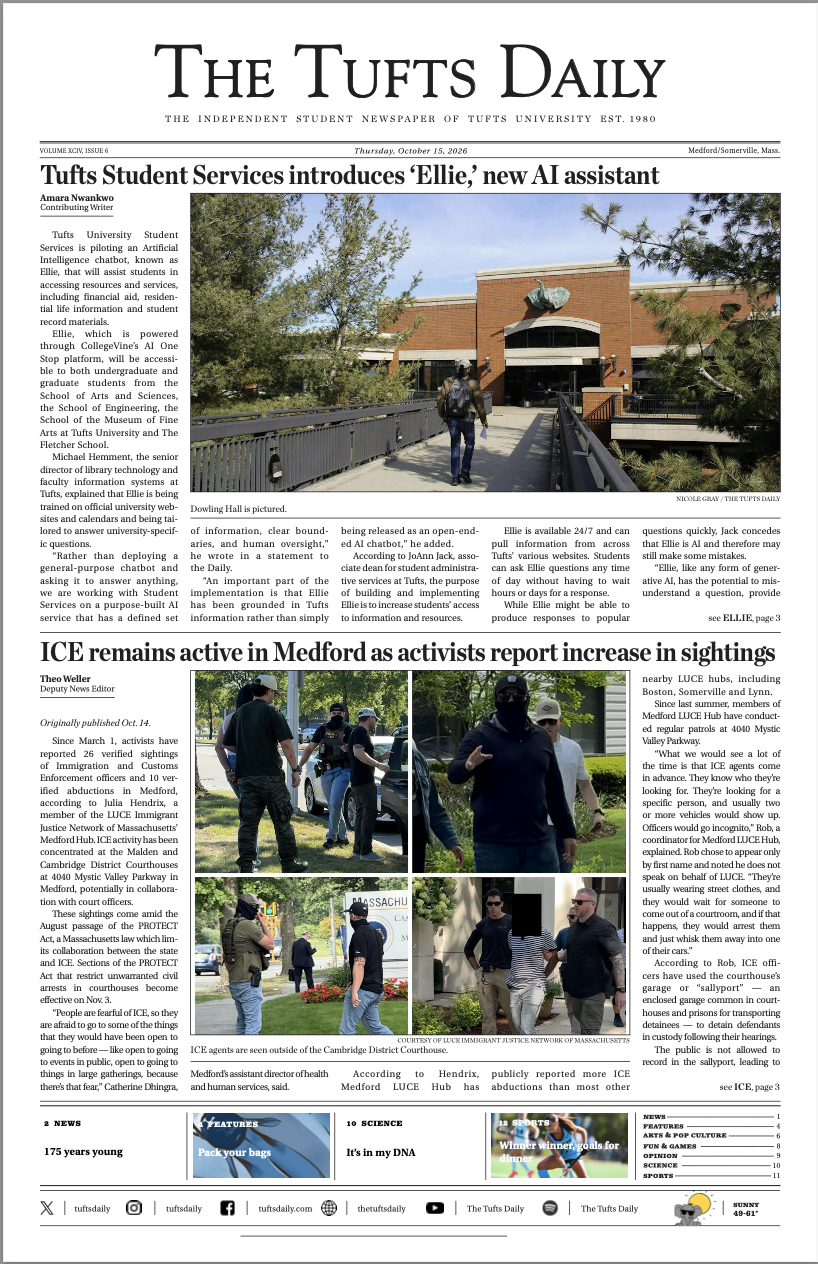
Tufts Daily front page