Skip to Content, Navigation, or Footer.

Opinion

The Setonian
Opinion

A sad, but necessary farewell to Asian Studies

Tufts has a well-deserved reputation for its global outlook. While there is a flourishing interest in Asian history, cultures, languages and literature at Tufts, and we have increased both the number of Asian-related courses and faculty in these disciplines over the last 30 years, very few students actually major or minor in Asian studies. You might be surprised to know that there are currently just four Asian Studies majors (one a senior) and only one Asian Studies minor - and that number is typical.


The Setonian
Opinion

Critics of SJP ignore crucial facts

Just when you thought it was over, here’s a new opinion on Israeli Apartheid Week (IAW). I, too, came back from spring break expecting the discussion to have dissipated, only to find yet another criticism of Students for Justice in Palestine (SJP) in the op-ed section of the Daily. First, let me be clear that I am not a member of SJP. I find that their tactics during IAW are an example of activists preaching to the choir. The demonstrations and events only seem to resonate with those inclined toward their cause, while students who are uninformed or neutral tend to be put-off by IAW. Having said that, the many op-eds published in the Daily are evidence alone that IAW resulted in campus dialogue. To claim that SJP has inhibited such discussions is, in my view, inaccurate. Even more worrisome, however, is the persistent claim that the application of the term “apartheid” to Palestine is offensive to those who “really” endured apartheid, namely black South Africans. While not popular in American political discourse, the apartheid analogy is given more credence in other parts of the world. The portrayal of Israeli Apartheid as a fringe argument that is offensive to those who were victims of “actual apartheid” is a great inaccuracy. Certainly, there are some South Africans who might object to the comparison, but many prominent leaders and groups have expressed solidarity with Palestine. As noted in Haaretz two weeks ago, Nobel Peace Prize winner Archbishop Emeritus Desmond Tutu said, “I have witnessed the systemic humiliation of Palestinian men, women and children by members of the Israeli security forces ... their humiliation is familiar to all black South Africans who were corralled and harassed and insulted and assaulted by the security forces of the apartheid government.” He’s not the only one. The African National Congress, the political party of Nelson Mandela and the current ruling party of South Africa, issued a press release titled “ANC in solidarity with the people of Palestine — supporting Israeli Apartheid Week.” It read in part, “The ANC is proud to join the over 75 South African organizations, trade unions, civil society groups, schools, universities, religious communities, NGOs and other formations in participating in this year’s 10th International Israeli Apartheid Week.” In addition, the Congress of South African Trade Unions (COSATU), the largest trade union federation in South Africa that represents 1.2 million workers, has supported a boycott of Israel. The President of COSATU even said, “As someone who lived in apartheid South Africa and who has visited Palestine, I say with confidence that Israel is an apartheid state.” These South Africans are not the only people aware of Israeli apartheid. Nobel Prize winner and former United States President Jimmy Carter would agree with Desmond Tutu and the ANC. In fact, in 2006 he published a book titled “Palestine: Peace Not Apartheid.” In a Jan. 25, 2007 interview with NPR, President Carter said, “Apartheid is a word that is an accurate description of what has been going on in the West Bank ... This is a word that’s a very accurate description of the forced separation within the West Bank of Israelis from Palestinians and the tool of domination and oppression of Palestinians by the dominant Israeli military.” The list goes on and on. I bring up these examples not to trivialize those who were personally offended by IAW, but to make a suggestion to those who were offended on behalf of black South Africans: If you want to be an ally to the people of South Africa speak with them, not for them. I am also shocked by how many people have argued that SJP has inhibited campus dialogue. Would these many op-eds, letters to the editor and discussions with fellow students happen if it weren’t for IAW? We are still talking about it, and it happened over two weeks ago! It seems quite ironic to argue that SJP inhibited campus dialogue by responding with an op-ed in the Daily, the primary conduit for campus dialogue. Whether you like SJP or not, is this increased discussion of the Israeli-Palestinian conflict not a result of IAW? Some of the most productive conversations I have had with people who I disagree with have been as a result of IAW. More troubling is the double standard that exists when it comes to the expectation of supporting dialogue. None of the SJP critics I have encountered who deride the organization for failing to engage pro-Israel groups have made the same criticisms of Friends of Israel or Hillel. In fact, Hillel as a national organization has a political stance on Israel that precludes chapters from holding events with groups that are in favor of BDS (boycott, divestment and sanctions). 12


The Setonian
Opinion

Late night T service a welcome improvement

The MBTA will initiate a pilot program to provide late-night T service beginning this weekend, extending service hours to as late as 3 a.m. on Friday and Saturday nights. Late-night T service is an enormous step forward in bringing Boston’s nightlife up to par with other major American cities. This change will make the city an even more attractive place for college students and residents that many news stories and politicians are calling “innovation workers,” who tend to be younger and want to stay out later. Without late-night T service, MBTA trains and buses stop running at 1 a.m. on weekend nights, effectively preventing Tufts students from being able to stay out past 12:30 a.m. (when the last trains leave the city center) in other areas of Boston without having to take what can often be an expensive taxi ride home at the end of the night. The extended train and bus service on weekend nights will cost an estimated $20 million annually, offset in part by corporate sponsors who have made new long-term marketing agreements with the MBTA. Should the extended service hours be picked up long term, it would likely be funded through the proposed increase in T fares. Tufts students should take full advantage of the year-long initiative for late-night T service. It gives students the opportunity to experience the nightlife of Boston and get out of the “Tufts bubble” more frequently. Additionally, the one-year trial program will be monitored closely for usage. If the extended service does not see enough ridership, the program may not be renewed for the following year. Extended late-night T hours might also be funded through an adoption of the proposed UPass by major Boston-area universities. The UPass, in which universities would, in effect, purchase large amounts of T passes for their students, would provide the MBTA with an excess of funding. The additional UPass funds could alleviate the MBTA’s budget problems and create a sustainable source of income for the extended late-night T service, paid for by those who would utilize late night service the most. Critics of the extended late-night service have noted the failure of the city’s Night Owl program, initiated in 2001, which offered late night service through new bus routes that mimicked existing train lines. This new late night train service, however, should be far more successful, by relying on a system and map that riders are already extremely familiar with. This weekend marks the start of a new era for Boston, one that brings it up to par with other great cities that run public transportation late into the night. This is a great opportunity for Tufts students to get off the Hill and see what the city’s nightlife has to offer.


The Setonian
Opinion

To end the occupation, empower the left

    The occupation must end. After spending five days in the West Bank this winter break and seeing it first hand, it is brutally clear to me that the Israeli occupation of Palestinian land is illegal, unjust and inhumane. I've opposed the occupation theoretically and intellectually for a while now. But seeing the immense physical and psychological damage it inflicts on Palestinian lives - seeing the tragedy that is Hebron - seeing the isolating hatred from both sides - is something completely different.     I met Israeli settlers in the settlement suburbs of Ofra and Binyamin who spoke of their deep religious connections to Biblical holy sites in "Judea and Samaria." They told me that all they want is to "live without fear" of Palestinian terrorism, showing me a bullet hole in their pre-school's wall as proof.     I met Palestinian leaders of the nonviolent protest movements in the towns of NabiSaleh and Bil'in, who said that simply to live with dignity is to resist. They spoke about their desire for a third nonviolent intifada, a peaceful mass uprising of Palestinians that would expose the harsh tactics of the Israeli military and force change.     I met with a lawyer from a human rights organization that tracks the violent interrogations and rigged trials of Palestinian children accused of throwing stones. He told me that Israel "is not an apartheid state. It's much, much worse." He meant that Israel is no longer simply separating and discriminating against Palestinians - it is actively annexing Palestinian land through settlements. He put it like this, "They are taking the land without the people."     Colonialism and imperialism are frameworks to use when looking at the Israeli-Palestinian conflict. Civil rights are another. As far as I could tell, most of the Palestinians I met saw themselves as oppressed and disenfranchised, but not necessarily as colonial subjects of Israelis. They often spoke of wanting to live normal lives, simple things like the ability to travel without checkpoints and roadblocks, to find employment, to provide decent education and healthcare for their families, to vote. Ideally, they said, they would cast their votes in an independent Palestinian state. But with eroding faith in the peace negotiations, they believed it far more likely that they would be absorbed into an Israeli state. And I'm not sure that Palestinians' civil rights in a Jewish state, in the form it exists today, would be equal to those of Jewish Israelis.     The status quo cannot continue. It is not sustainable for an increasingly fragmented and destroyed Palestinian society or for Israel if it claims to be a democracy that upholds equality and justice. But what is the way forward? First, we must recognize that Israel is not an evil monolith. It is a nation, it is not going anywhere and it has internal political complexities that have enormous effects on its future.     Israel was founded on Zionism, and Zionism exists on a political spectrum, from leftist and progressive to right wing and conservative. Much of Israeli society was founded on socialist labor Zionism in the form of the Kibbutz Movement. While sometimes painted as white European settlers colonizing Palestinian land, these Chalutzim (or pioneers) saw themselves as building a new future for the scattered and persecuted Jewish people. They were young idealists (like many of us at Tufts) and envisioned a utopian society in which Jews would work the land, live together in nonhierarchical, equal communities and coexist with their Palestinian neighbors.     This idealism didn't come from nowhere, though. The need to create a new future of the Jewish people came from a past of brutal and constant oppression in Europe. In many ways, Zionism was actually a liberation movement. It was the youth's quest for emancipation and empowerment of Jewish peoplehood in the wake of the Holocaust. However, the Jews' history of persecution made it even more crucial for the leftist Zionists to support sharing the land with Palestinians.     As Amos Oz writes in "Under This Blazing Light" (1995), "The Zionist enterprise has no other objective justification than the right of a drowning man to grasp the only plank that can save him. And that is justification enough. (Here I must anticipate something I shall return to later: There is a vast moral difference between the drowning man who grasps a plank and makes room for himself by pushing the others who are sitting on it to one side, even by force, and the drowning man who grabs the whole plank for himself and pushes the others into the sea. This is the moral argument that lies behind our repeated agreement in principle to the partition of the land…)"     The kibbutz network disintegrated as Israel transitioned into a capitalistic society, but many aspects of it continued to inform Israeli society. Socialist Labor Zionism gave birth to the Labor party, which dominated Israeli politics through the 1970s and played a large role in Israel's social welfare policies and Rabin's bid for peace at the Oslo Accords. In addition, the Histadrut labor union, founded 20 years before the state of Israel by chalutzim in the Third Aliyah, continues to be one of Israel's most important institutions.     It's equally important to note that Zionism had militant, rightist and intolerant factions since the very beginning. Revisionist Zionism called for the Jews' exclusive territorial rights to Israel and led to the foundation of the Irgun, a right wing terrorist group. The right wing strain of Zionism, unfortunately, gained dominance in current Israeli politics and policy as Palestinian violence increased and the left disintegrated. The right, which includes much of the ultra-religious community, is what enables increasing settlements in the West Bank, as well as harassment of Reform Israeli women attempting to pray at the Western Wall.     The re-emergence of the Israeli left is a critical step in ending the occupation. There is an urgent need for loud voices on the left urging Prime Minister Netanyahu to take initiative and forge a peace deal, recognizing and accepting the Palestinians' demands for an autonomous state and their already significant concessions. The left must mobilize a passive Israeli society against the occupation, prevent the continuing threat of settlements in the West Bank and stand in solidarity with nonviolent Palestinian resistance movements. In essence, the left must pioneer a new round of fundamental changes to Israeli society from within, which includes a fundamental questioning of what it means to be a Jewish and democratic state.     The liberal and progressive element of the American Jewish community, which includes organizations like J Street, has a crucial role to play here. America's longstanding support of Israel gives it a particular leverage to pressure the government to change its ways - which has been mostly absent so far. However, in a recent interview, President Obama stated his intentions to put pressure on Netanyahu to make peace, saying: "If not now, when? If not you, Mr. Prime Minister, then who?"     As for the Tufts community, I was encouraged to see the intellectual range and depth of discussion about the conflict during this year's Israeli Apartheid Week. I commend students for taking direct actions, writing op-eds and standing up against the despicable status quo of the occupation.     However, if we really want Israel's oppression of Palestinians to end, we can't reject Israel wholesale. We need to keep a nuanced and complete view of its history and politics, and remember that there are still segments of Israeli society that oppose their leadership and constantly work towards justice.     The risks of ignoring the Israeli left in our anti-occupation discourse far outweigh the benefits. What are we losing when we choose to erase the movements for peace from Israeli identity? What do we gain when we isolate allies who may be the most able to truly create a more just future for Israelis and Palestinians alike?     To end the occupation, we must see both Palestinians living under the occupation and Israelis fighting to end it as our partners.


The Setonian
Opinion

Tufts should make statement regarding Saakashvili

The Fletcher School’s Senior Statesman Mikhail Saakashvili has been ordered to present himself at the Prosecutor’s Office in Tbilisi on Thursday by Georgian prosecutors. If he fails to do so, he will become an internationally wanted person. The former Georgian present is under scrutiny for connection with ten distinct cases. Among them is a possible investigation into the 2005 death of Zurab Zhvania, a former prime minister and close ally. Other issues include a police raid on an independent broadcaster, illegal asset seizures and fund embezzlements by the state security service. Saakashvili’s second term as president concluded in November, and since then he has taken a position lecturing at the Fletcher School. Saakashvili has maintained that he will not respond to the summons. While Saakashvili’s presence at Tufts is an understandable one as a leading international politician, his post has come under scrutiny by Tufts students following the Georgian government’s allegations. While it is an honor to have such a well-known and influential diplomat, Tufts, as his current employer, must take a stance on the charges. Saakashvili’s decisions impact Tufts, so it is critical that the university, as a leading international institution, ensures its reputation and make a statement about his affiliation. While neither the Fletcher School nor the university currently has taken an official stance, the U.S. Department of State has issued a statement. In it, the U.S. suggests that the multiple allegations against the former president are suspicious, and that they may be a product of political retribution rather than justice. The statement urges Georgia to focus on “the future, a strong economy, continued reform of the justice sector, and rapid progress on Euro-Atlantic integration.” Many of these goals are ones Saakashvili worked for as president of Georgia, and are still ones the Georgian government is striving to achieve. As leaders in global diplomacy and international relations, the Fletcher School and the university should make some sort of statement in regard to the ten cases that have been brought forward. Whether supporting Saakashvili, or holding him accountable, making a statement, as the Department of State has, is necessary and beneficial, both for the community and so that Saakashvili understands his standing as a lecturer. The summons was issued on Saturday, and Saakashvili responded on Sunday. Tufts should not delay any longer, and should issue a statement on this controversy which bears plenty of direct relevance to the university’s position as a important international institution.


Feature-Image_Place-HolderWINTER3
Opinion

To end the occupation, empower the left

The occupation must end. After spending five days in the West Bank this winter break and seeing it first hand, it is brutally clear to me that the Israeli occupation of Palestinian land is illegal, unjust and inhumane. I’ve opposed the occupation theoretically and intellectually for a while now. But seeing the immense physical and psychological damage it inflicts on Palestinian lives — seeing the tragedy that is Hebron — seeing the isolating hatred from both sides — is something completely different. I met Israeli settlers in the settlement suburbs of Ofra and Binyamin who spoke of their deep religious connections to Biblical holy sites in “Judea and Samaria.” They told me that all they want is to “live without fear” of Palestinian terrorism, showing me a bullet hole in their pre-school’s wall as proof. I met Palestinian leaders of the nonviolent protest movements in the towns of Nabi Saleh and Bil’in, who said that simply to live with dignity is to resist. They spoke about their desire for a third nonviolent intifada, a peaceful mass uprising of Palestinians that would expose the harsh tactics of the Israeli military and force change. I met with a lawyer from a human rights organization that tracks the violent interrogations and rigged trials of Palestinian children accused of throwing stones. He told me that Israel “is not an apartheid state. It’s much, much worse.” He meant that Israel is no longer simply separating and discriminating against Palestinians — it is actively annexing Palestinian land through settlements. He put it like this, “They are taking the land without the people.” Colonialism and imperialism are frameworks to use when looking at the Israeli-Palestinian conflict. Civil rights are another. As far as I could tell, most of the Palestinians I met saw themselves as oppressed and disenfranchised, but not necessarily as colonial subjects of Israelis. They often spoke of wanting to live normal lives, simple things like the ability to travel without checkpoints and roadblocks, to find employment, to provide decent education and healthcare for their families, to vote. Ideally, they said, they would cast their votes in an independent Palestinian state. But with eroding faith in the peace negotiations, they believed it far more likely that they would be absorbed into an Israeli state. And I’m not sure that Palestinians’ civil rights in a Jewish state, in the form it exists today, would be equal to those of Jewish Israelis. The status quo cannot continue. It is not sustainable for an increasingly fragmented and destroyed Palestinian society or for Israel if it claims to be a democracy that upholds equality and justice. But what is the way forward? First, we must recognize that Israel is not an evil monolith. It is a nation, it is not going anywhere and it has internal political complexities that have enormous effects on its future. Israel was founded on Zionism, and Zionism exists on a political spectrum, from leftist and progressive to right wing and conservative. Much of Israeli society was founded on socialist labor Zionism in the form of the Kibbutz Movement. While sometimes painted as white European settlers colonizing Palestinian land, these Chalutzim (or pioneers) saw themselves as building a new future for the scattered and persecuted Jewish people. They were young idealists (like many of us at Tufts) and envisioned a utopian society in which Jews would work the land, live together in nonhierarchical, equal communities and coexist with their Palestinian neighbors. This idealism didn’t come from nowhere, though. The need to create a new future of the Jewish people came from a past of brutal and constant oppression in Europe. In many ways, Zionism was actually a liberation movement. It was the youth’s quest for emancipation and empowerment of Jewish peoplehood in the wake of the Holocaust. However, the Jews’ history of persecution made it even more crucial for the leftist Zionists to support sharing the land with Palestinians. As Amos Oz writes in “Under This Blazing Light” (1995), “The Zionist enterprise has no other objective justification than the right of a drowning man to grasp the only plank that can save him. And that is justification enough. (Here I must anticipate something I shall return to later: There is a vast moral difference between the drowning man who grasps a plank and makes room for himself by pushing the others who are sitting on it to one side, even by force, and the drowning man who grabs the whole plank for himself and pushes the others into the sea. This is the moral argument that lies behind our repeated agreement in principle to the partition of the land?)” The kibbutz network disintegrated as Israel transitioned into a capitalistic society, but many aspects of it continued to inform Israeli society. Socialist Labor Zionism gave birth to the Labor party, which dominated Israeli politics through the 1970s and played a large role in Israel’s social welfare policies and Rabin’s bid for peace at the Oslo Accords. In addition, the Histadrut labor union, founded 20 years before the state of Israel by chalutzim in the Third Aliyah, continues to be one of Israel’s most important institutions.12


The Setonian
Opinion

University pass: a benefit for all

Five years from now, Tufts University will be a vastly different place from the one we know today. The recently passed Strategic Plan will play a large role, but the greatest impact will be felt from the 2017 arrival of the new Green Line T Station at College Avenue.


The Setonian
Editorial

Tufts Dental program highlights active citizenship

Tufts Dental School is raising the bar by making active citizenship and public service a core component of its student experience. The school's new Global Service Learning Initiative, which works to make international service opportunities for students more accessible and sustainable, speaks volumes to how Tufts prioritizes community service across its many schools. Along with the recently announced Tufts 1+4 program - which will allow select, incoming undergraduates to embark on a gap year devoted to national or international service on Tufts' dime - the dental school's program is a promising step forward by instilling service opportunities as one of the central parts of a Tufts education.


The Setonian
Editorial

ResLife can learn from Mayor Walsh

Just this week, the recently inaugurated mayor of Boston, Martin J. Walsh, announced his intention to launch a much needed city-wide reform of rental housing. In previous years, nearly every one of the tens of thousands of annual apartment inspections throughout the city was provoked by tenant complaints. In an effort to preempt complaints and prevent tragedies, Mayor Walsh is sending a team of city inspectors to examine 150,000 apartments in search of problems that will subsequently be addressed before residents bring them to the city's attention. Additionally, Mayor Walsh will begin working to ensure that most apartments in Boston are inspected a minimum of once every five years, and that special attention will be paid to landlords with previous offenses or a history of complaints. Efforts such as these will undoubtedly force property owners to clean up and maintain their properties, and will help to keep tenants safe.


The Setonian
Opinion

More than just the sum of my parts

The old adage goes that beauty is in the eye of the beholder. But who exactly is this beholder? Any feminist will tell you that beauty should be defined on a woman's own terms, but in many cases, it is the voice of patriarchal society that tries to be the so-called beholder for all women. I'm hardly the first one to complain about this issue, but a discussion on street harassment at the Women's Center's First Friday Luncheon a while ago got me thinking about what's at play when objectification rules our world. The presenters, Andrew Culler and Shannon Mackey from Smith College's School of Social Work, defined objectification as "the experience of being treated as a body (or collection of body parts) valued predominantly for its use to (or consumption by) others." They then went on to define something that I think is at the crux of this problem: self-objectification. In their words, self-objectification is "internalizing the objectifying eye: evaluating oneself, consciously or unconsciously according to the terms and perspective of the objectifier." This struck a chord with me. Self-objectification is when I order salad on a date not because I love kale, but so I don't look like a girl who eats too much. It is when the slogan "touchably smooth" makes me re-read an advertisement as I subconsciously run my fingers up my shin to see if indeed, a guy would deem me "touchable." It is when I hear myself rated on a numerical scale of physical attractiveness and no matter what I do, I can't get that pesky little number out of my mind.


The Setonian
Opinion

How SJP is sending the wrong message

As a freshman, I found many of the demonstrations and events hosted by Students for Justice in Palestine (SJP) in the recent week before break quite appalling. I was stunned by the implicit message many of these events sent about Israel as a whole. In my opinion, these events, at least from a neutral perspective, left a lingering anti-Israel aura, rather than a clear message of needing to provide humanitarian aid to those Palestinians in the West Bank and Gaza.


The Setonian
Opinion

Career Center must expand

Friday, Feb. 7, I gave a presentation to the Board of Trustees about the need to support new initiatives in the Career Center that maximize the way it supports students.The ideas I presented came from the hard work of many professionals within the Career Center who had listened to students and had thought diligently about how to best meet the needs of today's Tufts students. The suggestions also came from students I had talked to who had expressed frustration about the internship grant process and about getting an appointment with a career counselor. I met at length with Jean Papalia and Donna Esposito in the Center and I believe that the plan we created will maximize support for students' unique needs and would set Tufts on the cutting edge of universities in preparing its students for entering the working world.


The Setonian
Editorial

Poster campaign shows quality of vibrant, artistic campus

In the last few weeks, a series of art installations have popped up on a variety of walls around campus. Featuring the faces and words of prominent voices of color, the installations have helped to spark vibrant discussion via a new and exciting medium on the university's campus.


The Setonian
Opinion

I’m an English major who might be the assistant director of marketing

There’s a myth out there that a degree in the humanities is a ticket to post-graduation employment behind a fast-food counter. As shown in a Tufts Daily article published last week, we’ve begun cultivating another myth that humanities and English majors in particular are only eligible to become journalists, teachers or publishers. The idea that English majors might understand something like (*gasp*) business has, apparently, become ludicrous.


Feature-Image_Place-Holder
Opinion

Career Center must expand

Friday, Feb. 7, I gave a presentation to the Board of Trustees about the need to support new initiatives in the Career Center that maximize the way it supports students. The ideas I presented came from the hard work of many professionals within the Career Center who had listened to students and had thought diligently about how to best meet the needs of today’s Tufts students. The suggestions also came from students I had talked to who had expressed frustration about the internship grant process and about getting an appointment with a career counselor. I met at length with Jean Papalia and Donna Esposito in the Center and I believe that the plan we created will maximize support for students’ unique needs and would set Tufts on the cutting edge of universities in preparing its students for entering the working world.During my time at Tufts, I have found that most if not every student wants to do an internship related to their career interests. Eighty-five percent of Tufts students have had at least one internship before graduation. Students know that, in a competitive job market, internship experience is one of the most powerful pathways into employment. Nationally, somewhere between one third and one-half of all internships are unpaid. Likewise, 40 percent of Tufts students’ internships offer no compensation. To ameliorate this financial burden, Tufts offers 40-45 internship grants to students who will not be paid for their summer work. The grant application process is competitive with a deadline in late March. There are a number of challenges with this model. First, 45 grants are not enough to match students’ needs. Also, many students do not hear back from employers before the March deadline, thus disqualifying them from applying for the grants. Even with these challenges, the Career Center receives more than 100 applications for the internship grants and has to turn away over half of all applicants.With the increasingly mandatory nature of internships, this seems unfair. Tufts must support its students to gain meaningful work experience that jumpstarts their careers, especially those students that need financial assistance. Students whose parents or guardians have the financial means to accommodate an unpaid internship should not be at an advantage for gaining this experience. We need funding for all students on financial aid who wish to work an unpaid internship for the summer. Equalizing the playing field allows Tufts students to succeed, no matter their financial background. I have heard stories of students who would not even apply to full-time unpaid internship programs, because they knew that they would not be able to financially support the experience. I know others who worked nights and weekends to support themselves, in addition to working full time at an internship. Simply stated, we need more internship grants. We need a system that allows all students on financial aid to be eligible to receive one internship grant to support an otherwise unpaid summer internship. In the proposed system, students would be able to receive this funding after meeting a set of prerequisites, including attending an internship prep course or workshops offered by the Career Center. These classes could cover topics ranging from narrowing in on a career field to writing cover letters and resumes. The workshops equip students with the tools that they need to search for and land an internship. With more funding there would be greater flexibility in deadlines, making grants much more accessible to students who need them the most. In order to support this plan, it is imperative that we hire more employees within the Career Center. Williams College is half our size, yet has roughly the same number of career counselors that we do. Tufts is falling behind many of our peer institutions in the ratio of career counselors to undergraduate students. Having more counselors will allow the Career Center to match the increasing demand among first and second year Tufts students. This past year, there was double the amount of consults with first and second year students as there were even five years ago. The greater desire for meetings among younger students means that there are fewer meeting times for juniors and seniors. The wait time for a one-on-one consultation averages around three weeks. When you have an application deadline in two weeks and you want someone to look over your resum? beforehand, this system is failing you. Hiring professionals focused on targeting first and second year students would address their unique needs and would allow for greater specialization for juniors and seniors. Instead of providing general support, career counselors would be able to be sector-specific coaches, with counselors specializing in a particular career field.At my meeting, the trustees spent a considerable amount of time discussing the need to change the Career Center to reflect the reality of the 21st century, and discussed the possibility of online work and group meetings. While I think this is valid, it does not apply to the student who wants someone to look over his resume or wants specific advice based on his experiences. Students still desire the one-on-one connections with career professionals. They also want connections with alums. The Alumni Association made clear that alums overwhelmingly want to support students trying to navigate the job and internship markets. We should capitalize on this convergence of interests and facilitate more interactions and mentorship possibilities between students and alumni.12


The Setonian
Editorial

Poster campaign is postitive artistic initiative

In the last few weeks, a series of art installations have popped up on a variety of walls around campus. Featuring the faces and words of prominent voices of color, the installations have helped to spark vibrant discussion via a new and exciting medium on the university's campus.


The Setonian
Opinion

An oasis of diversity in the Middle East

My pharmacist is an Arab. My taxi driver is Uzbeki. I live with a Russian woman. The girl in the coffee shop is chatting away in French. That M-16-clad soldier in the olive uniform over there is a Bedouin. My friend's mom is Moroccan, and her father is Japanese. Her friend's grandfather is from Austria. The winner of the national 2013 beauty pageant I watch on my laptop is Ethiopian. Now, take a guess. What country am I in? That's right, it's Israel. All these people are Israelis.


The Setonian
Editorial

Individual Student Fund is a step toward full student-body inclusion

One of the integral components of being a Jumbo is joining one of the hundreds of clubs and activities offered at the university. From the Tap Ensemble to Shir Appeal, participating in a school organization allows students to involve themselves into the Tufts community in a productive way. However, many of these clubs can be expensive to participate in. Competitive sports club teams often require more than just signing up for a club or activity. Participation in a club like Mock Trial is often contingent on a $50 to $100 participation fee that Tufts Community Union (TCU) imposes on members of clubs and activities that request funding in order to supplement costs of the groups' activities. 


Op-ed submissions are an integral part of our connection with you, our readers. As such, we would like to clarify our guidelines for submitting op-eds and what you can expect from the process.

Read More
The Tufts Daily Crossword with an image of a crossword puzzle
The Print Edition
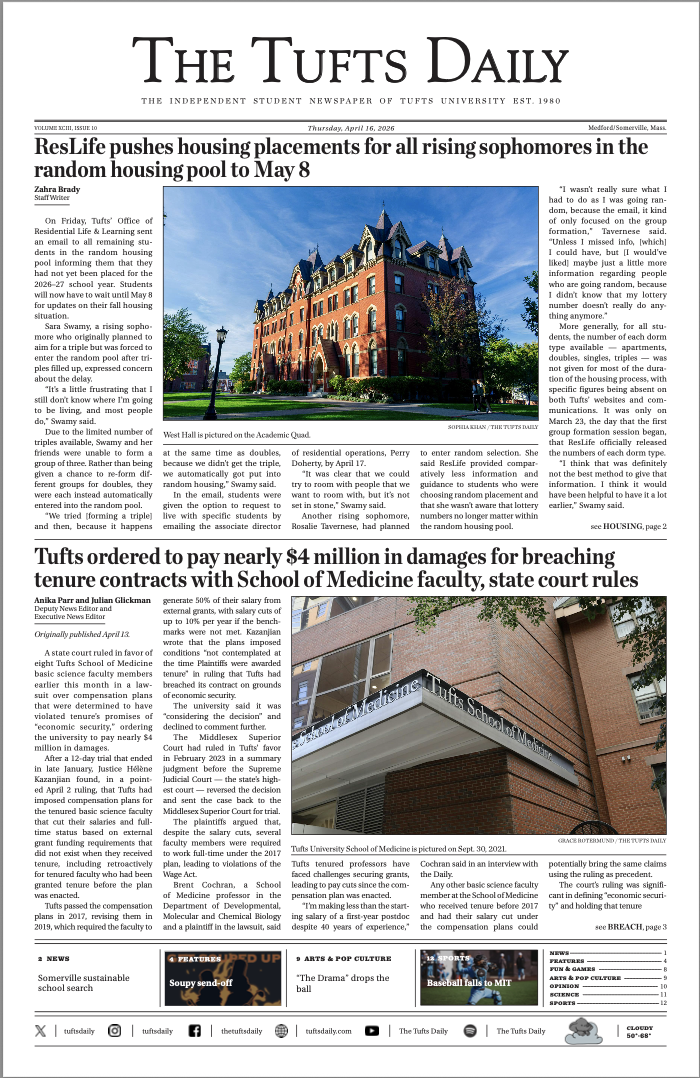
Tufts Daily front page