Skip to Content, Navigation, or Footer.

Opinion

The Setonian
Opinion

Excluding non-Christians from leadership is unnecessary, sets dangerous precedent

Last month, the Committee on Student Life revised its policy on student religious and philosophical groups, no longer allowing religious groups to apply for a "justified departure" from the University's non-discrimination policy. This has sparked discussion and debate on campus, including a Feb. 24 Daily op-ed written by Edward Lowe and David Foresy entitled "Compatibility between non-discrimination and religious inclusion."


The Setonian
Opinion

Increased tuition demands transparency

In May, the Board of Trustees will meet to discuss the approval of a four percent increase in the annual price of tuition and living at Tufts, which will increase to a staggering $61,000. The proposed tuition increase would make Tufts the second most expensive university in all of Massachusetts.


Feature-Image_Place-HolderOLIN
Opinion

What’s so very wrong with ‘Israeli Apartheid Week’

I think I first heard the phrase “Israeli Apartheid” when I was a sophomore here at Tufts. It wasn’t something I had ever heard before, and I’ll admit that I was taken aback. That’s an understatement: I was repulsed. Comparing the struggle of Israelis and Palestinians over ancient lands and modern dreams was, to my mind, nothing like the blatant denial of human dignity to which South Africa subjected a subset of its own population on the basis of skin color. To appropriate the struggle of blacks in South Africa to demonize the state of Israel disgusted me.


The Setonian
Editorial

Tufts must value humanities

Many have discounted the educational value of majoring in fields that lie outside of the science, technology, engineering and math arenas, yet an education in humanities is not the professional death sentence that it so often gets branded as. In fact, studying literature, philosophy and other humanities-based subjects can even be considered an essential part of all students' educations. Learning about the humanities can create a more well-rounded person, something that is certainly beneficial in the professional realm. Indeed, in certain job markets, someone who knows a little about a lot may actually be more employable than one who is an expert in just one area.


Feature-Image_Place-HolderTISCH
Opinion

Israeli Apartheid Week in retrospect

It is most fitting, in a most disturbing manner, that Israeli Apartheid Week at Tufts University should be inaugurated on the heels of breaking news that, over the past year, Israel has doubled its rate of settlement construction in the illegally occupied West Bank. According to Israel’s Central Bureau of Statistics, 2,534 new housing units were begun in 2013, compared to 1,133 in 2012. Most major media outlets omitted this story from their headlines for March 3 of this year, and they could almost be forgiven for doing so. The story of Israel’s dismemberment of sovereign Palestine is one of the most tired news stories of our contemporary world. What has also become tired, almost desensitized, to the tragedy of Palestinian oppression is the collective global conscience of mainstream society. Israel has made routine out of subjugation and banality out of persecution. This status quo is utterly disgraceful and unacceptable.


The Setonian
Opinion

SAT changes are important initial step

Yesterday, the College Board, the non-profit organization that administers the SAT Reasoning Test to over one million college-bound high schoolers each year, announced a dramatic overhaul of the test’s content, scoring and format. The overhaul represents a responsible step by the College Board to both make the test more accessible and to refocus its content and scoring on skills that translate more directly to academic success.


The Setonian
Opinion

A call to higher discourse

The Facebook event page for Tufts Apartheid Week features a collection of quotes, all of a similar nature. In each, the speaker voices concerns over Israeli policies, and their implications on Israel’s character as the democratic homeland of the Jewish people.


The Setonian
Editorial

Education major would benefit many

The Tufts Community Union (TCU) Senate voted unanimously last month to endorse the implementation of an education major. At this point in the process, professors and administrators have begun discussions about installing this secondary major at Tufts. Weighing the merits, it is clear how this major could benefit undergraduates. Tufts stresses that its students should be active global citizens, and teaching is a prime way in which Jumbos could fulfill this goal: giving back to the global community by educating a younger generation.


The Setonian
Opinion

Those without a Birthright

We are writing this piece as six students who identify as Palestinian. We were born into different religions: Christianity, Islam, Judaism and atheism, although none of this should matter. What matters is that all of us identify as Palestinian because our parents and/or our grandparents (and generations ...


The Setonian
Opinion

Growth of Greek life at Tufts

In about two and a half short months I will be graduating from Tufts University. I will also become a proud alumna of the Tufts fraternity and sorority system. Fraternities and sororities have been a tradition at Tufts University for more than 158 years, and one that I have fully embraced and taken advantage of. And while our community has struggled in the past, both internally and with the university, I am confident leaving my post as Inter-Greek Council president knowing that we have made immense progress in the past four years.


The Setonian
Editorial

Greek life needs more space

With the announcement that the Sigma Nu fraternity and Kappa Alpha Theta sorority will move into a house together next year, the growth of Greek life on campus is back in the news. The new location for SigNu, a previously established campus fraternity, and Theta, a new sorority, reminds us that Greek life now is more prominent on campus than ever. 123 more women went through the formal sorority recruitment process this year than in 2012, and a record high 216 women received bids. 


The Setonian
Opinion

Hand in hand: Israel and white supremacy

Faces dripping with sweat move together as one in a crowd. Shouts echo through a darkened sky as hands wave national flags in a rapid pulse. The mob pounces on a solo taxi in the middle of the street, spraying broken glass over the ground. Egged on by politicians, the mob continues its vengeance by attacking any black bodies in their midst. This harrowing scene is neither from Apartheid South Africa nor the segregationist riots of South Boston in the 1970s. This is May 2012 in Tel-Aviv, Israel, in the southern neighborhood of Hatikva where most residents are Mizrahim — Jews from the Arab and Muslim world. We might react to this as just isolated bigotry, a poor neighborhood inflamed by xenophobia targeting asylum seekers from Eritrea and Sudan. But that would miss the bigger picture. Arab Jews, too, are victims of racial violence and subjugation wrought by a variant of European colonialism. This system has violently labelled, dehumanized, exploited and excluded bodies of color. Like Palestinians living under apartheid, Ethiopian Jews and African Migrants, Arab Jews are also victims of Zionist white supremacy.Israel was founded upon Zionism, an ideology that has sought to establish and maintain a white, European-Jewish (or Ashkenazi) colony in non-European lands. It’s not hard to see that this is a racist project — after all, establishing a state in land already inhabited by indigenous people is a clear sign of a belief in their inferiority. Zionism’s roots are in white supremacy and colonization. It contains the same vein of logic that perpetrated the violent, genocidal European colonization of the non-Western world. Theodor Herzl, the father of Zionism, first lobbied the British government for the creation of a Jewish colony in Uganda in 1903. When his proposal was rejected, Herzl turned his gaze towards the Middle East, joining forces with the Palestine Jewish Colonization Association. Herzl explicitly envisioned Israel to be “a part of a wall of defense for Europe in Asia, an outpost of civilization against barbarism” — or, as former Israeli Prime Minister Ehud Barak once put it, a “villa in the jungle.” This logic portrays those in Israel and Europe as “civilized,” as opposed to the “barbaric” and dangerous peoples of Asia and the Middle East who must be tamed. Zionism claims to be a movement for the Jewish people to a homeland, but being a movement created by white European Jews for white European Jews, Zionism has always concentrated power in the hands of a European elite. When colonialism stopped being fashionable, Zionists dropped the “c” word from their lexicon, but their practices of racial exclusion and white supremacy continued. Zionist white supremacy labels non-white bodies in various ways — in the case of the Palestinians, they were (and are) marked for destruction, as they occupy the land Herzl declared to be the homeland for Jews. Zionism’s racist framework subordinates Palestinian bodies to white Jewish people — if white Jews need a state, brown Palestinians will be subjugated for its creation. The erasure of Palestinians cannot be disassociated from Zionism, and the state of Israel cannot exist without it. The ethnic cleansing of Palestinians in 1948, and the ongoing arrest, torture, siege, bombing and water crisis enacted upon Palestinians by Israel are the physical manifestations of this destructive ideology.White supremacy in Israel does not limit itself to expressly subjugating Palestinians. It is a pervasive force in Israeli politics. Israeli Minister of the Interior Eli Yishai, recently spoke in response to new detainment policies for African refugees. Yishai was quoted in a June 3, 2012 Haaretz article saying that Israel “belongs to the white man” and that he would use “all the tools to expel the foreigners, until not one infiltrator remains.” But who are these infiltrators? While Zionism targets non-white Jews for forced assimilation and exploitation, this racist ideology casts African asylum seekers as “infiltrators” — a term actually used by the Israeli government. This demeaning and accusatory label ignores the imperial histories and the personal circumstances of asylum-seekers. In rhetoric and in practice, the state has attempted to strip migrants of their right to decent treatment and with it, their humanity. Up until 2009, Israel granted only one percent of asylum applications. Instead, the government has begun rounding up Sudanese and Eritrean peoples, sending them to prison, internment camps and deporting them.This racist ideological framework also permeates the Israeli government’s treatment of non-European Jews. Mizrahim, also known as Arab Jews, are targets of racist policies, as well. From 1930 to 1970, Israel — under the control of white, European elites — systematically and forcibly removed Yemeni Jewish children from their parents and placed them in boarding schools or sold them to white European Jewish parents for adoption. In the 1950s, 150,000 North African Jewish children were given dangerously high doses of radiation without their parents’ consent in a series of unauthorized medical experiments under the pretext of treating ringworm. Arab Jews were forced into transit camps where they were subjected to a ‘de-Arabization’ process upon arrival into the country. This cultural genocide sought to transform them into proper Zionist subjects by making them ashamed of their histories, mother tongues and their customs. Over the last three decades, the state has reapplied this policy to Ethiopian Jews.12


The Setonian
Opinion

Palestine is about America

Upon entering Tufts - an elite liberal institution - we are discretely told which problems to focus on and which problems to ignore. "Think beyond borders," we are encouraged; be a "global citizen." Go solve Rwanda's, India's, Guatemala's and Jordan's problems; export ...


The Setonian
Editorial

EPIIC is valuable resource for all

It's not often that one of the countless acronyms that circulates around the Tufts campus gathers such a following, but each year EPIIC manages to garner a fair share of the limelight. These five letters can often become all-consuming for the cohort of students involved in the program each year; however, while EPIIC is publicized to the entire Tufts community, its offerings can sometimes be passed over by those who are not a part of the program. This inconsistency raises a few questions: What exactly is EPIIC? Who should be paying attention to it and why? EPIIC, or "Education for Public Inquiry and International Citizenship," takes center stage each year with its annual symposium, a four or five-day public forum that brings international figures and speakers to cam- pus. These experts, activists, academics and journalists lead presentations, panels, dis- cussions and workshops, stitching together a compelling and educationally valuable conglomerate perspective on the sympo- sium's chosen topic. This year, the 29th annual EPIIC symposium was held from Wednesday, Feb. 26 to Sunday, Mar. 2, and featured presentations about "The Future of the Middle East and North Africa." But EPIIC does not begin nor end with the symposium. At the heart of EPIIC is a year-long, intensive and multidisciplinary course that prepares approximately 50 students to think critically and analytically about global issues. This year's roster of students, who went through an applica- tion process and round of interviews in order to gain admission into the course, included a diverse set of perspectives, with some students having studied the Middle East for their entire Tufts career and others having little academic experi- ence with the region. The class, which meets twice a week for two and half hours each, hears from dif- ferent speakers each session. In order for the students to be able to participate in discussions with the presenters, they are assigned extensive readings each week and are tested via three comprehensive exams. At the time of the symposium, students are asked to play key roles in committees, sometimes preparing short speeches and presenting awards to featured speakers. EPIIC, which is a rigorous and excep- tional program, deserves all of the atten- tion it gets - and then some more. While the audience typically consists of a mixture of students, faculty and other academics, the symposium should be piquing the interest of the entire student body, not just the International Relations majors. EPIIC is an invaluable resource that provides eye-opening perspectives for all those who desire to be an active citizen, and everyone should be taking advantage of it - even if it's only by asking to hear about all of the hard work and dedication that our peers have put in.


The Setonian
Editorial

Salary freeze and low job security problems for adjunct professors

In September of last year, Tufts' adjunct professors voted to unionize. The School of Arts and Sciences has now begun negotiations with the Service Employees International Union (SEIU), representing the university's adjunct faculty. In a recent statement sent to the Tufts community, the administration announced that, "Tufts is committed to a good working relationship with the SEIU and hopes to work productively and with mutual respect toward a contract." They promise to engage collegially with the union, and hope to reach amicable, fair terms. This is the first step to resolving conflicts between the administration and more than half of the professors that Tufts enlists every semester.


The Setonian
Opinion

Taking back Zionism

In 1894, a French-Jewish officer, Alfred Dreyfus, was unjustly accused of treason, eventually convicted and sentenced to life in prison. A young journalist from Vienna, Theodore Herzl, covered the events, witnessing boisterous rallies in the streets, hearing crowds chant “Death to Jews!” a reflection of the increasingly vicious anti-Semitism that characterized Europe at the time. Three years later, in 1897, Herzl organized the first Zionist Congress, a meeting of 200 delegates from 17 countries, to discuss the creation of a homeland for the Jewish people. It was a bold project, one that would be the salvation for a population soon to face near annihilation at the hands of Nazi-controlled Europe and one that would face constant internal and external challenges. Ultimately though, Zionism would transform the identity of a people tied together by religious tradition and history into a unified nation.This, however, is not how Zionism might be described today. Rather, you might hear the words racism, expansionism, imperialism and settler colonialism associated with the movement. As Israeli Apartheid Week prepares to sweep campus once again, I wanted to take this opportunity to address an issue that is too often misrepresented.The false portrayal of Zionism in much of the media today, and by leaders in the Arab and Muslim world, stands in stark contrast with the goals and values of the movement. Whether it’s in a tweet by Iran’s Supreme Leader, Ayatollah Khamenei, written out on a sign at an anti-Israel protest or codified via a United Nations General Assembly resolution (later overturned), Zionism has been consistently maligned and berated for its so-called racist ideology. But this is not the true philosophy of Zionism, nor the spirit of the movement, and both Israel’s detractors and its supporters need to be reminded of that.The Zionist movement is neither simple nor monolithic. It’s important to note that not every Jew is a Zionist, and not every Zionist is a Jew, even within Israel today. Many different strains of the ideology emerged in the late 19th and early 20th centuries, and they continue to shape Israeli society and politics. But Zionism, at its core, is the simple desire for a homeland for the Jewish nation and the desire of the Jewish people to freely determine their own fate after centuries of persecution and helpless wandering. And it is based on this fundamentally just philosophy that I comfortably and proudly call myself a Zionist.The troubling perception that Zionism is akin to racism and settler colonialism, or that Zionism exists to deprive the Palestinians of a state, continues to pervade the current discourse in international media and in anti-Israel rhetoric. This is not the Zionism I know. To equate Zionism to racism is to unjustly single out Jewish nationalism and to maliciously twist the history and purpose of the movement. Similarly, comparisons of Zionism to settler colonialism misunderstand its historical context and goals. European colonialism sought to conquer land in the name of an empire and to rob that land of its resources. Zionism, while initially supported by the British Empire, sought refuge for a homeless people, themselves victims of Europe. Early Zionists had foreseen that the walls of the ghetto would soon begin to rise and understood that the Jewish reality in the Diaspora was untenable. They saw that general disunity and assimilation had weakened Jewish identity and culture. And so they sought a new beginning and prosperous future in a desert historically inhabited by Jews for 3,000 years.Still, I believe that a true Zionist should empathize with other nations seeking independence and the right to self-determination. After all, Zionism intended to liberate a people, not to occupy another. Like the Jewish nation, the Palestinian nation deserves the right to a state and is granted such under international law. Zionists acknowledged this right in their acceptance of the 1947 U.N. partition plan, which proposed a Jewish state alongside a Palestinian state, a plan the Arab states vehemently rejected. Israel has since acknowledged this right through several rounds of negotiations, starting with the Oslo Accords of the early ‘90s. While many are skeptical about the progress of current negotiations, and while I do not agree with many of the current Israeli government’s policies in the West Bank, I continue to believe that there is a space for both nations to thrive. It is as a Zionist that I support a two-state solution to the Israeli-Palestinian conflict, and the majority of Israelis agree on this point.In the spring of 2013, I had the privilege of studying abroad at Hebrew University in Jerusalem. Living in the heart of East Jerusalem continuously shaped and reshaped my understanding of the often-difficult realities on the ground and my own identity as a Zionist.As I took in each new experience, my Zionism appeared in a myriad of unexpected places. At a Purim fair on Ben Yehuda Street where I saw children in all forms of costume running around happily, I was reminded that the Zionist dream saw a prospering nation espousing the family values so evident on this most joyful of days. While visiting Yad Vashem, the Holocaust museum in Jerusalem, I was confronted with the hatred and loss that inspired Herzl in France over a century ago. Even when witnessing instances of discrimination or racism — decades of conflict between cultures have almost ensured its existence — I was reminded that there is still much work to be done. Israel was meant to be a “light among nations,” and there are areas that it shines as brightly as ever despite constant challenges, but other areas which need attention and reform to truly reflect the values of “freedom, justice and peace” as stated in Israel’s Declaration of Independence.12


Op-ed submissions are an integral part of our connection with you, our readers. As such, we would like to clarify our guidelines for submitting op-eds and what you can expect from the process.

Read More
The Tufts Daily Crossword with an image of a crossword puzzle
The Print Edition
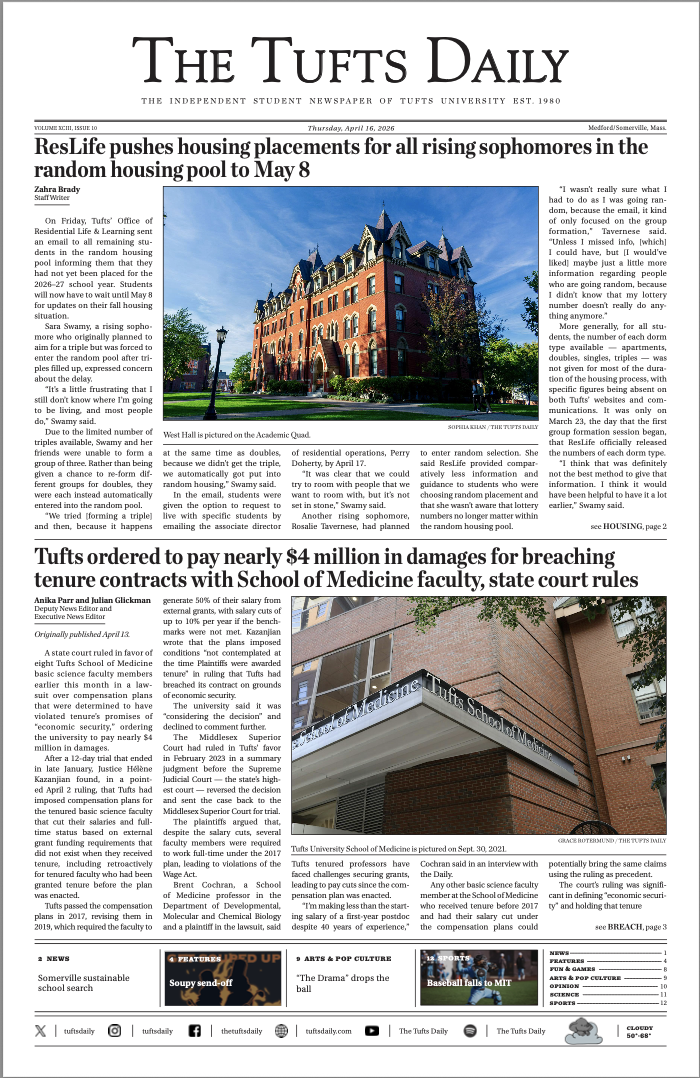
Tufts Daily front page