Skip to Content, Navigation, or Footer.

Opinion

The Setonian
Editorial

What a difference two years make

"The gifts that God has given to Barack Obama are as enormous as his future is unlimited. As his mentor, as his colleague, as his friend, I look forward to helping him reach to the stars and realize not just the dreams he has for himself, but the dreams we all have for him and our blessed country."


The Setonian
Opinion

From the Editor | Our new look

Hey! Notice anything different about us? And no, I'm not referring to the fact that we're no longer recycling old Sudokus. Although if you did catch that, be sure to come copy edit for the Daily! We can also refer you to Sudoku Addicts Anonymous.


The Setonian
Opinion

When compliance needs to be toned down

In the midst of an ongoing anti-piracy campaign led by the Recording Industry Association of America (RIAA), Tufts is correct in protecting its students from unreasonable litigation. In its most recent round of legal action, the RIAA has subpoenaed the names of 11 Tufts students who allegedly engaged in illegal file sharing. The trade association wants Tufts to identify the offending students through university network records.


The Setonian
Opinion

From the TCU President | Get involved, know your resources

We use a lot of words to describe what Tufts is. Words like "beyond boundaries," "active citizenship," and "civic engagement." At their core, these terms are what this university aspires to be, but we use them so much that it has become difficult to figure out their exact meanings.


The Setonian
Opinion

The greatest generation available

In a television commercial from Robert Kennedy's 1968 campaign for the presidency, the ever-youthful New York senator answered the questions of a crowd of schoolchildren and asked them to join his historic effort. In the closing moments of the ad, he said to the young people of the country, "You have the greatest stake in the future, and the least ties to the past." Four years later, a campaign poster from the 1972 presidential race featured Senator George McGovern's smiling face with the words, "I stake my hopes in 1972 in large part on the energy, the wisdom and the conscience of young Americans." McGovern was defeated by incumbent President Richard Nixon in a 49-state landslide, and the nation was given two decades of Nixon, Ford, Carter, Reagan and Bush. Every four years, pundits, prognosticators and politicians place their hopes in the hands of young people. And from McGovern in 1972 to Gary Hart in 1984 to Senator John Kerry (D-Mass.) four years ago, candidates have rocked the vote with hope and desperation only to see their mighty armies come up short on Election Day. And yet every four years we hope again that this newest generation will be the one to deliver - not just in politics, but on the pressing challenges of our society. Now, it has fallen to us. Naturally, after so many years of disappointment, the pundits are beginning to suspect that the recent excitement and strength our generation has shown at the polls are fickle and fleeting; that, like the young generations before us, ours, too, will ultimately fade away. They argue that we do not have the fortitude of the Greatest Generation, who fought to protect freedom at home and abroad when the world threatened to disintegrate. They say that we do not have the passion of the baby boomers, who distinguished themselves by refusing to take the word of authority for granted, and by challenging those who demanded that they fight a war they did not believe should be waged.


The Setonian
Opinion

McKissick's departure underscores conflict

It is often said that students learn the most in college outside of class. As graduating seniors, some of our most lasting memories probably will not involve textbooks or course readers. However, it is also true that some of the people who have touched our lives the most are our professors. We have all had at least one special instructor who sparked our interest, made trekking across the Hill in a blizzard worth it and changed the way we looked at a subject - or even at the world around us. For many students, that professor was Gary McKissick. McKissick, who arrived at Walnut Hill seven years ago, originally taught in both the political science department and the Community Health Program. He earned a reputation as a stellar teacher who was passionate about his subject matter and genuinely cared about students, and his acclaimed teaching won him the Professor of the Year Award in 2006. It may come as a shock to many students, then, that a professor of the year is being forced out of the university. McKissick's lack of outside research prompted him to withdraw himself from the tenure review process the same year that he won his award. It may come as a further shock that tenure-track professors who are not approved for tenure are typically asked to leave the university - despite any teaching accolades they may have accrued. To avoid being forced out of the teaching position he so loved, McKissick transferred to a full-time job in the Community Health Program, where he and other staffers had fashioned a position that combined teaching with administrative duties to relieve the program's burden. While the program tried to have McKissick stay on at Tufts, recognizing the immense value he had as a teacher and as a staffer for the growing Community Health Program, others in the administration did not see eye-to-eye. McKissick said Dean of Arts and Sciences Robert Sternberg denied him permission to stay on in his new position, even though the program had a slot for him and had allotted money within its budget to pay his salary. According to McKissick, Sternberg essentially fired a man recognized as one of Tufts' best instructors.


The Setonian
Opinion

Turn on, tune in and, above all, speak out

For most members of the Class of 2008, today will mark the last time they pick up a hard copy of the Daily as they mill about on the Hill. But even as they leave behind the world of campus journalism, grads' relationship with the news media will follow them long after they leave Tufts - and will likely teach them much more than just how to work on the sudoku in the middle of a lecture without being seen by their professors. Our hope here at the Daily is that today's graduates will continue to consume the media of "the real world" as intelligently and critically as they have here at Tufts. Over the last four years, we've seen students engage in thoughtful discussion about journalistic standards and ethics that demonstrate their unwillingness to sit back and passively digest what they hear on the news or read in the paper. Last year's controversy over the Primary Source's publication of offensive material denouncing Islamic fundamentalism and affirmative action admissions policies, while regrettable, was met with smart, constructive feedback that ultimately prodded the administration to take positive steps toward defining the university's free speech policy. The Media Advisory Board, the coalition formed by the leaders of the campus media outlets, changed from a lifeless, toothless, mostly administrative body to a vibrant association known as the Media Advocacy Board, which promotes events like the Annual Conference on Student Journalism to address questions of how student-run media groups can better serve their community. And our own Op-Ed pages - as well as those of our peer publications - have always brimmed with your letters to the editor and op-ed essays, letting us know that you know how to use the media as a tool for public discourse. But will critical analysis of the media end up being merely a college habit that goes out the window as soon as the cap and gown are doffed and the rigors of adult life start monopolizing your time and energy? When you take that job in California next month and you read something in the San Francisco Chronicle that really gets you keyed up, will you write a letter to its editor? When you start grad school in Atlanta and you think that Channel 11's evening news coverage is unfair or inaccurate, will you post a comment on its Web site?


The Setonian
Opinion

From the outgoing TCU president | A united community

When I first had the opportunity to write my reflections for last year's Commencement issue of the Daily, I struggled to find a topic that would express my excitement about beginning my term as president of the Tufts Community Union (TCU), while also maintaining relevance to issues we were all facing on campus. In the end, I decided to focus my thoughts on our Tufts community and how we, as individuals, come together in a variety of ways to create that community. Today, as I have the opportunity to reflect on the past year, I want to continue to build on the theme of community - incorporating many of the lessons I've learned while having the privilege of serving as your TCU president. This year, and over the previous two years, I have had incredible experiences at Tufts that have helped me to change and grow in a multitude of ways. That, in my opinion, is the job of institutions of higher learning - to accept students each year, challenge them to grow in all areas of their lives and release them with the skills necessary to improve and learn from the world around them. Along this journey, learning does not take place solely in the classroom - rather, we learn much about ourselves and those around us outside of the stone and plaster walls of the buildings on the quad. And it is those experiences outside of the classroom that build our larger Tufts community - the one which I, and others, speak of frequently. It has been through my experiences this year that I have learned the impact that each and every one of us has on the building, and shaping, of the Tufts community. This community is amorphous; it does not reside in any one place, and there is no singular definition that is able to adequately characterize this community and the people who make it come alive. After spending a year working with a cross-section of people in our community - students, staff, faculty and administrators - I have come to the realization that our community and what it represents are in the eyes of the beholder. Talk with 10 Tufts students or administrators and you will receive 10 definitions of our Tufts community. However, this does not mean that we have no community at Tufts. As I discussed in my first viewpoint a year ago, I firmly believe that our strength as a community is in our diversity in thought, background, ethnicity, religion, race or any of the multitude of areas. Much of the strength of our community comes from the variety within it, but as we have seen, the diversity within our community can also be used to divide. That said, as I finish my third year on the Hill, I have come to learn one very important lesson about our community - each of us, knowingly or unknowingly, has an equal and profound effect upon it. We help shape the Tufts community each and every day. This community is formed in the words we do or do not say to each other. Each letter to the editor or op-ed piece shapes our community. We leave our mark in events we choose to attend or not attend, and in the petitions we do or do not sign. Even our own ambivalence about events and issues on campus has an effect on the Tufts community. In that sense, we all have an equal share in what goes on during our time here, and what the community we build and shape will say about us. Whether we bide our time studying in the library, working out in the gym, serving as leaders of organizations, serving as members of those organizations or doing none of the above, we make decisions every day that impact others - and that ultimately impact our experience at Tufts. In my opinion, this is the message that often gets lost in our discussions about community. Each and every one of us has a stake in this community and in the direction it goes. While student leaders and administrators may seem to be the tone-setters of campus, they are only individuals within our community, and thus have an equal say in the shape our community takes. As issues of community and our values continue to be discussed, as they will for years in the future, it is important to remember that we are all responsible for the ethos of this community. No one is able to say that they are not a part of the community, or that they have no say in our community values. It is in the decisions we make - including the decision to be uninvolved or uninformed - that define our community and its values. Having had the opportunity to serve as the president of the TCU Senate this year has been an amazing experience. I have met and have had the privilege to work with some of the most incredible, hardworking people I have ever known. But a year has passed and it is time to welcome another president and another Senate that, I am confident, will work to make the student experience next year even better than it was during my time as president. As this year comes to a close and next year looms on the horizon, I can say confidently that I am excited about next year - not because I will be free of panicked 3 a.m. phone calls about Fall Ball, but because I know that my place in this community, and my ability to make change at Tufts for the better, is secure no matter what position or title I hold. It has been a privilege and a pleasure to serve you all this year. I cannot thank you enough for allowing me to have this opportunity, and I only hope to continue to work to better our community in the coming year. I hope you'll join me in this journey. Neil DiBiase is a junior majoring in history. He is the outgoing TCU Senate president.


The Setonian
Editorial

Students sick of poor health insurance options

A student fights back and forth with her insurance company over reimbursement for more than a year, with her bills being sent to collection agencies in the meantime. Another eschews health care altogether despite his crippling injury in order to avoid the almost-guaranteed financial battle that visiting a doctor would spark.


The Setonian
Editorial

Hillary should know when to quit

The Democratic primary began as a spirited, substantive contest between capable candidates. Now, after the conclusion of the Pennsylvania primary, the prolonged process has degenerated into an increasingly bitter, trivial and damaging confrontation between Senators Hillary Clinton (D-N.Y.) and Barack Obama (D-Ill.).


The Setonian
Editorial

Pickard has vision to lead as TCU president

As Jumbos head to the polls tomorrow to vote for their Tufts Community Union (TCU) president, they'll be faced with the same challenge Democratic voters have faced throughout this primary season: how to choose between a clear vision for the future and a series of concrete plans that perhaps lack vision when no candidate offers both.


The Setonian
Editorial

Carter's Hamas visit is misguided

Last week, the Arabic-language newspaper Al-Hayat reported that former President Jimmy Carter was planning a trip to Syria for mid-April, during which he would meet with Khaled Meshal, the exiled head of the Palestinian terror group Hamas, on April 18. That is a terrible, terrible idea.


The Setonian
Editorial

Size shouldn't matter

An overweight but highly qualified woman finds herself consistently denied receptionist jobs for thinner candidates who can barely turn on a computer. A five-foot-tall man is constantly ridiculed in his office, with taller coworkers going so far as to pat him on the head patronizingly at meetings.


Op-ed submissions are an integral part of our connection with you, our readers. As such, we would like to clarify our guidelines for submitting op-eds and what you can expect from the process.

Read More
The Tufts Daily Crossword with an image of a crossword puzzle
The Print Edition
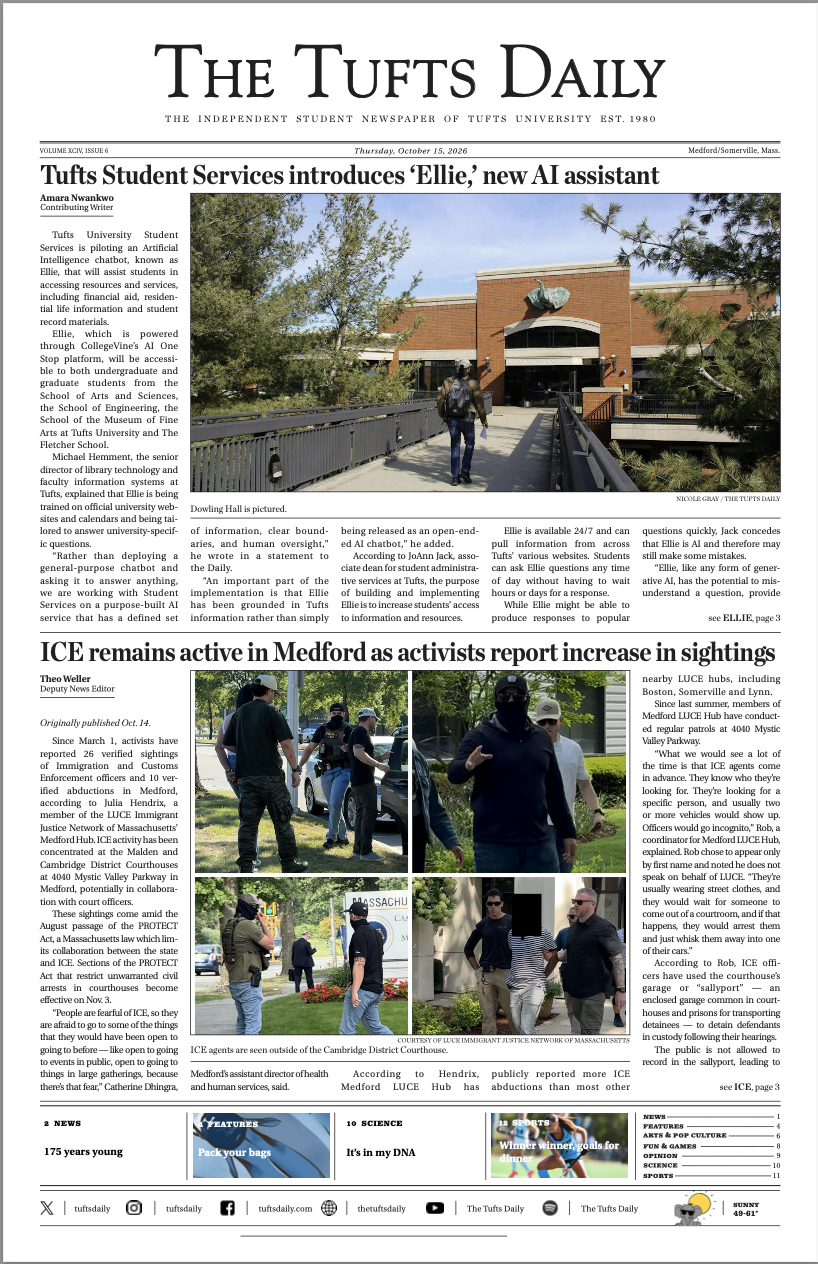
Tufts Daily front page