Over 200 students, faculty, and members of the outside press packed Pearson 104 on Friday to hear a lecture by former US Senator Gary Hart. Hart, who held a Senate seat from Colorado from 1975 to 1987, spoke on National Security in the 21st Century as part of the 2003 EPIIC symposium.
Hart's speech was followed by short responses from political science professor Jeffrey Taliaferro and Fletcher School of Law and Diplomacy Professor Hurst Hannum. The two expressed their evaluation of Hart's opinion, and their agreement, or lack thereof, with his arguments. There was also a brief question and answer session.
In his lecture, Hart, a democrat, expressed concern for the future security of the United States. "This country is adrift in both its foreign policy and its national security policy in the years after the end of the Cold War, because we do not have a Grand Strategy for the United States," he said.
Such a Grand Strategy, he said, must be different from that of the 20th century due to three key revolutions.
Globalization, the information revolution, and the erosion of the nation-state are factors that need to be taken into account when examining national security, Hart said.
While Hart believes that the Cold War allowed the US to pursue the definite goal of containment of communism, Taliaferro disagreed. The US, Taliaferro said, had "no definite Grand Strategy in the Cold War."
Hart also cited the breakdown of civic duties as a dangerous factor to security, and he criticized the absence of democracy from US foreign policy. Along with performance of civic duty, Hart said that "cleaning up the corruption in the halls of politics in America and re-identification of the common good," must be the focus of the American public.
The speech made reference to the impending war on Iraq. Before war starts, Hart said, the US must ask itself four fundamental questions.
Hart asked, "Who is going with us... how long will we be there... how much does it cost... how many casualties?"
According to Hart, one aspect that many people forget is that "people die in wars." He also warned that "we don't want to have another Vietnam on our hands." The only acceptable condition for going to war, Hart said, is "if we need to do so to prevent killing American people."
Hannum warned that the government and the media may be over-focussing on terrorism. The US seems to be "pandering to the fears of Americans," he said.
During his tenure in the Senate, Hart served on both the Armed Services and Intelligence Oversight committees. Recently, Hart served as co-chair of the US Commission on National Security in the 21st Century.
The Commission's report concluded that without significant changes in the national security infrastructure, the US would face serious risk of terrorist attacks on its homeland within the next 25 years. Tragically, this report's prediction was realized only a few months after its publication in Feb. 2001.
According to the New York Times, Hart is considering making another run for President, as he did in 1984 and 1988. But he did not address the issue either during his talk or the question and answer period.
Though he did not address the issue, many students were interested in the possibility of a 2004 Presidential campaign. "If he decides to run he will be a good policy candidate _ he will support new liberal values and he is going to bring an academic Jeffersonian aspect," freshman Mike McGeary said.
After the program, there was a reception in Ballou Hall for EPIIC students and invited guests.
Since leaving the Senate, he has been a Visiting Fellow at Oxford University, Global Fund Lecturer at Yale, and Regents Lecturer at the University of California.
More from The Tufts Daily



Trending
SMFA courses canceled over low enrollment numbers
By
Evan Vezmar and Eli Brigham
| December 8
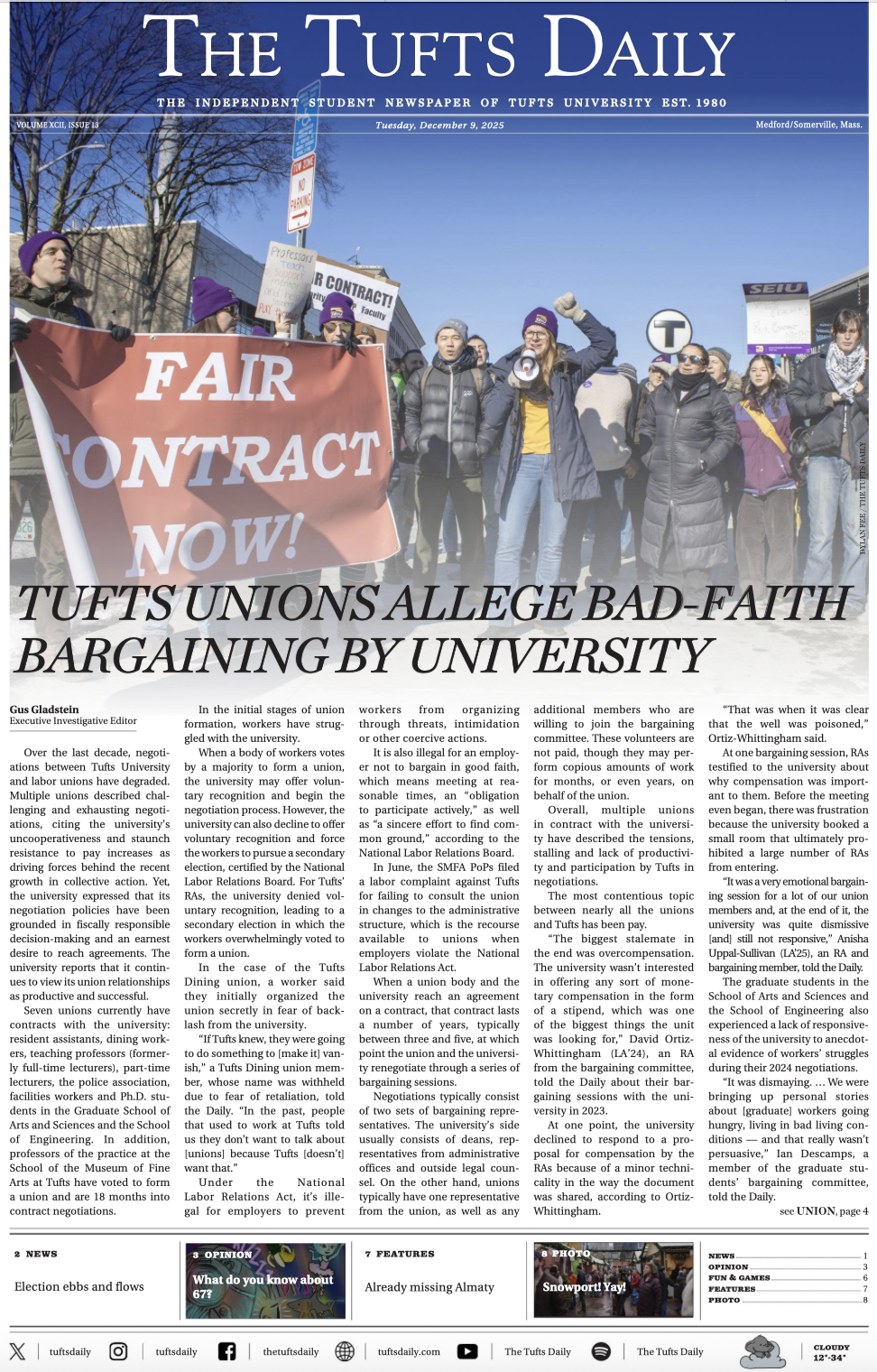
Tufts unions allege bad-faith bargaining by university
By
Gus Gladstein
| December 9

The Print Edition