Over the last decade, negotiations between Tufts University and labor unions have degraded. Multiple unions described challenging and exhausting negotiations, citing the university’s uncooperativeness and staunch resistance to pay increases as driving forces behind the recent growth in collective action. Alternatively, the university expressed that its negotiation policies have been grounded in fiscally-responsible decision-making and an earnest desire to reach agreements. The university reports that it continues to view its union relationships as productive and successful.
Seven unions currently have contracts with the university: resident assistants, dining workers, teaching professors (formerly full-time lecturers), part-time lecturers, the police association, facility workers and Ph.D. students at the Graduate School of Arts and Sciences and the School of Engineering. In addition, professors of the practice at the School of the Museum of Fine Arts at Tufts have voted to form a union and are 18 months into contract negotiations.
In the initial stages of union formation, workers have struggled with the university.
When a body of workers votes by a majority to form a union, the university may offer voluntary recognition and begin the negotiation process. However, the university can also decline to offer voluntary recognition and force the workers to pursue a secondary election, certified by the National Labor Relations Board. For Tufts’ RAs, the university denied voluntary recognition, leading to a secondary election in which the workers overwhelmingly voted to form a union.

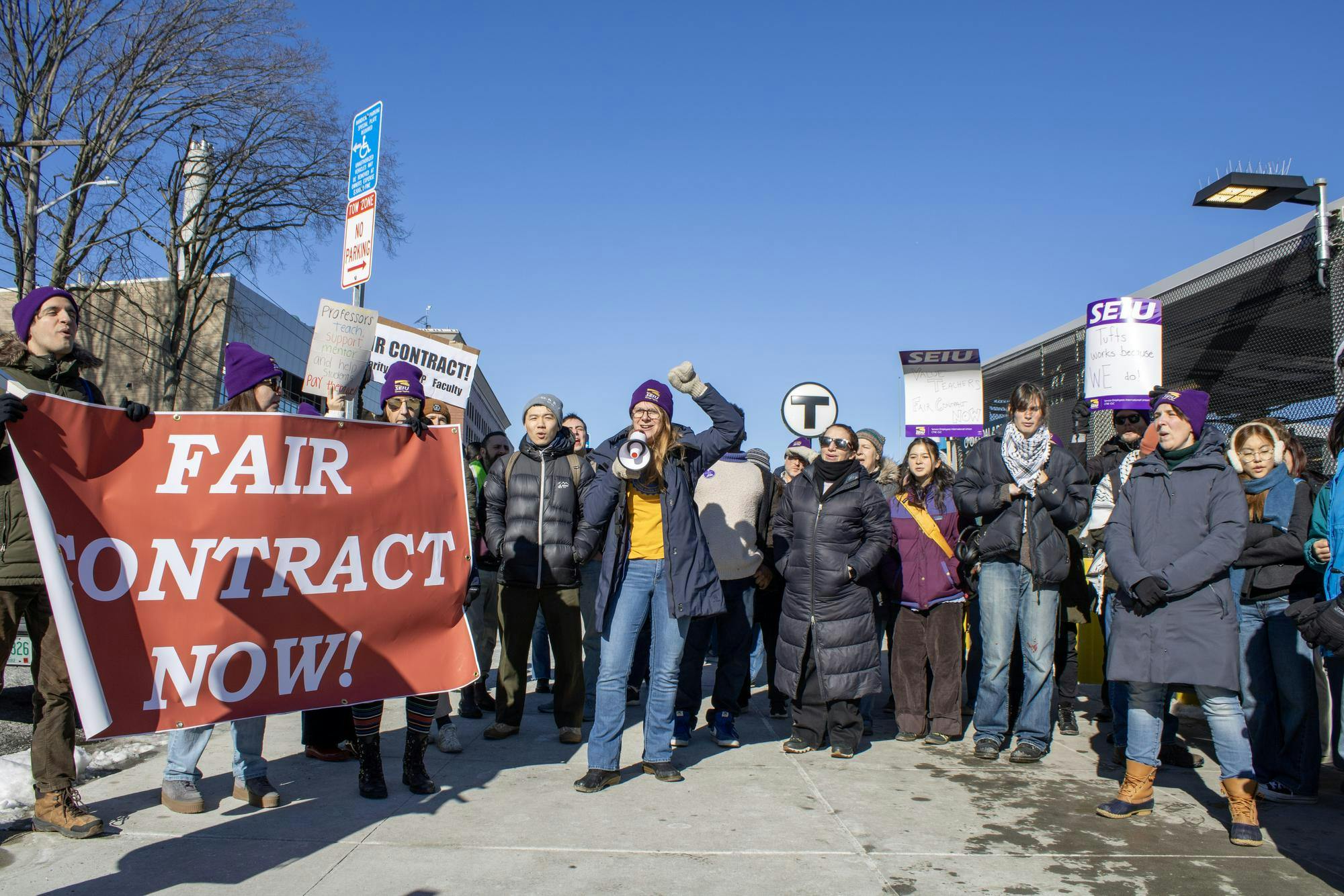
Students and dining workers rally at the Campus Center on April 27.
In the case of the Tufts Dining union, a worker said they initially organized the union secretly in fear of backlash from the university.
“If Tufts knew, they were going to do something to [make it] vanish,” a Tufts Dining union member, whose name was withheld due to fear of retaliation, told the Daily. “In the past, people that used to work at Tufts told us they don’t want to talk about union[s] because Tufts [doesn’t] want that.”
Under the National Labor Relations Act, it’s illegal for employers to prevent workers from organizing through threats, intimidation or other coercive actions.
It is also illegal for an employer not to bargain in good faith, which means meeting at reasonable times, an “obligation to participate actively,” as well as “a sincere effort to find common ground,” according to the National Labor Relations Board.
In June, the SMFA PoPs filed a labor complaint against Tufts for failing to consult the union in changes to the administrative structure, which is the recourse available to unions when employers violate the National Labor Relations Act.
When a union body and the university reach an agreement on a contract, that contract lasts a number of years, typically between three and five, at which point the union and the university renegotiate through a series of bargaining sessions.
Negotiations typically consist of two sets of bargaining representatives. The university’s side usually consists of deans, representatives from administrative offices and outside legal counsel. On the other hand, unions typically have one representative from the union, as well as any additional members who are willing to join the bargaining committee. These volunteers are not paid, though they may perform copious amounts of work for months and even years on behalf of the union.
Overall, multiple unions in contract with the university have described the tensions, stalling and lack of productivity and participation by Tufts in negotiations.
The most contentious topic between nearly all the unions and Tufts has been pay.
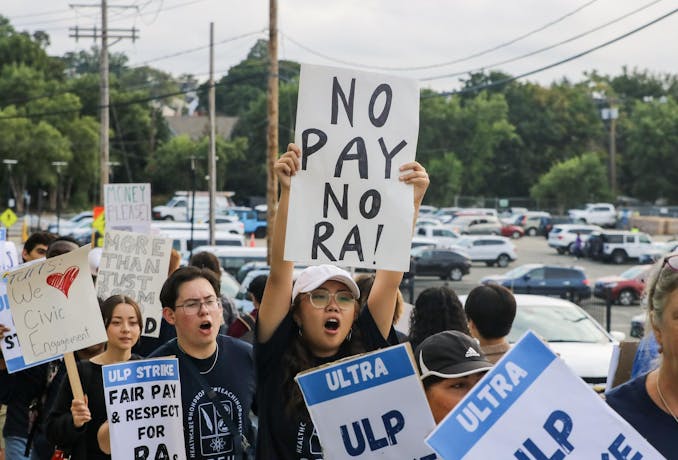
Tufts resident assistants picket in front of the Joyce Cummings Center on Aug. 29, 2023.
“The biggest stalemate in the end was overcompensation. The university wasn't interested in offering any sort of monetary compensation in the form of a stipend, which was one of the biggest things the unit was looking for,” David Ortiz-Whittingham (LA’24), an RA from the bargaining committee, told the Daily about their bargaining sessions with the university in 2023.
At one point, the university declined to respond to a proposal for compensation by the RAs because of a minor technicality in the way the document was shared, according to Ortiz-Whittingham.
“That was when it was clear that the well was poisoned,” Ortiz-Whittingham said.
At one bargaining session, RAs testified to the university about why compensation was important to them. Before the meeting even began, there was frustration because the university booked a small room that ultimately prohibited a large number of RAs from entering.
“It was a very emotional bargaining session for a lot of our union members and, at the end of it, the university was quite dismissive [and] still not responsive,” Anisha Uppal-Sullivan (LA’25), an RA and bargaining member, told the Daily.
The graduate students in the School of Arts and Sciences and the School of Engineering also experienced a lack of responsiveness of the university to anecdotal evidence of workers’ struggles during their 2024 negotiations.
“It was dismaying. … We were bringing up personal stories about [graduate] workers going hungry, living in bad living conditions — and that really wasn’t persuasive,” Ian Descamps, a member of the graduate students’ bargaining committee, told the Daily.
In order to support their proposals, many of the unions conduct research contrasting their pay with comparable institutions in the Boston area. This research tended to show that the pay of Tufts workers lagged behind other universities. At times, the teaching professors’ research showed Tufts’ placement as low as No. 12 out of the 13 universities analyzed, according to Penn Loh, a teaching professor and bargaining member in the School of Arts and Sciences.
In the teaching professors’ two negotiations in the 2010s, it was a norm for both the university and the union to conduct their own research and present it to the other side. However, according to Loh, in the most recent 2024 negotiation, the university neither produced a counter-analysis nor substantively engaged with their analysis.
Last month, Tufts issued a university-wide update on its negotiations with the PoPs. In it, they described why the PoPs’ comparative analysis of pay is unpersuasive.
“[The PoPs] cited peer institution pay rates to support this request. However, their analysis does not adequately differentiate between tenured and non-tenured positions, nor between art-focused PoPs and other faculty roles. A more appropriate comparison, such as with recent job postings from peer institutions, indicates that the university’s proposal is in line with the market for these positions,” Dean Bárbara Brizuela and Dean Scheri Fultineer wrote in a statement sent to the entire university.
In meetings and university-wide communications, the university has cited financial constraints as the reason for its inability to agree to certain increases in pay.
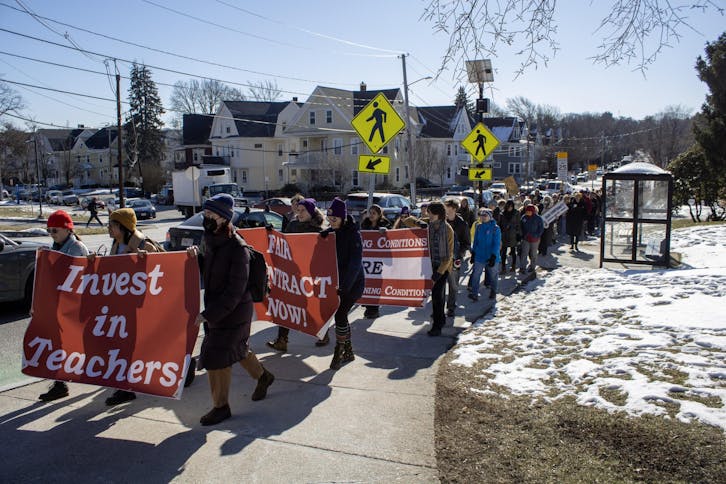
The full-time lecturers’ union marches up College Avenue on Jan. 27.
“All we heard back from the administration was that cost finances are really tight right now, and we just don’t have any more money. That was the only response we ever got,” Loh said about the most recent teaching professors’ negotiations.
In last month’s update, the university invoked financial constraints as a key reason for rejecting the PoPs’ most recent proposal.
“From the university’s perspective, the union’s proposed increase significantly exceeds market norms and raises serious concerns about long-term financial sustainability,” Brizuela and Fultineer wrote in their statement.
It seems unclear whether the university’s finances are actually in jeopardy.
Overall, the university states in its 2024 financial overview, “Financially, the university remains strong.” Indeed, Tufts’ finances show healthy surpluses. In Fiscal Year 2024, Tufts’ net unrestricted opening results contributed $18.7 million to unrestricted net assets, according to its annual financial report.
On the other hand, one former administrator, who spoke to the Daily under the condition of anonymity out of concerns of retribution, noted that in internal meetings among university administrators, “there’s real concern” in regard to the university’s finances.
According to Loh, the university never provided unions with any evidence of financial difficulties.
“The total difference [between] what [the teaching professors] wanted in a financial package versus what the administration wanted, [was] far lower [than the budget surpluses,] less than a million dollars,” Loh said. “There is money, according to [Tufts’] own reports.”
Similarly, Tufts’ rejection of the RA’s proposed compensation was not justified by their cited fiscal constraints, as “the [proposed] number was not high enough,” Uppal-Sullivan said.
Notable discrepancies exist between the university’s public financial decisions and its private communications to unions.
For example, amid the graduate workers, PoPs and teaching professors’ negotiations in the fall of 2024, the university separately announced the Mortgage Assistance Program, a $6 million fund to support mortgage payments for tenure-track faculty.
“They were acknowledging housing [costs in the Mortgage Assistance Program]. ... [Tufts] made a commitment to spend that money to support the tenured faculty [but didn’t] have an additional hundreds of thousands of dollars for [the unions]. We just never ever had that conversation. They didn’t want to have that conversation face-to-face,” Loh said.
Generally, negotiations for all unions have been prolonged.
The RAs described that over the summer of 2024, their negotiations began to stall.
“It was getting more challenging to find dates. It had been four months, and they had no response on compensation,” Upppal-Sullivan told the Daily. “They were less responsive than they had been previously.”
Not only did the negotiations in total take a long time, but individual bargaining sessions became longer and more aggressive, according to the RA, with bargaining sessions running as long as 12 hours.
When negotiations stall and an agreement is not reached, the members of the union continue to work under the conditions of the agreement from years before.
In the case of the graduate workers’ union, prolonged negotiations meant months of unfulfilled raises or adjustments for inflation, causing financial issues for many students.
“A lot of grad workers [couldn’t] afford rent and bills. [If] anyone goes to the hospital, they’re in debt because of how low we were being paid,” Descamps told the Daily.
The vulnerability produced by the longevity of the negotiation put pressure on the unions to make concessions.
“[Longer negotiations] put more pressure on the workers. … How long can workers handle a bad paycheck? It becomes easier to swallow a bigger compromise because [we’ve] been paid so little for so long that any raise will be good. … That’s an effective tactic. … The bargaining committee [was] certainly feeling the pressure because we were working on this outside of our regular jobs, whereas the administration was paid to do this,” Descamps said.
“We reject the notion of intentional stalling or coercive tactics and note that just as the unions can decline any University proposal and offer their own perspective, collective bargaining also affords the same opportunity to the University,” Patrick Collins, executive director of media relations at Tufts, wrote in a statement to the Daily.
Normally, unions operate under previously-negotiated conditions as negotiations occur. Because the PoPs are bargaining for the first time, the prolonged talks mean they continue to work under the conditions that inspired the union to form in the first place.
The Boston City Council passed a resolution in August supporting the PoPs and condemning Tufts. “Tufts has attempted to silence vocal union members while failing to meaningfully address their concerns,” the resolution states.
The PoPs are struggling as faculty depart and no new hires occur. Ten PoPs have left the SMFA, which is 25% of the group — a significant amount of the departures being faculty of color — and Tufts has refused to fill these positions, forcing the remaining faculty to shoulder the weight, according to the resolution.
The university claims departures are natural.
“While we always aim to retain our talent, our faculty are regularly recruited by some of the world’s most prestigious institutions. … Occasional departures are an expected part of that dynamic.” Collins wrote in a statement to the Daily.
“Morale is quite low. … This is the lowest I have ever seen [in over 16 years],” Ethan Murrow, a professor of the practice at the SMFA, wrote in a statement to the Daily. “This administration has alienated us and left us confused about what the university’s goals are.”
Union-university relations have not been strained historically.
While the teaching professors’ first two contract negotiations were meaningful and productive, they reported a changed dynamic in the university’s communication and engagement during their third contract negotiation in the spring 2024.
“We were encountering an administration that had become much more rigid in terms of what they would be willing to talk about and what they weren’t willing to talk about, and we weren’t used to that. We were used to being able to talk about anything and having meaningful [conversations]. It’s not that we agreed on everything [before] — we disagreed on a lot — but we were always able to talk about it,” Loh said.
In the mechanics of a bargaining session, a working document (30–40 pages long) is passed back and forth during each bargaining session, with one side making edits and then presenting to the other side. In these past negotiations, Loh explained that the university stopped this level of participation and resorted to bullet points.
The university acknowledged no such shift.
“The university is committed to constructive dialogue and timely resolution, reflected in Tufts’ collaborative approach to labor relations. The university consistently engages in good faith bargaining and prioritizes open communication with unions,” Collins wrote in a statement to the Daily.
In recent negotiations, unions had to resort to large-scale collective action such as protests, campaigns, public speeches and strikes. The solidarity between the teaching professors, PoPs, graduate student workers and part-time lecturers was driven by mutually unproductive negotiations with the university.

However, these campaigns can be debilitating to the formation of new unions and the survival of existing unions.
“If you’re doing events after events, action after action, people start to get frustrated at a lack of response. [The] power of the union comes from the collective of the workers. If that collective begins to fracture, then the administration is able to put on more pressure, and compromises become much more in the favor of the administration,” Descamps said.
While strikes were uncommon among the unions a decade ago, over the last 10 years, multiple unions have had to strike to reach agreements.
In 2018, the dining workers voted to strike, but their agreement was met by the university in 2019 before the strike began.
Before the RAs went on strike, Uppal-Sullivan and Ortiz-Whittingham alleged that the university made threats. One threat was a lockout, which is when an employer stops workers from entering the facility. This proved particularly damning for the RAs, given that their primary compensation is housing. When the RAs asked the university about what would happen to their housing in that scenario, the university did not answer.
The second threat was replacing RAs.
Despite these threats, in the fall of 2024, after more than eight months of negotiating, the RAs went on strike and reached a contract in the subsequent weeks.
In January, the teaching professors went on strike for two days. However, an agreement wasn’t reached until mid-June.
“Pressure at the table and externally makes the difference in trying to break open negotiations into a more productive place,” Loh said.
“What it took was showing the administration that we are unified, that we had 150 people showing up to our bargaining sessions and dozens of people showing up to commencement to hand out flyers,” Descamps said. “We really had to show the administration that we are going to fight for a living wage, and we aren’t just going to roll over because [Tufts] put some pressure on us.”
The graduate workers had to go to an outside mediator to ultimately reach an agreement after 18 months of bargaining.
Student support for these campaigns was also critical to reaching agreements.
“It’s a fight at these meetings. It’s a big fight,” a Tufts Dining union member told the Daily. “There’s no union without the students. We don’t have any power to make Tufts accept [the contract].”
Overall, former bargaining committee members expressed mixed feelings about whether they view their ultimate contracts as successful, but all felt that the negotiations were difficult, stressful and filled with resistance.
Comparatively, other universities seem to have shown a far greater transparency, support and engagement with unions.
“Wesleyan went through a much easier process than we did. They got voluntarily recognized by the university, and then had a pretty short negotiating period. … I [didn’t] expect [our] bargaining period to be as long, prolonged and challenging as it eventually ended up being,” Uppal-Sullivan said of Wesleyan’s RA union.
In contrast with information from Wesleyan, the university claims it's actually performing better than other institutions.
“Tufts has maintained a strong record of resolving labor issues efficiently and collaboratively, especially when compared to our peers nationally that have experienced multiple prolonged disputes lasting weeks and in some cases several months,” Collins wrote in a statement to the Daily.
“The University acknowledges that there have been broad changes in higher education and labor dynamics nationally over the past decade that have led to some challenging discussions at bargaining tables. … We believe we have been successful in working through differences given successful long-term contracts reached over the same period of time,” Collins wrote.

The children of the janitorial staff pose for pictures with one of the protest signs. Translation: “Students and workers
united will triumph.”
With art schools specifically, “Many of our peers at other institutions around the country are facing stiff push back when they stand up for themselves and ask for a fair wage. Art Schools and Art Departments are closing all over the country,” Murrow wrote in a statement to the Daily.
More broadly, “Increased confrontation and constraint with unions [generally] is the pattern we’ve seen at universities over the last decade. This past year, I imagine it’s worse given the [Trump] administration cracking down on universities and threatening their funding,” Ortiz-Whittingham said. “Universities are becoming more corporate … using some of the cost-cutting and outsourcing measures that private corporations do … rather than [acting as a] community-based non-profit.”
“[As] the university becomes more corporatized, it stops seeing its employees as members of an academic community and more just as cogs in a machine. … The university is acting with their unions in similar ways as for-profit corporations engage with their unions in a very aggressive, very cost-cutting manner,” Ortiz-Whittingham told the Daily. “This is the consequence of a corporate university that acts like a for-profit corporation. We’re trying to fight back against that.”
Unions expressed that the administration has definitively changed.
“The Tufts of 10 years ago and the ways that we relate to our administration have absolutely, definitely changed. There has just been a much more top-down approach from leadership,” Loh said. “In the past, [we had] a much more collaborative process, one that was open to a lot more meaningful and productive dialogue.”
Sravya Dontharaju contributed reporting.