
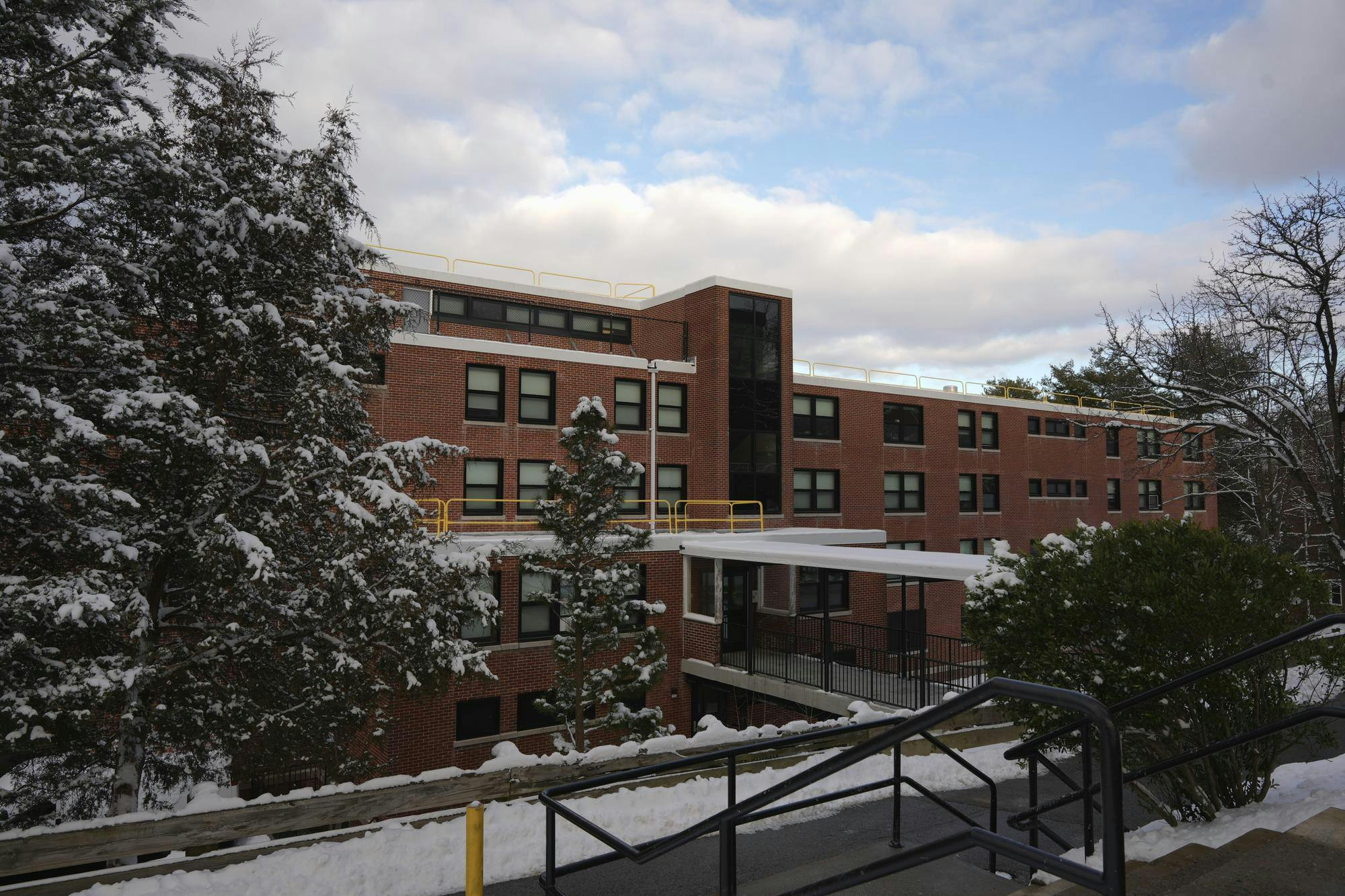
The Campus Planning and Development Committee, a group of Tufts faculty that advises the administration on infrastructure projects on campus, presented at an Arts, Sciences and Engineering faculty meeting. The committee detailed recent efforts to improve accessibility, develop the Boston Avenue corridor and decarbonize.
The university has implemented new infrastructure along campus walkways and is conducting research on infrastructure needs with plans for continued campus development. The committee, which has a dedicated staff and sometimes includes student representatives, seeks to provide oversight and perspective to new projects on campus.
“When faculty have questions and administration has questions, they come to us and we’ll provide a forum so the committee has convening authority to talk about these issues,” Eric Hines, a professor of the practice in the Department of Civil and Environmental Engineering and the chair of the committee, said.
“At the same time, we’re a forum for providing feedback from the faculty, and then also we act as stewards of communicating between the senior administrators and the faculty,” he added.
The committee has updated faculty on university projects and development over the past three years. Given Tufts’ hilly campus, the CPDC has taken particular interest in accessibility improvements.
“It’s wonderful that we’re the light on the hill and being at the top of that hill is fantastic. It has some of the best views in Boston,” Hines said. “It brings up the question, well, how do you get to the top of the hill? This is something that, in recent memory, the campus has really taken under consideration in a rigorous, systematic way.”
One such project is Critical Pathways, which aims to create an accessible route over the hill by adding railings and ramps where needed.
According to Anand Patil, a student member of the CPDC, these questions require input from students.
“As a student, we walk around campus more than anyone else does. I always have something to bring up — this crosswalk, this thing could be improved,” he said.
The administration is also interested in developing the land around Tufts, including the Boston Avenue corridor, where the university is building a dormitory with 664 beds. Set to open in the summer of 2027, the new residence hall, called Pachyderm Place Apartments, is being built through a more affordable public-private partnership.
“Boston Ave. has never had a strong sense of place on the backside of Tufts. [It’s] a place that’s going to start to develop an identity and to become inhabited in a new way,” Hines said.
This new construction also reflects Tufts’ long-term commitment to decarbonization. Hines described Tufts’ historical commitment to innovation and leadership in university-level environmental efforts, including decarbonization.
According to Dano Weisbord, the chief sustainability officer and executive director of campus planning, Tufts has prioritized decarbonizing for many years.
He cited the Second Nature Climate Commitment, a unified pledge by university leaders to achieve carbon neutrality and build climate resilience that was signed by former university president Anthony Monaco in 2016. The pledge is part of a decades-long commitment to environmentalism at Tufts.
“We’re embedding sustainability and decarbonization into everything we’re doing. The new Residence Hall will be fossil fuel free as will the new Aquatics Center,” Weisbord wrote in a statement to the Daily.
There are also plans to transition from steam heating to ground source heating, which would allow for both heating and cooling. Hines says that although the plan would likely reduce costs and be more carbon neutral, it will also be very disruptive to campus life.
“There will come a time where we’re going to have to dig up parts of campus in order to be able to replace this infrastructure, and this is in the interest of the energy transition,” Hines said.



