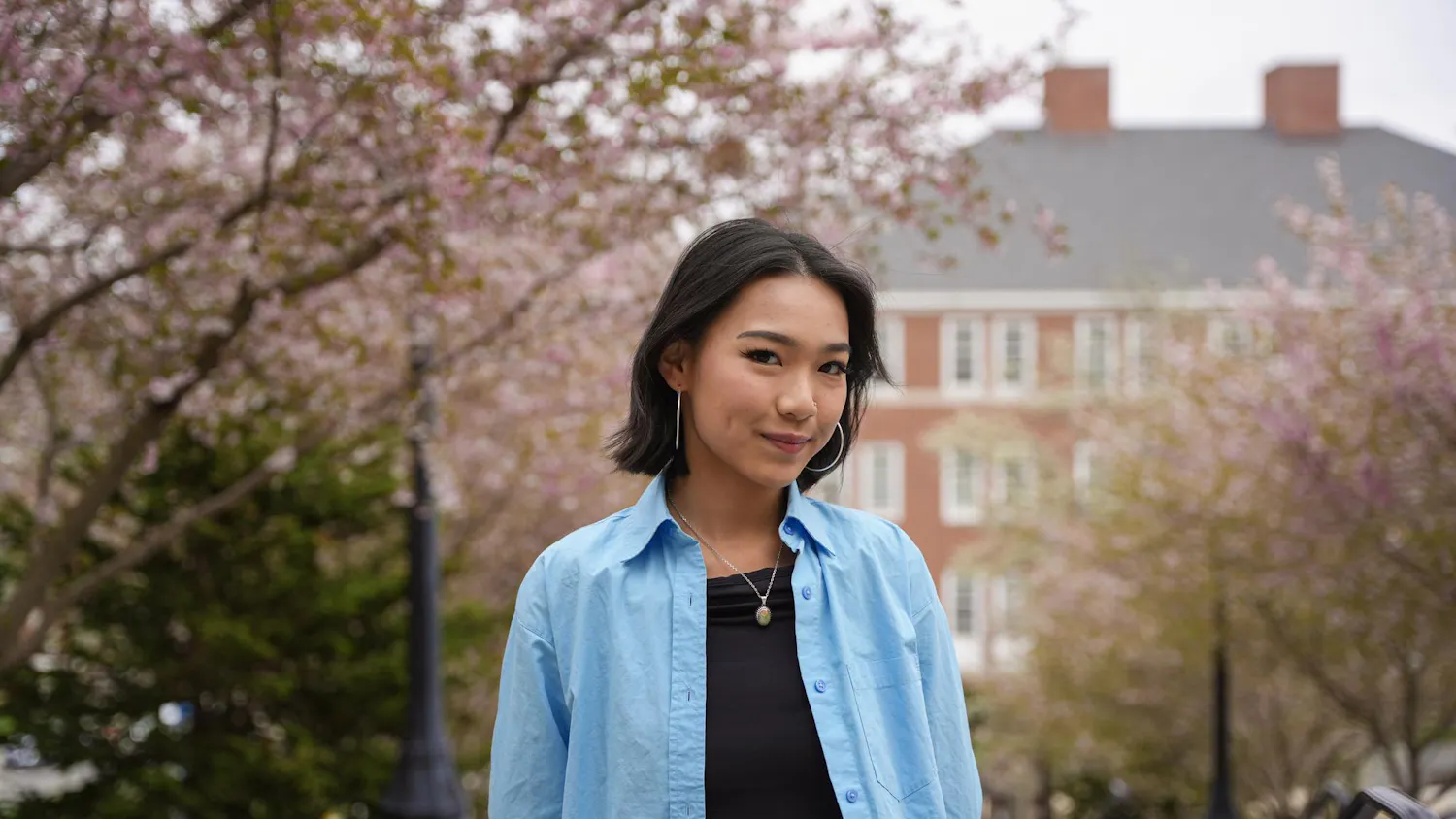
My name is Becky A. I am a senior majoring in architectural studies.
My hometown is Wallisellen, Switzerland. I am a Swiss-Canadian citizen and permanent resident of the United States. I speak five languages, have lived in three countries and have traveled to eight. I graduated at the top of my Connecticut public school class and was captain of our track team. Academic and athletic successes allowed me to feel equal to my peers even though I was always of a lower class.
At Tufts I rowed, ballroom-danced, worked as a resident assistant and now hike as a part of the Tufts Mountain Club. I have worked in the Department of Biology, in the chemistry labs and as a security guard in Cousens Gym. I have even been employed as the Jumbo mascot. I'm a natural red head. I shaved my head three months ago as a social experiment and then dyed it blonde to give my best friend the confidence she needed to dye hers. I am white, heterosexual, multicultural, non-religious and open-minded.
I have come here to tell you my secret, with hope that it will give you something to think about.
I have been depressed for 19 years.
I was born into a household where I felt responsible for other people's unhappiness. It was only until later that I found out that my mom was sexually abused by her grandfather and that my dad became orphaned at a young age. My brother was diagnosed with type 1 diabetes when he was only six years old, and any extended family that I had was always several countries away. From a very early age, I was expected to be the strong and reliable one. There are numerous other events and circumstances which led to my depression, but today I will focus on my story as it relates to Tufts.
Coming to Tufts was both terrifying and exciting because it gave me the opportunity to find out about myself. Before I could experience the greatness that Tufts had to offer, I needed to face the demons that I had brought with me. During my first two years here, the depression that I was hiding became harder and harder to conceal. Eventually, I could no longer get out of bed. I wasn't eating, wasn't showering, wasn't working. I thought that I had no friends — no one to talk to. All I could do was cry. I cried in the hallways, in class, walking down the street. But still, no one noticed.
I got so deep into feeling sad, hopeless, unloved and alone that I started to have thoughts of suicide. I know that this is a lot to hear, but it's also a lot to share, so please bear with me. I would start to make plans. I remember very clearly one night sitting in the corner of my room by the door; I was looking at my pale wrists thinking to myself, "Wow, these would really look much better with blood on them." I was thinking of the patterns I could cut.
I remember then, a red flag popping up in my brain. I needed to get help. I could no longer be silent about my suffering and reached out to professionals. To my surprise, they didn't know what to do with me. All I wanted was for someone to take care of me. But when my parents brought me home, I realized that even they couldn't help. I was so frustrated because I had spent so much time worrying about and taking care of my parents and my friends and my boyfriends and my peers, but this one time that I leapt out for someone to catch me, I was dropped.
I told my dad to take me to the emergency room as a last resort. The psychiatrist who treated me that night was the first person in my entire life who understood what I was going through. This complete stranger. I felt enormous relief.
I was admitted to the psych ward and stayed there for several days. This was one of the most surreal experiences of my life. I went from an environment where everyone looked to me as an authority to a place where I was looked at as a patient — as a crazy person. There were college kids that came in to play ping-pong with me as community service. It's really phenomenal how quickly the tables can turn in your life. I had always been the responsible one taking care of the ill, but it didn't take much to find myself on the receiving end of strangers' volunteer hours.
Eventually I got back to Tufts and finished my academic and employment responsibilities. I then had to take the summer to recover from all of the physical illnesses that accompanied the mental breakdown. I came out on the other side of this experience a much stronger and happier person.
We can learn from this experience how seemingly healthy people can have difficulties with depression. What's important is that we normalize talking about mental health issues in order to educate each other.
Being at Tufts has allowed me to find the good in myself. I am proud of having fought depression; it has shaped much of who I am. So far, I have lived one year in genuine happiness. It's hard to put into words what it means to me; I can describe it as nothing short of flying.
That being said, welcome to Tufts. It's a great place, and you can be happy here.
--
Rebecca A. is a senior majoring in architectural studies. She is the co-founder of Active Minds at Tufts.