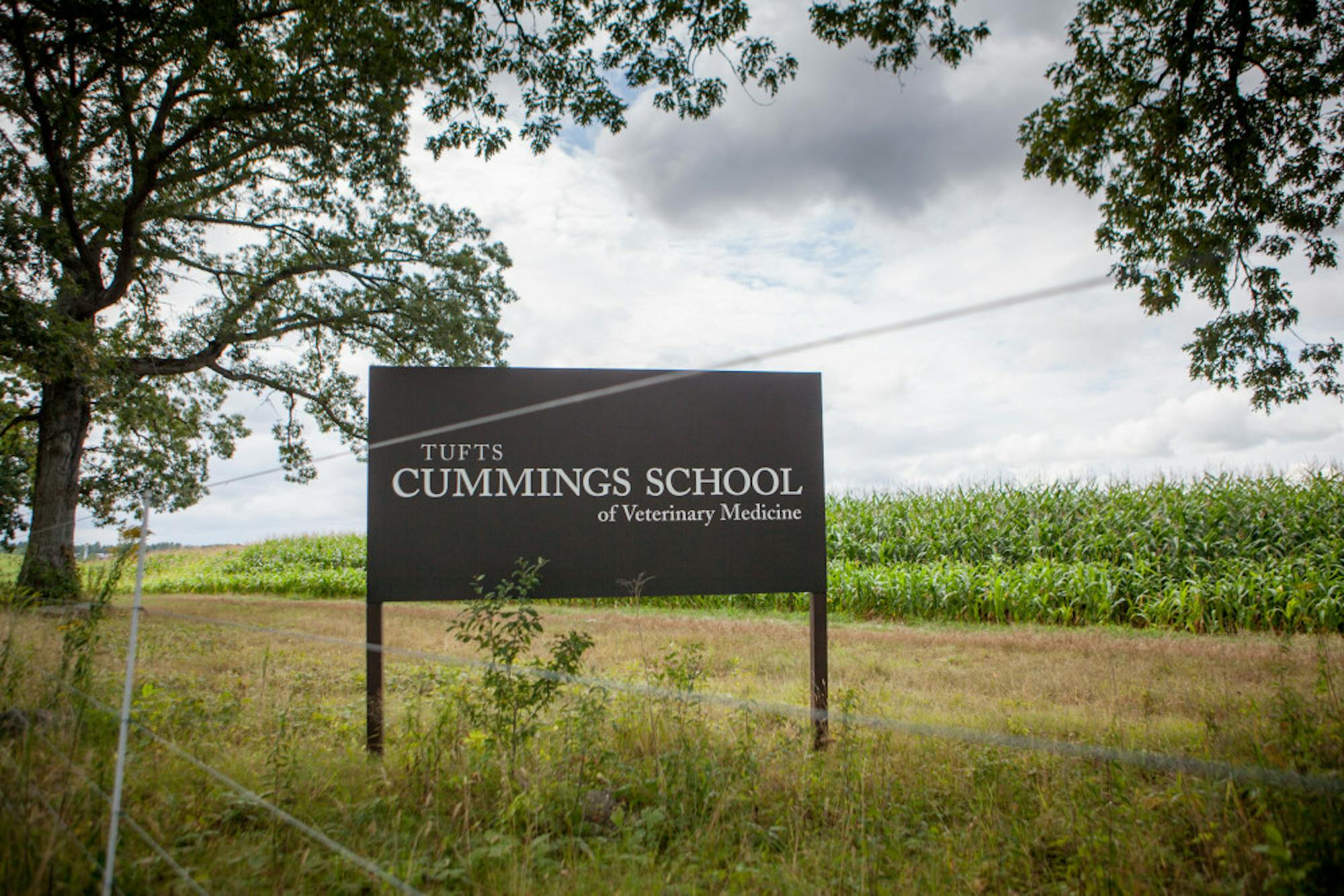
The Cummings School of Veterinary Medicine has begun accepting applications for the fall 2015 semester to its new Master of Science in Infectious Disease and Global Health program.
Program Director Abhineet Sheoran explained that the program lasts one year and will train students in both human and zoonotic infectious diseases of national and global impact. He added that the Cummings School is an ideal location for the program because the majority of human infectious diseases originate in animals and the school has a well-established research program in human infectious diseases with experienced teaching faculty.
“There are only a handful of programs like us that exist in the nation -- five or six of them -- and the focus of our program is training these students, providing them with skills that they can utilize in infectious disease-related fields such as biodefense, biocontainment -- organizations such as [the Centers for Disease Control and Prevention (CDC), the U.S. Department of Agriculture (USDA), the Food and Drug Administration (FDA) and the U.S. Agency for International Development (USAID)] that need people that have good training in infectious disease areas,” Sheoran said. “This is at the vet school, but we are not really teaching animal diseases here.”
The idea to create the program came from the Department of Infectious Disease and Global Health at the Cummings School, which characterizes and studies the biology of human pathogens, according to Department Chair Saul Tzipori.
“It was only natural that we would think in terms of developing a master’s program because we are an academic institution, and we are in the business of training students as well as doing scientific research,” he said.
The program was designed with a holistic curriculum to include both practical and theoretical training for students, Sheoran said. Students will not only learn about infectious diseases, but will also understand the basic anatomy and physiology of organs that are affected by the pathogens. They will also be given training in laboratory techniques in areas of disease diagnosis, immunotherapy, molecular biology and microbiology, according to Sheoran.
“It’s going to be didactic to a great extent," Tzipori said. "It’s going to be global. That means involving the disease of humans or animals in the U.S. and elsewhere, so it’s not really restricted in any way, and the person who does [the program] would really be well-equipped to understand all aspects of infectious agents including vaccinology, treatments, antibiotics, detections and so on."
According to Tzipori, the program is targeted at college graduates who are not sure what they want to do next and do not want to commit to a five-to-six-year Ph.D. program, which would give them highly specialized knowledge and limit their scope of different employment fields.
“This was intended for students who graduated and are looking for something that will direct them to a set of skills that will allow them to acquire employment whether with the CDC, with the USDA, global agencies, food safety, water safety or [the U.S. Environmental Protection Agency],” he said.
Tzipori added that the program will also be useful to students who want to go on to a higher degree such as medicine, veterinary medicine or dentistry but currently cannot make it in with the scores, background or knowledge that they have.
“This gives you an edge to compete more successfully,” he added.
Rebecca Russo, director of admissions at the Cummings School, said the department is aiming for a class size of 10 to 12 students for the program’s inaugural year.
“We’d like to really give the students individual attention -- basically work with them on projects and be able to supervise and basically mentor them as closely as possible,” Tzipori said. “Once you go beyond 20, it gets to be more difficult to do that.”
According to Russo, the application process is rolling, with deadlines on Dec. 1, Feb. 1 and April 1. Applicants will receive admissions decisions on Jan. 15, March 15 and April 30, respectively.
“We would love to see Tufts students applying," she said. "Basically we’re at the building awareness stage right now because it is a brand new program, so [we are] just trying to get the word out."