
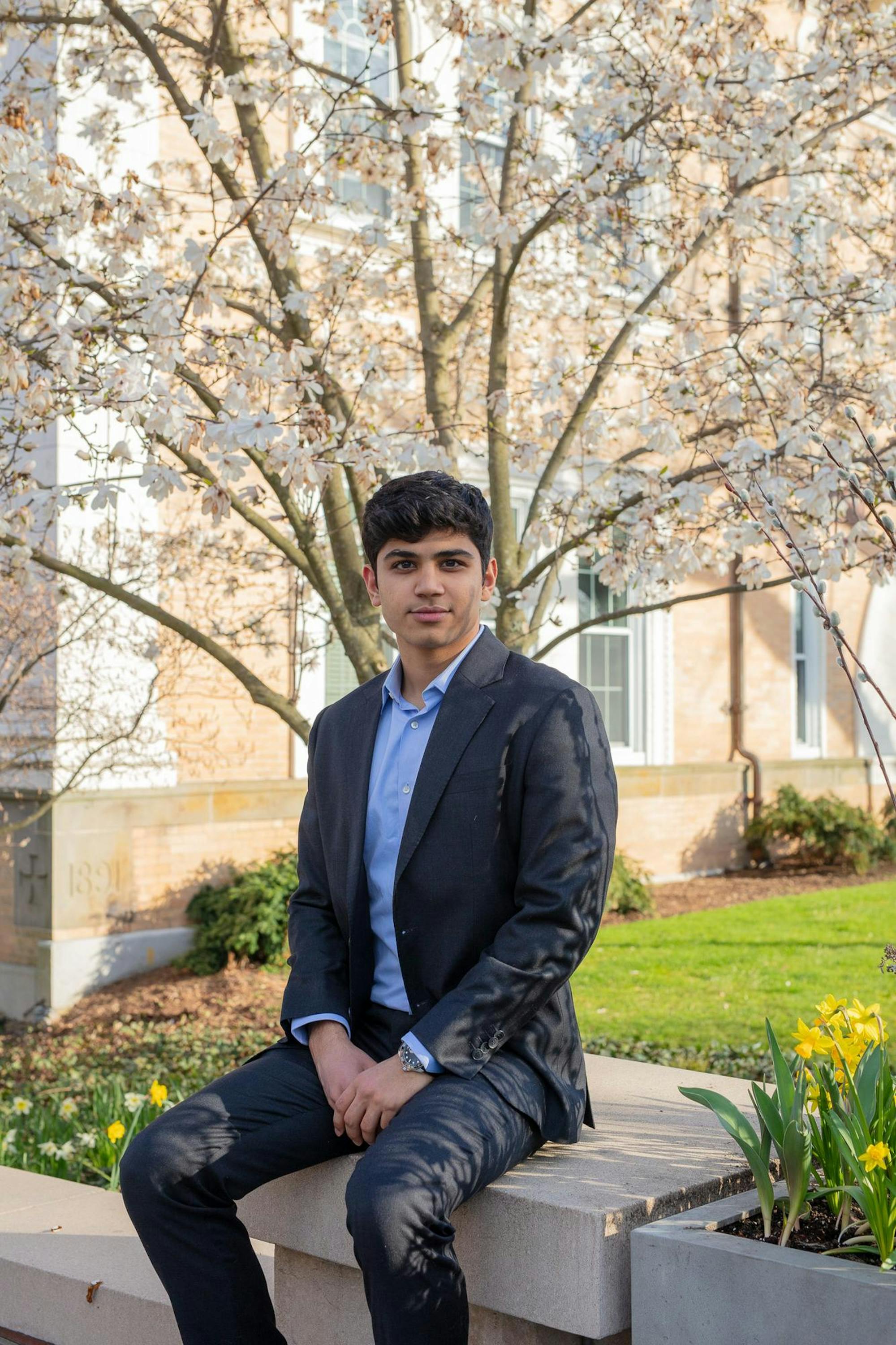
For rising senior Dhruv Sampat, it’s been a moment long in the making. After winning the 2025 TCU Presidential election a few weeks ago, he will serve as the president of the Tufts Community Union Senate for the 2025–26 academic year. Involved in student government since high school, Sampat will culminate years of experience serving his fellow students, including two years managing the $2.9 million Student Activities Fund as TCU treasurer, with this position.
Sampat has been a senator since his first year at Tufts, after stumbling across the TCU table at the Student Organizations Fair. When Sampat saw the changes he could make in students’ lives, particularly making it easier for students to join campus clubs, he began to enjoy the role. He cites former TCU President Jaden Pena (LA’23) as an inspiration.
Soon after, Sampat became treasurer, where he learned valuable lessons about the challenging parts of leadership.
“Student activities are something that people are very passionate about and [make] up a big chunk of their time at university. So when you have to give people hard news, it’s obviously not the best day for you or for them,” Sampat said.
Sharing bad news is something Sampat has unfortunately had to do recently. After supplementary club funding ran out with a few weeks left in the semester, senators decided to deny requests that had not been bookmarked the previous year.
“There was a constant pressure between letting students achieve what they wanted to do and us having that limitation on resources, in terms of fiscal resources," Sampat said. “I don’t think there was a negative impact of that pressure whatsoever. Instead, I think it just made the Senate more cognizant and made the student body more cognizant that there are very limited resources.”
Despite the supplementary funding crunch, Sampat underscored the strong position of the Treasury budget overall. According to Sampat, the budget currently has a “very healthy surplus” despite providing the highest amount of supplementary funding in Treasury history.
“We were able to honor all the bookmarks that we set for most clubs. Any club that we told down the line, ‘We’re going to give you money through that bookmark,’ we were able to honor that," Sampat said. “But towards the end of the year, we certainly had to take some really difficult calls.”
Sampat said that moving forward, clubs that rely on supplementary funding will have their needs built into their yearly budgets, reducing the burden on the overall fund.
In the role of TCU president, Sampat sees a chance to expand his impact as a representative and cater to students as individuals.
Sampat’s top three priorities are tuition transparency, accessibility of student infrastructure and increasing pre-professional opportunities.
“I think I would deem myself to be successful if I set the foundation for those projects to be carried forward, whether in the next year or the year after that,” he said.
As the cost of attendance at Tufts continues to rise, students are wondering where their money goes. Sampat envisions semesterly town halls with University President Sunil Kumar and other upper-level administrators to break down tuition costs, something he hopes to start as soon as next semester.
“The charges that [students] incur while they’re at Tufts become so burdensome that it can really take away from their experience and become barriers to entry,” Sampat said.
Sampat also sees free printing for all students during exam season and laundry stipends for low-income students as a critical part of a larger effort to make resources more accessible. He added that he plans on continuing to utilize the Student Support Fund and leadership stipends.
Sampat sees the Career Center as his most important partner to improve pre-professional opportunities. He also sees room for collaboration on alumni engagement by giving alumni more incentive to stay in touch with Tufts students and aligning the work of Tufts’ pre-professional clubs with the Career Center.
“Right now, there’s no exchange of information between our pre-professional societies that the Senate funds and the Career Center itself,” he said. “I think joining those two forces will also have a big impact.”
In Sampat’s experience, one thing will be essential in achieving these priorities: understanding Tufts’ administrative bureaucracy.
“If you know who to speak with and you can speak with the right person within this massive administration, half the job gets done,” Sampat explained. “I’m certain that if we’re able to find the correct mentors, then we will be able to achieve a lot of these accessibility-related goals.”
When asked how he would manage his priorities alongside other Senators’ projects, he said wants to give them the best support to be able to pursue their own goals.
Sampat wants the Senate to be a resource that students feel they can go to for guidance and assistance for anything they need.
“I want Senate to be the first thing that pops into students’ minds when they don’t know where to go and they need guidance or help with anything,” Sampat said. “I want people to think about us as a resource and be comfortable enough to come forward and engage with us, whether formally or informally.”



