
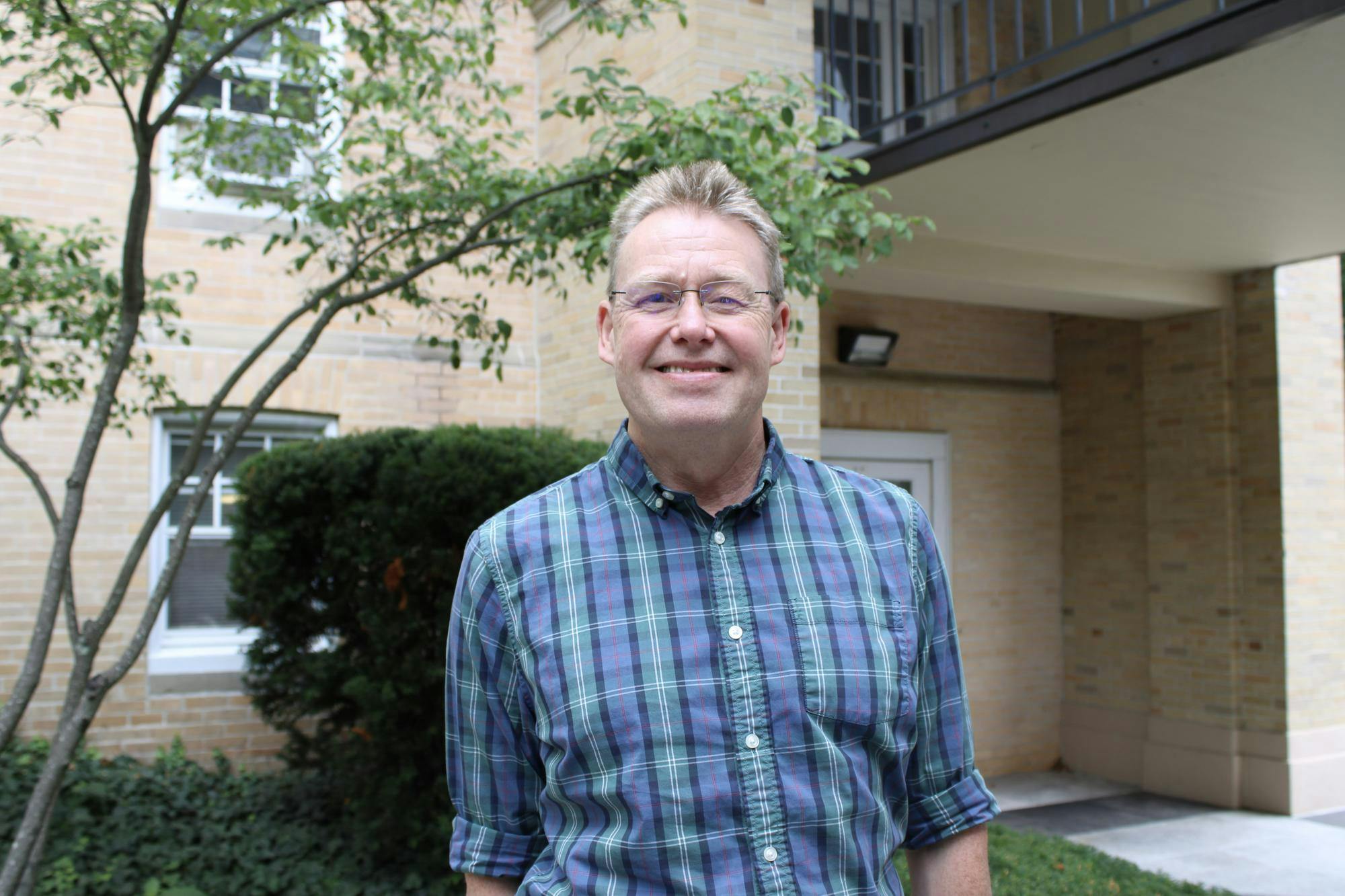
Many students have at least heard of Professor David Denby, if not taken a course with him during their years at Tufts. Known for his enthusiastic and engaging teaching style and contagious passion for the field, Denby has been a cornerstone of the Tufts philosophy department since 1996.
This semester, Denby is teaching Introduction to Ethics and Introduction to Philosophy. Introduction to Ethics, a 75-person class, draws a variety of students — many of whom enroll to fulfill a requirement, whether for their major, minor or to complete the humanities distribution requirement. As a result, students from across disciplines, with varying degrees of familiarity with philosophy, find themselves in the course. According to Denby, that is a blessing.
“[As] a teacher, that’s a very good thing,” Denby said. “If you take math teachers or someone like that, by the time the students get to the math class at Tufts, they’ve done years and years of math and they have all sorts of prejudices and bits they hate … whereas I get everybody fresh.”
Denby enjoys the diversity of students who take his course and caters towards it.
“I do structure the course with that very much in mind, so I teach not just the content of ethics but also basic philosophical techniques and methodology so that people could really see how to do philosophy,” Denby said. “When they can actually do it and think in a philosophical way, that’s very fulfilling for me, and I think it’s very useful for them.”
While Denby might seem like the face of philosophy here at Tufts today, he wasn’t always set on pursuing the subject as his career. His interest in the field began somewhat by chance in his high school library.
“I was in my high school library, and I just found a copy of Bertrand Russell’s ‘[A] History of Western Philosophy,’” Denby said. “Russell just goes through various periods, introduces you to various thinkers — Hume and Kant and Aristotle and Plato and so on — it’s very opinionated … and I just found it very interesting.”
After high school, Denby decided to study philosophy at University College London. But even then, he was not fully sure what he wanted to do.
“I didn’t necessarily intend to go into it,” Denby said. “I didn’t have a long-term plan. [I thought], ‘It’s just my undergraduate career, and I have to do something, I’ll go to grad school.’ So, I went to Oxford and I thought, ‘Well, I like this, I’ll carry on doing this for a bit.’ So, I came over [to the U.S.] and I did my Ph.D. at UMass Amherst. … I don’t remember ever making a decision to go into philosophy. It’s just that at every step, I just took the next step.”
According to Denby, his Ph.D. gave him both important mentors and teaching experience, which encouraged him to pursue philosophy as a career.
He credits one of his mentors, Edmund Gettier, with inspiring him to question conventional wisdom and remain critical. Gettier is best known for publishing a short paper that debunked the traditional view about the nature of knowledge established by Plato.
“I think people who know him are not surprised that he was the guy who spotted that the 2,000-year-old tradition was just mistaken,” Denby said. “He had this ability to not accept anything that wasn’t 100% clear, and that way, he exposed things that people lazily take for granted, and that had an enormous influence on me. It showed how many holes and gaps there are in our intellectual structure. … I try to channel him as much as possible.”
When it comes to the classroom, Denby also draws inspiration from formative instructors at UMass such as Fred Feldman, a professor who modeled successful teaching strategies and the importance of clear, engaging lectures.
In his own lectures, Denby is a strong advocate for making philosophy accessible and fun for students — a skill he has intentionally cultivated.
“[I] make sure that every class has some fun parts to it. You do the argument and let [the students] loose on it, so they can attack, and encourage them to find flaws,” Denby said.
Outside the classroom, Denby continues his own philosophy research, specializing in metaphysics. His two main research focuses are modality and mereology. His work on modal talk — broadly the study of necessity and possibility — is a continuation of his Ph.D. dissertation.
“Since the 1960s, there’s been an attempt to incorporate this modal talk within our lovely logical languages that are so clear, so precise,” Denby said. “Doing so runs into certain metaphysical problems, and those are the ones I’m interested in.”
Research can be challenging to balance alongside teaching commitments. Not to mention, Denby has four sons — two of whom graduated from Tufts, and one who is currently a player on the Tufts men’s soccer team. As you might imagine, Denby is often found cheering at games in his free time.
Despite those commitments, Denby still finds time to read Welsh — a language he grew up hearing in his hometown in southwest England — and play the guitar. When asked what he likes to play, Denby whipped out the sheet music to Beethoven’s Für Elise, conveniently sitting on his desk.
It is clear that Denby has wide-ranging interests. Reflecting on his own education, he expressed gratitude for his high school’s well-rounded curriculum, which encouraged him to study many different subjects.
When comparing his experience in both the English and American education systems, Denby found many advantages in a U.S. liberal arts education.
“The idea of a liberal arts education is central to U.S. education in a way that it isn’t in England [where] you tend to specialize in one thing,” Denby said. “It’s nice [in the U.S.] that you’re forced to take a range of classes, and you learn what you do like and what you’re more suited to in a way that you can’t in England.”
Denby believes that philosophy is an important part of every student’s education. He hopes to impart skills that apply across disciplines and even in day-to-day life, from concise writing to critical thinking. In his classes, he aims to set students up for a lifetime of learning.
“[Students] get used to being contrarian in some sense,” Denby said. “They get used to criticizing views that they hear, and hopefully they’re equipped with the clarity of thought and the methodology needed to do that effectively.”



