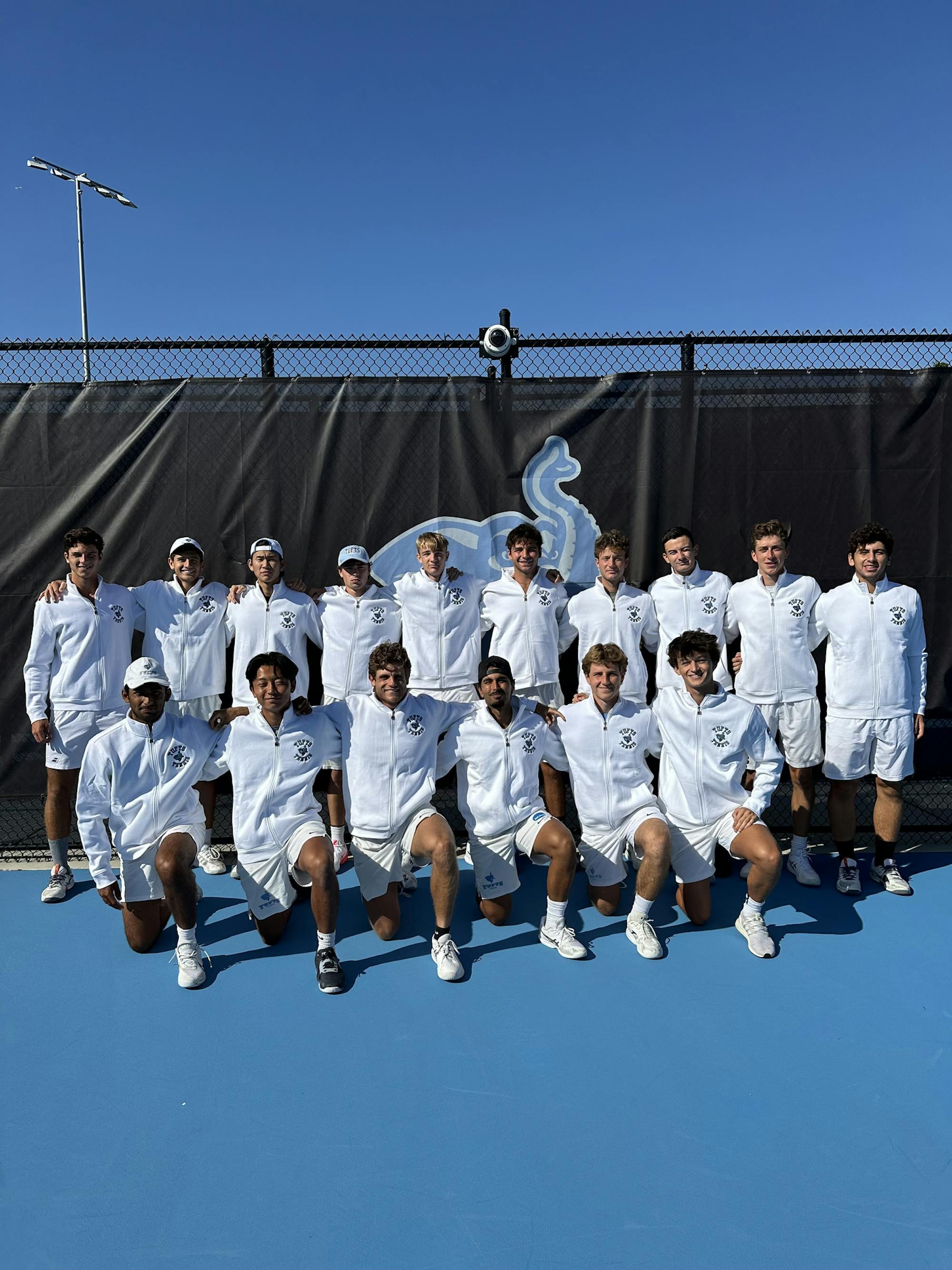
After a remarkable 2024–25 season that saw the Tufts men’s tennis team reach the NCAA semifinals with a 23–3 record and an undefeated 10–0 NESCAC campaign, Tufts is taking a different approach to their championship aspirations.
One day at a time
Following an exclusive series of interviews with the Daily, it’s clear that this year’s team has undergone a fundamental philosophical transformation. “In the previous years, we were so fixated over … winning the national championship,” senior Alex Ganchev said. “And I came to the realization that when we can’t control the outcome … I personally decided to focus more on improving my game, my mindset and just being a better teammate every day.”
Senior Sacha Maes emphasized that the goal for the upcoming year is showing up. “I want people’s focus this year to be [on] how [they can] bring their best effort, day in, day out,” Maes said. “Whatever your role is that day, it can change match to match, but whatever your role is that day, you stay in the present, and you give your best effort.”
Fresh faces
The team’s cultural transformation is aided by an influx of talented first-years who bring both skill and a team-first mentality. First-year Jackson Rich embodies the program’s balanced approach to excellence. “Off the court, I want to get at least a 3.7 GPA. On the court, I want to do whatever I can do best to contribute to the team,” Rich said. He expressed that at Tufts, he “completely fell in love with the team from the beginning.”
First-year Anirudh Dhanwada from Lake Nona, Fla., brings forceful tennis and an enthusiasm for team competition to Tufts after a junior career focused on individual play. “When I visited Tufts, it was probably the best visit I had out of every other visit I’ve been on. The team was so welcoming, and it was just the energy of the team I loved more than anything else,” he explained.
The addition of first-year Matej Djokic from Bosnia and Herzegovina adds a unique family dynamic to the team, as he is the younger brother of senior Andrej Djokic. The clay court specialist is making the transition to American hard courts, while also embracing team tennis. “I always wanted to be part of a team,” Matej Djokic said.“It is amazing to have the opportunity [to play] with my brother … it feels like home.”
First-year Will Moldenhauer from Denver, Colo. arrived with confidence and championship aspirations, excited by “the chance to compete for a national title,” while first-year Logan Mahan from Tulsa, Okla., focused on development and team dynamics. “The team culture seems like they’re pretty big on being one unit,” Mahan observed. “There’s been a big emphasis on uplifting everyone.”
One year wiser
The sophomore class bridges the program’s championship aspirations with its cultural evolution. Sophomore Eren Cheung is eager for increased responsibility. “I think that my role as a teammate has changed from learning to helping the [first-years] adapt ... there’s a lot more at stake. So I think I will take practices, fitness, recovery, a lot more seriously,” he said.
Sophomore Andrey Ignatyev learned valuable lessons about American college tennis. “[The] biggest learning curve [is that] there’s levels to this game. You play in one country, you think you’re good and then you pull up here and you get grounded real quick,” he said.
Sophomore Stavros Mastrogamvrakis, who stepped up in crucial doubles matches last season, explained the team’s practice intensity. “We play a lot of match style point play, which is really important. Obviously, we’re all friends off court, but during practice, we’re all focused on one thing,” he said. He also emphasized the team’s use of productive competition. “There’s so many guys, everyone’s hungry, everyone’s ready to play. We push each other, and the level just gets higher,” Mastrogamvrakis said.
Sophomore Nico Tremblay embraces long-term development. “With a sport like tennis, there’s so many aspects that you need to be highly proficient with. … You’ve got four years here, so it’s not going to be sort of a one-week progression. It’s going to be a progression over time,” he said.
Transfer sophomore Kaetan Mehta brings Division I experience to Tufts’ Division III program. “To win a national championship, to raise everyone’s level ... we have to be able to push each other in practice. It all starts in the practices,” he said.
Leading by example
Junior Takehiro Shuda relishes taking a greater leadership role. “I definitely see my role as a junior having a little bit more responsibility in terms of being a better role model for the team,” he said, also identifying the team bond as crucial. “Team chemistry has meant not only our presence on court during matches, but more so off the tennis court, hanging out more as a team … so that during matches, we feel more close together and we’re fighting as a team.”
Shuda has also worked extensively on mental preparation. “Learning how to control my nerves was a huge thing that I wanted to work on over the summer. By playing a lot of matches and really delving into specific stuff, like breathing, even though it sounds cliche, it’s helped a lot,” he said.
Junior Davide Mirza exemplifies leading by example. “Even if I [haven’t been] a starter for the last two years, I promised myself that I really want to give an example to the younger guys, to be disciplined,” he said. His holistic approach extends beyond tennis: “Give 100% in classes and have good team bonding experiences.” Technically, he’s focused on expanding his game. “I worked on coming into the net and give more consistency,” he said.
Veteran voices
The senior class embodies the team’s philosophical shift most dramatically. Ganchev and Maes formed one of Division III’s most dominant doubles partnerships last season, with their chemistry stemming from a friendship that began before college. “We’ve been really close ever since we met at the U.S. Open a few weeks before we started [our first] year,” Maes recalled. “Last year, we finally got a shot at playing pretty much the whole season. … We made the most of it.”
Senior Javier Gonzalez, who reached the NCAA singles semifinals last season, embraces the team’s new approach. “This year, we’re trying to focus a bit more on different goals. … We’ve had very kind of quantitative goals in terms of what ranking, what position, what number we want to end up as,” Gonzalez said. “So I think that we have to focus a bit more on the process, and making sure that we’re doing everything that we should be doing,” he says.
His breakthrough season exemplified the power of sustained confidence and trust in his preparation. “I think that that was honestly part of the success that we were actually enjoying, playing throughout the season. I started well. I usually have the tendency to start being very nervous, but as you continue playing more and more matches, you kind of lose that,” he noted.
Andrej Djokic, who was rallying in his match when play was halted in the NCAA semifinals, channels that experience into team preparation. “I was actually up a break in the third set. … But that’s something that I would like to take and make the whole thing work on this year, to actually feel the pressure during practice and more often, so once we get in this situation, we are able to overcome it,” he said.
Djokic emphasizes the foundation of success. “If we build trust within our team, that’s something we needed and relaxed in the last couple of years. I think [titles will] just come in our hands. By the end, it’s all about trust and about creating chemistry,” he said.
Championship culture
Ganchev’s legendary “Goggins” mentality, named after ultra-endurance athlete David Goggins, has become synonymous with the program’s relentless work ethic, but even this iconic moniker has evolved to reflect the team’s cultural transformation. Originally earned through his habit of pushing teammates beyond their perceived limits, the nickname has transcended individual achievement to embody collective growth.
Andrej Djokic offers insight into Ganchev’s evolution. “[Ganchev] was always Goggins, not because of his mentality, because how he’s always pushed everybody in the court,” he said. Djokic, however, sees something deeper emerging. “I trust in [Ganchev] being the real Goggins now, or actually, let’s say the Alex Ganchev.”
Ganchev himself still embraces the core philosophy while applying it to team development. “I still try to embrace [Goggins], because one of the things he always teaches is to keep pursuing and pushing the limits, like see how far you can go. And once you think you’re done, that’s when you have to push even harder,” he said.
As the Jumbos prepare for what could be their most promising season yet, their transformation from a results-oriented program to a culture-driven collective represents a fundamental reimagining of what championship pursuit looks like. With returning players who reached individual national championship matches and newcomers bringing fresh energy, this team has learned that the path to titles isn’t forced with pressure and expectations, but rather built through trusting and enjoying the process as a team.