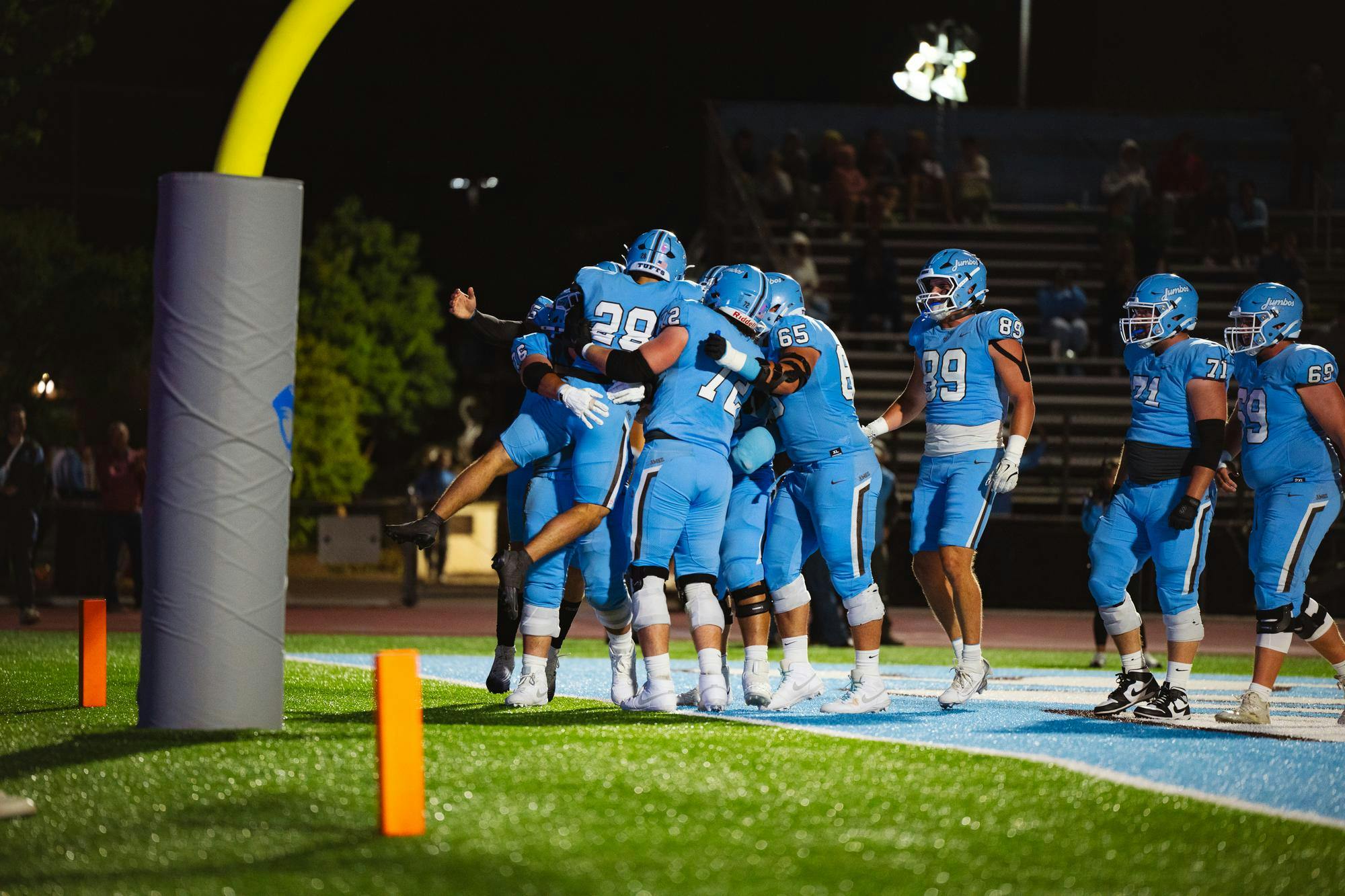
September after dark makes a football game feel bigger. The lights sharpen everything: edges of pads, breath in the air, the collective wince of a crowd when a return man gets the corner and the volume turns from murmur to, ‘Oh my god, go.’ Ellis Oval had all of that Saturday, and then some. Tufts defeated Wesleyan 22–20, a win stapled together with all the duct tape a football team keeps in the equipment trunk: defense, field position, special teams, grit, more special teams and, when it absolutely had to happen, one burst through daylight to slam the door.
Start with the night’s most unexpected hero: special teams. Tufts won the rock fight because they owned the liminal moments. There was senior kicker Vaughn Seelicke thumping a 41-yarder late in the third quarter and a 36-yarder in the fourth, 6 points that wound up being the difference in a 2-point game (math: still undefeated). There was sophomore linebacker Dazer van Leeuwen blasting through to get a hand on a punt and bat it out of the end zone for a safety. This play helped him secure the NESCAC Special Teams Player of the Week award. And there was sophomore wide receiver Keller Rogers, a kickoff return magnet with a turbo button, stacking 146 yards on four runbacks, including a 71-yard lightning bolt return into the endzone that immediately flipped the field after Wesleyan had tied it. Between the two plays, that’s 9 points of swing delivered by the phase of the game you forget about until it completely hijacks your game script.
The biggest roar arrived on a takeaway turned jailbreak the other way. Early in the third, sophomore defensive back Cameron Pineda read a throwback, jumped it and thundered 64 yards for six. Pick-sixes are plot twists; this one re-centered a game that had been trenchy and focused on field-positions, giving Tufts the lead it would never fully surrender. Pineda finished with eight tackles (seven solo) and the highlight you circle from Saturday night, earning him the NESCAC’s Defensive Player of the Week award.
If you’re looking for fireworks on offense, you were watching the wrong game. Tufts gained 219 yards, produced nine first downs and still seemed composed. The Jumbos went 7-for-13 on third down conversions, kicked when it was wise and protected the ball. Wesleyan out-gained Tufts 261–219 yards and won the first-down count 16–9, but lost the phase that turned drives into points. You wouldn’t frame the box score. You’d absolutely keep the result.
Junior running back Christian Shapiro supplied the rhythm, then landed the final punch — 13 carries for net 65 yards and the first Tufts touchdown, a three-yard second-quarter tie-maker. Later, with the clock blinking nervously, Shapiro slammed the door: third-and-seven, under two minutes, he knifed 42 yards to the Wesleyan 10 and green-lit the victory formation. He’d been talking himself into that moment all night.
“On that last run, it was a run-play that we’ve been calling all game and to be honest didn’t have much success with,” Shapiro wrote afterward in an email to the Daily. “I was saying all game that if we keep getting these small, gritty yards, that the big one will eventually present itself. And it just so happened that it popped in a very crucial moment in the game.”
Junior quarterback Justin Keller’s legs were the glue, producing 58 yards on eight carries, while maintaining a tidy 12-of-17 for 96 passing yards. Exactly the sort of night that allows your defense and specialists to be loud. When Keller kept on zone reads, linebackers flattened, safeties widened a half-step and those were the inches the offense needed. Not flashy, but effective.
About that defense: Bend, snap back, repeat. Tufts logged the game’s lone sack (senior defensive lineman Suleiman Abuaqel and junior linebacker Riley Yaker, a shared effort for minus-15) and kept making Wesleyan earn every yard. Junior linebacker Johnny Ferrelli matched Pineda with eight tackles, Yaker popped up at all the important collisions, and senior defensive back Nate Sousa kept getting paws on throws. The night’s neon arrow came with 1:57 left: Wesleyan scored to get within two, lined up for the tie, and Tufts detonated the two-point, with Yaker and Ferrelli meeting it at the goal line.
Wesleyan had answers, just not enough of them. Wesleyan quarterback Matt Fitzsimons was the featured character: two 1-yard plunges, a short touchdown throw, 137 passing yards and designed keepers to stress the edges. Wide receiver Donte Kelly found soft spots, running back Angelo LaRose ripped a chunk run, and the Cardinals owned time of possession by a few minutes. But trims killed them: a missed 43-yard field goal before halftime, a punt that became a safety and the two-point denial at the end. In a 2-point game, that’s a trilogy of regrets.
If you’re trying to sketch an early identity for Tufts, call it opportunistic composure. The Jumbos answered jolts with poise: Down 7–0 late in the first? Nine plays, Shapiro from three. Tied midway through the third? Rogers detonates a return, Seelicke bangs through points. Backed up late? Defense stacks downs, closes the door on the conversation. Nothing felt fluky. It felt practiced.
Trends to keep an eye on as the calendar turns: Tufts’ kick return game is a problem for opponents. Rogers’ average, 36.5 a pop, could force squibs and pooches, as teams look to avoid putting the ball into his hands. The secondary attacks the ball (see: Pineda), and the front has a pocket-wrecking gear when it needs a possession-changer. Most of all, the third-down math travels. 7-for-13 is composure translated into chain movements.
And the closer from the closer: As he ripped through the second level on that 42-yarder, Shapiro said, “The emotions were definitely high, when I broke through the line of scrimmage, all I saw was the endzone. It took a lot out of me to not finish that run, but I knew if I got down the game was over, so sliding felt like the best option.” That’s a veteran call that echoes this roster’s wiring, the kind you want traveling week to week.