Joseph Strauss, chief engineer of the Golden Gate Bridge, said: “Bridges are a monument to progress.” Such is the case of the recently completed William Fenton ‘Bill’ Russell Bridge, named after the Celtics player and civil rights activist, which honors Boston’s past changemakers while innovating for its future. The bridge was designed by Miguel Rosales, a Boston-based architect and president of the architecture firm Rosales+ Partners. Rosales has designed some of the most well-known bridges in the country, including the Zakim and Charlestown Bridges in Boston, the Woodrow Wilson Bridge in DC and the Puente Centenario Bridge across the Panama Canal. Born to a middle-class family in Guatemala, Rosales earned an architecture degree from University Francisco Marroquín before continuing his studies at MIT, earning a Masters of Science in Architecture Studies. Rosales credits his education in architecture, urban planning and engineering for his unique designs saying, “I think I combined all of those disciplines into one person, and I think that makes me special and be able to do the work I do.”
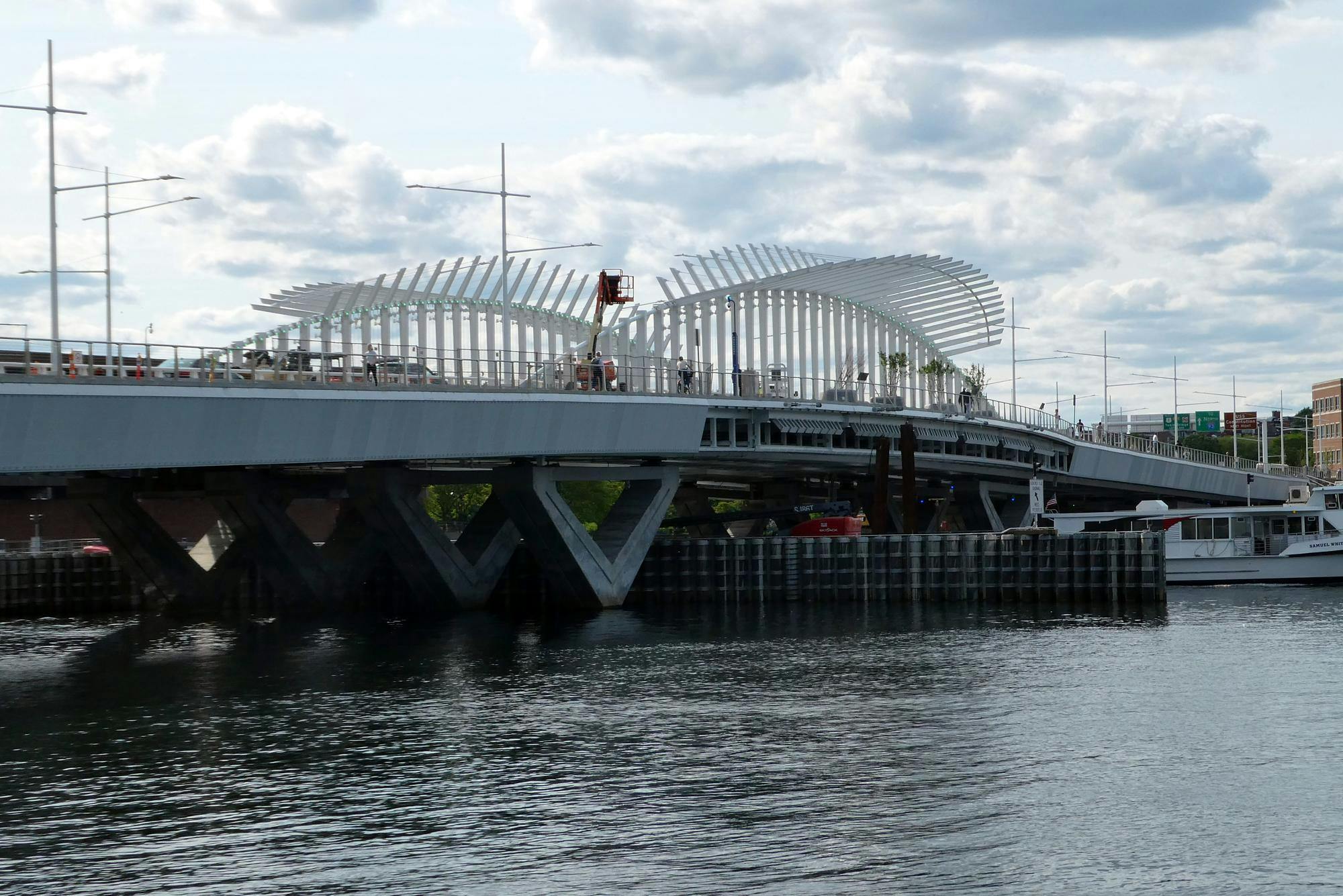
Monuments designed by Rosales frequently become symbols for the communities in which they are built, a process described in his 2024 book “Bridges as Structural Art.” For an infrastructure project to gain significance in a community, Rosales cites the importance of a “distinct design,” emphasizing aesthetics, especially scale, proportion and contextual relevance. According to Rosales, an aesthetic bridge should not be “too large or…over designed.” For example, in order to maintain the Russell Bridge’s “sleek appearance,” Rosales hid essential utility pipes behind an “architectural facial edge,” since they could not be put under the river.
The Charles River influenced aesthetic choices beyond the utilities. While the city originally wanted to restore the historic North Washington Street Bridge connecting the North End and Charlestown, the cost proved prohibitive so they turned to Rosales to replace it. Rosales explained that the Russell Bridge was intended to “complement the Zakim Bridge,” one of Rosales’ past projects that also spans the Charles River. However, the Russell Bridge could not be an exact copy of the Zakim because, while the Zakim Bridge carries the interstate, the Russell Bridge serves primarily local traffic. So, to create a feeling of harmony between the two, Rosales inverted the shape of the towers on the Zakim Bridge to create the piers for the Russell Bridge and used the same color and finish. While the North Washington Street Bridge blocked views from the harbor with its 12 wall piers, Rosales reduced the number of piers to five, which, coupled with their comparatively slender shape, increased visibility.
When Rosales designs a bridge, he considers the community that will use it. He said that an aesthetic bridge should not be overcomplicated “so anybody looking at it can understand how it’s working.” Rosales’ interest in user experience led to several innovations on the Russell Bridge. He “allocated 40% of the area of the bridge to pedestrians and bicycles,” which is “quite unprecedented in the city of Boston.” Rosales hopes that the pedestrian and bicycle friendly design of the bridge will “give incentive to people to walk and bike on the bridge. That way you are reducing some of the pollution.” Rosales also intends for the bridge to “extend, in some way, the Greenway.” To do this, he created an overlook in the middle of the bridge where people can “look out and relax,” and included plantings along the structure. Although his team researched plants that could endure the wind and exhaust fumes and installed an irrigation system, Rosales described the landscaping as “kind of an experiment, because it’s never been done in the city to put plants on the bridge. So hopefully they work, but we might need to make some adjustments.” While the plantings may need to be adjusted, the structure of the bridge itself likely will not because it’s made from steel, which is durable and recyclable, unlike other materials such as concrete.
Rosales begins his design process by discussing the goals and objectives of the project with stakeholders. “I’m not a believer that you really can design a bridge by committee,” Rosales said. Instead, he uses these initial conversations to create and present three to five designs, according to his vision. “We develop very careful cost estimates at the beginning so people can understand what are the implications of this design or another design,” Rosales said. “We always make sure that we are showing something that we can deliver.” The only hiccup in building the Russell Bridge came when cracks were found in the welding of some of the steel boxes which support the bridge, causing a two year delay. Rosales maintained that this was a construction issue rather than a flaw in the design.
A ribbon cutting ceremony for the Russell Bridge was held Sept. 24, which was attended by the family of Bill Russell. Rosales described the ceremony as “a rewarding experience after over a decade of working on the design and construction of the bridge.” At the ceremony, Governor Healy and Mayor Wu spoke about Russell and his legacy, and echoed Rosales’ belief that the bridge will become a symbol of Boston.