
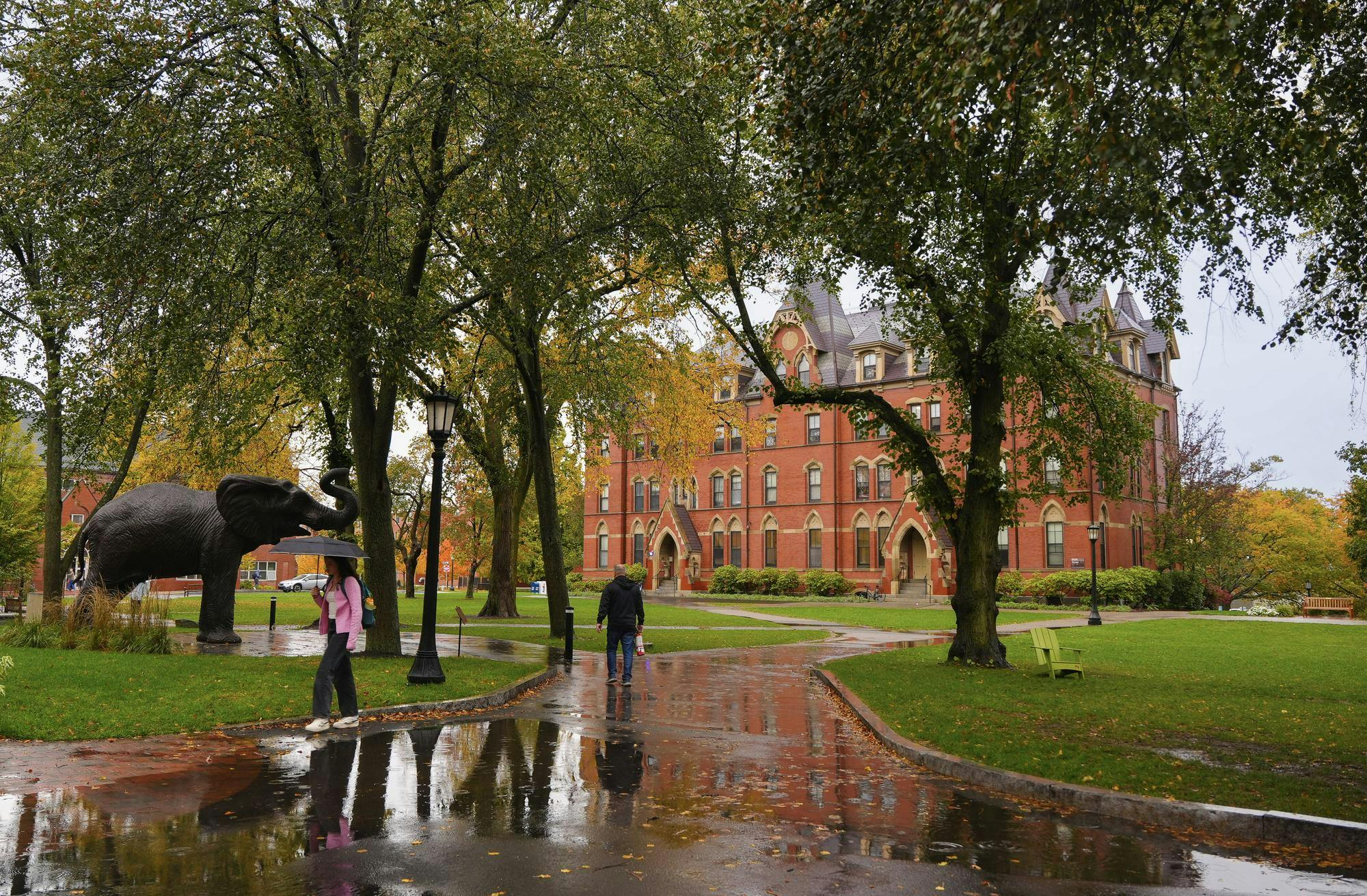
One day at the School of the Museum of Fine Arts this past summer, fifth-year combined-degree student Clara Davis took a box of 10,000 photos of legs from her locker and laid them out like a mosaic on classroom tables. This is just one example of what a typical day could look like for a Tufts Summer Scholar. The Summer Scholar program is a 10-week program that allows rising juniors and seniors to conduct independent research projects on campus under the guidance of a faculty mentor.
The Summer Scholars program encourages students from any discipline to conduct research on a topic of their choice, while providing each accepted applicant a $3,500 stipend for living expenses and an additional $1,000 for their research budget. The research conducted by students is then shared with the Tufts community at a poster session, allowing the student researchers to present on their topics and interact one-on-one with attendees. This year, the poster session will be on Friday at the Tsungming Tu Complex Atrium from 2 p.m. to 4 p.m.
Program Manager Emily Palermo emphasized the importance of providing research opportunities to undergraduate students across the three schools at Tufts.
“[Research] can mean so many different things depending on your discipline,” Palermo wrote in an email to the Daily. “We ensure that we provide opportunities for any student to conduct research, whether they’re in the School of Arts and Sciences, the School of Engineering, or the SMFA.”
One particularly unique element of the Summer Scholars program is getting to spend an extended period of time on the Tufts campus with a small group of other students, all of whom are working on extremely unique and varied projects. According to Palermo, this aspect of the program is intended to encourage students from all disciplines to learn from one another.
“[The] program is specifically organized to provide regular opportunities for students to talk about their research with people who aren’t in their field. We strive to build a community of bright, curious individuals who are all learning from each other,” she wrote.
Davis noted that, despite often being surrounded by students working on vastly different projects, she felt a solidarity with her peers.
“I’d see all these people doing their lab rat stuff. I was like, ‘Wow, this was kind of hilarious that we’re all doing [this program] together.’ But I feel like I could relate to them to a certain extent,” she said. “Whether you’re in the lab … poking your rat … or if you’re in the studio, we’re all … trying to answer some question ... poking at whatever we’re poking at.”
For Davis, who is studying English and studio art, these 10 weeks in the program were dedicated to investigating the phenomenon of point-of-view leg selfies on Pinterest. She hopes to utilize her summer research to create an artist book that explores the significance of these photographs. Davis, whose work is often focused on internet culture, first got the idea for her project after noticing the trend of leg selfies on social media.
“It’s an interesting category because it doesn’t have the face in it, so it has a level of anonymity and you can project yourself onto somebody else’s legs,” she said. “There’s also just a vast diversity of the types of pictures that people take of their legs, depending on who they are and what they’re trying to say.”
Davis’ research was also interested in the cyclical nature of posting these leg selfies, and the ways in which viewers participate in the culture.
“Especially on sites like Pinterest, where it’s not based on people that you actually know, it is like you’re … becoming part of this collective movement. And what that movement is doing I think is an open question,” she said.
Maggie Zhang is a fourth-year combined-degree student studying psychology and studio art. Zhang focused her project on intersectional microaggressions among women of color. Her summer was spent designing a survey that asked participants about their experiences with microaggressions, with a particular interest in the experiences of individuals with intersectional identities.
“We are hypothesizing [that] for women of color, based on different historical contexts or their past experiences, they will reflect a pattern for their microaggression examples,” Zhang said.
However, Zhang’s study is unique in that she is not assuming that the outcome will be strictly focused on a race-gender combination. Instead, the survey gives participants the choice between many different identifiers before narrowing it down to the two identifiers that participants found most central when experiencing microaggressions.
“We’re collecting data from their own [experiences] … and then just trying to explore if there’s any other patterns [that] show up, or if they’re following a gender or race pattern as the previous research talked about,” Zhang said.
Zhang is currently preparing to launch her survey in a matter of weeks. In November, she plans to conduct a pilot study of the survey by releasing it to students in the Introduction to Psychology class at Tufts. Zhang then plans to publish the survey on Prolific, an online platform that helps researchers recruit participants for their online research, where the study will reach a national pool and a wide variety of participants. Zhang has set the goal of 420 participants for both rounds of the study.
Zhang noted the essential role that her faculty advisor, Aerielle Allen, assistant professor in the Department of Psychology, played in encouraging her to aim for a wide participation pool.
“I started to ask Dr. Allen … ‘What do you think is an ideal number for the amount of participants?’ And she said, ‘Yeah, maybe 420.’ I was like, ‘420 for [the first study]? I’ve never seen that [many] people in my life.’”
At the School of Engineering, junior and engineering physics major Julian Sutaria is also undertaking an ambitious project. His research focused on developing a method of modifying an atomic force microscope to measure the electrical properties of neurons. While the microscope is typically used to measure the physical properties of a sample, Sutaria hopes to use it to measure neuron action potentials.
“The ultimate goal is to use this data to develop a theory of how electrical signals propagate in networks of neurons. So if we detect an electrical signal in one neuron and it’s connected to other neurons, what neurons after that are stimulated and themselves send signals?” Sutaria said.
In order to achieve this with the atomic force microscope, Sutaria had to modify his research in several ways, which included adding devices to the microscope that allowed it to send signals to the test chip and writing software to enable the instrument’s time-resolved capabilities.
“Normally, [the microscope is] just measuring something over space, and you can’t get any evolution in time. Whereas here I was writing software so that you could use this instrument to measure stuff over time,” Sutaria said.
The Summer Scholars program often acts as a head start for students to begin working on their senior thesis or undertake the first step of a larger research project. While neither Davis, Zhang nor Suteria’s projects were done by the end of the summer, they are each continuing to work on them throughout the school year to achieve their projects’ various goals.
Palermo expressed that the research projects are not meant to be contained within 10 weeks during the summer but instead are intended to provide a path into future research.
“This program (and undergraduate research as a whole) is all work of futurity,” she wrote. “[When] there are intrepid scholars asking questions and being curious about the world around us, the future is always going to look a little bit brighter.”



