
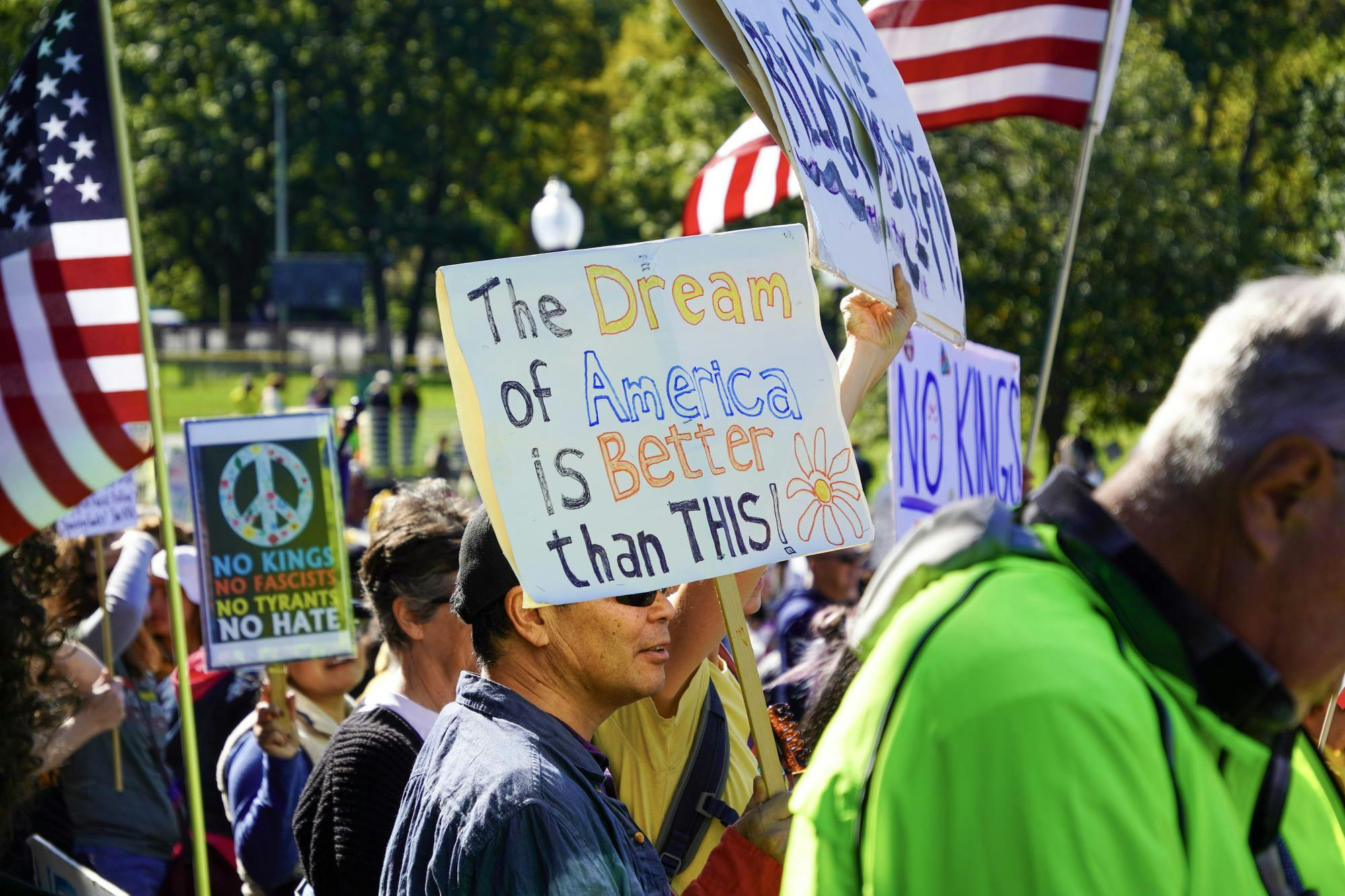
On Saturday, thousands of people flocked to the “No Kings” protest in Boston Common. The protests against the administration of President Donald Trump, which occurred across all 50 states, followed a series of demonstrations that occurred in June.
According to the “No Kings” website, the protests are strictly nonviolent and encourage citizens to unite to fight dictatorship. Across the country, nearly 7 million people attended. This marks an increase in protesters compared to the rallies earlier this summer, which drew 5 million.
Attendees sported signs that shared comedic, hopeful and clever messages. One sign depicted a monarch butterfly and read, “The only monarch we need,” while another, adorned with a colorful hand-drawn Squidward read, “No King, Yas Queeeen.”
Among this group of thousands were many Tufts students, who expressed various motivations for attending the protest.
Damian Curt, a junior studying cognitive brain science, was inspired to attend after missing the first stage of protests earlier this summer. For Curt, the Trump administration’s recent crackdown on immigration — as well as the increased funding for U.S. Immigration and Customs Enforcement granted by the One Big Beautiful Bill Act — strikes a personal cord.
“My father was undocumented, so that’s … really the biggest personal driving factor for me,” Curt said. “I also just recently read that today was the first day that Trump could invoke the Insurrection Act in order to not reopen the government, so that was very scary, and I just felt this passion to show up and show out.”
The Insurrection Act of 1807 is a rarely invoked law that was created to allow the executive to deploy the military domestically in nonwar times. At the beginning of his term, Trump signed an executive order that would explore potential interpretations of the law to curb immigration.
Sophomore Theo Pakgross emphasized how he felt moved by recent government conditions to attend the protests.
“I wouldn’t consider myself a very political person, but obviously we’re in very desperate times,” Pakgross said. “It kind of felt like [an] obligation.”
Keola Edelen Hare, a junior studying biology, shared a similar rationale for participating in the protests.
“It’s pretty important to me that I play an active role in the communities I am in and stand up for what I believe in,” Edelen Hare said.
Some students heard about the protests from friends and family, while others learned of the events through social media. Edelen Hare shared that he first learned about the protests from his parents but was later reminded by Instagram reels to attend.
“I saw a reel that reminded me that I need to make it, lock in and actually go,” Edelen Hare said.
Edelen Hare, Curt and Pakgross were all surprised by the format of the protest, which remained in the Boston Common and rotated between speakers and performance groups.
Pakgross even described the event as “corporate.”
“It felt oddly corporate: the entire event, the way that the stage was rented, and there [were] all these booths. … Something about it felt very corporate, which was interesting,” Pakgross said.
Pakgross is referring to the nearly 24 organizations that tabled at the protest. Organizations represented ranged from the Mothers Out Front Massachusetts branch, a group of caregivers working to combat the fossil fuel industry, to Tesla Takedown, a peaceful grassroots movement working to strip power from Elon Musk.
Pakgross elaborated on the setup of the programming.
“It felt like the setup was more of a concert, which was interesting … with all the music that was in between [the speakers],” Pakgross said.
Curt described the music as somewhat distracting.
“When the band came on … I felt like that was a bit performative and kind of taking you away from the purpose and the goal [of the protest],” he said.
Edelen Hare similarly was surprised by the format of the protest.
“Something that kind of surprised me was that it wasn’t a march,” Edelan Hare said. “It [was] all fenced in. … My past experiences of protests have felt more meaningful because [they’re] impacting the whole city.”
For the Tufts students interviewed, the speakers were the most impactful part of the programming.
“I … enjoyed the different speakers. I thought that they had a good range,” Edelen Hare said. “And also people that all have a lot of influence, obviously, which makes it feel more like there’s hope.”
Curt and Pakgross offered specific examples of speakers who resonated with them.
“At the tail end, there was a Black female speaker, and she was saying our … freedom [is] worth more than fascism and that we’re better together,” Curt explained.
Curt was referring to U.S. Rep. Ayanna Pressley, who represents most of Boston and Cambridge in the U.S. House of Representatives. She was one of the multiple elected officials who spoke at the rally. Pressley ended her speech by pulling off her baseball cap, saying, “No kings, but one bald queen.”
In addition to politicians, representatives from nonprofit organizations across the state spoke at the protest, including Executive Director Carol Rose of the American Civil Liberties Union of Massachusetts, the same organization currently representing Rümeysa Öztürk in the ongoing Öztürk v. Trump case.
“Seeing the speaker [from] the ACLU was really empowering,” Pakgross said. “She mentioned the student from Tufts and how real work is happening and how the ACLU is having an impact.”
While Curt explained there is power in showing up and raising awareness, he also mentioned how there is still so much more that needs to be done at the community level. He shared how he recently translated a banner protesting ICE into Romanian to raise awareness in the Romanian community.
“[They’re] little things that you can do, no matter how small, even if you feel like you don’t have power on a grand scale,” Curt said.
Overall, Edelen Hare, Curt and Pakgross emphasized the importance of taking action and the comfort of seeing people who want change; furthermore, they left the protest with a hopeful note for the future.
“I do think the more people that show up and show out, hopefully our government can listen,” Curt said.



