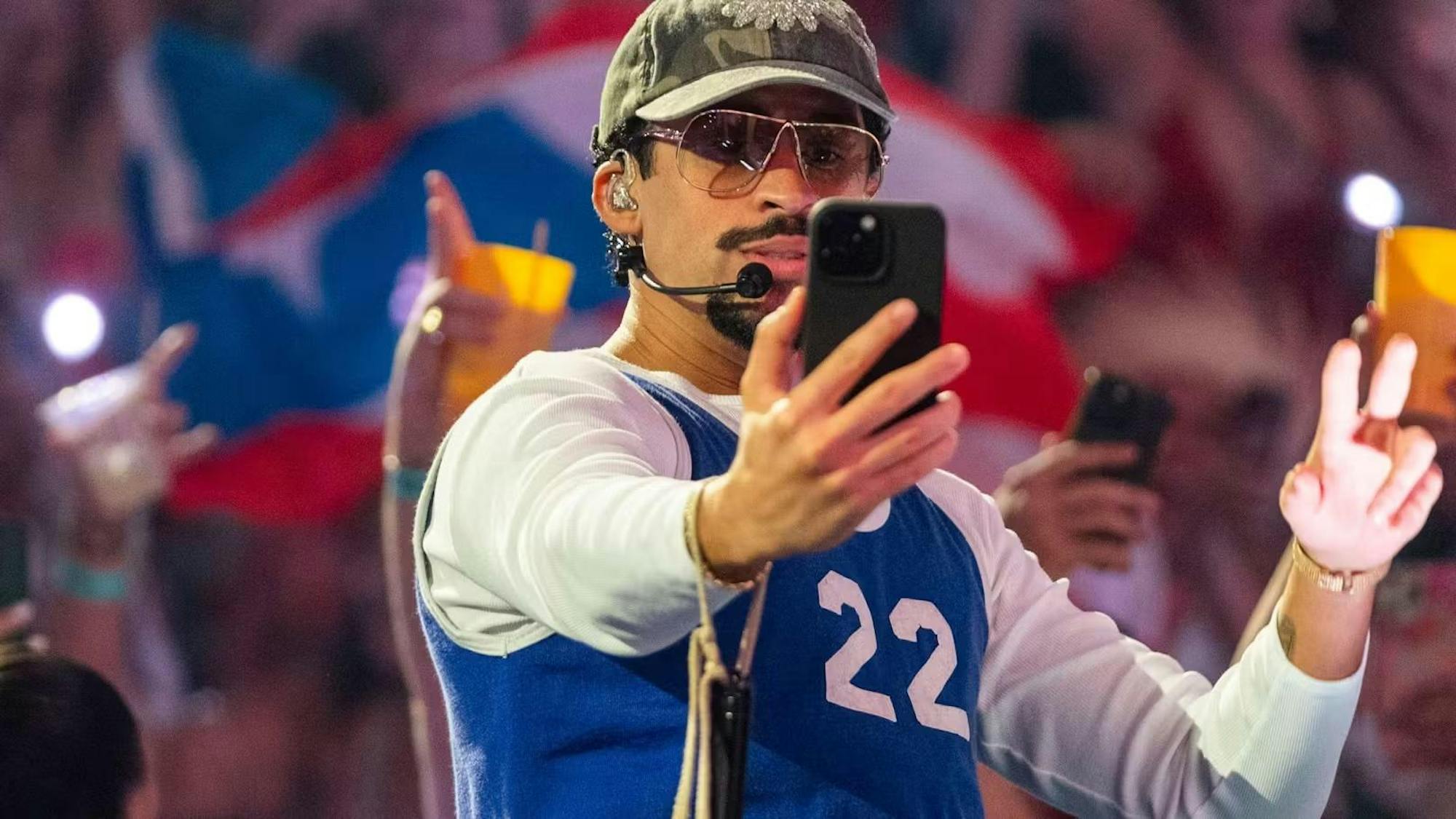
It’s fitting that the last lyric of Bad Bunny’s record-breaking 2025 album “DeBÍ TiRAR MáS FOToS” is “¡Viva!” — or in English, “Long live!” It’s the resounding final exclamation of “LA MuDANZA,” a track that begins as an intimate ballad — a retelling of the tender love story from global superstar Benito Antonio Martínez Ocasio of his parents — and then, in a heartbeat, erupts into a raucous, full-throated anthem. Piano, bass, congas, bongos and horns collide, igniting a sound that, as with the 16 tracks before it, channels the soul of Puerto Rico and its people.
While unmistakably a celebration of Puerto Rican life, there’s a spark of political urgency no matter where you turn. Early in “LA MuDANZA,” he declares, “De aquí nadie me saca/ de aquí yo no me muevo” (“No one’ll kick me out of here/ I’m not going anywhere”). “LO QUE LE PASÓ A HAWAii” takes direct aim at the toll of tourism on the island. And in the music video for the opening track, the ’70s-salsa-inspired “NUEVAYoL,” a group of young men listen to — and quickly shut off — a recording mimicking President Donald Trump issuing an apology to immigrants.
It’s understandable that Benito, as his ultra-dedicated fans so lovingly refer to him, once again embraced the unexpected — he’s never been easy to pin down. His fourth No. 1 studio album, “DeBÍ TiRAR MáS FOToS” signals a new register in his voice, one capable of speaking to a global audience in a way few have been able to before.
And this impact has extended itself far beyond a single album. Eight days after the record’s release, Bad Bunny announced that he would be performing 21 shows at the Coliseo de Puerto Rico José Miguel Agrelot during the following summer. Ultimately, he would perform 31 shows — the final date uncoincidentally coinciding with the eighth anniversary of Hurricane Maria — injecting hundreds of millions of dollars into the Puerto Rican economy.
“I think Benito is fully aware of that saying that money talks,” explains Juan Carlos Quintero Herencia, a Puerto Rican scholar of Caribbean and Latin American culture who teaches Bad Bunny as part of his course “Contemporary Puerto Rican Musicality” at the University of Maryland. “So instead of having merely rhetorical or moralistic stances or discourses, he uses his money and his capital to put forward his idea.”
His intention may be clearest in the residency’s title: “No Me Quiero Ir De Aquí” (“I don’t want to leave here”). The name underscores the mission of “DeBÍ TiRAR MáS FOToS”: to show the world a Puerto Rico that is self-sufficient and vibrant, exactly as Bad Bunny believes it can, and should, be.
“Many [Latinos] … had to leave their home or their parents had to leave their home one day,” Bad Bunny explained in an interview with Residente, long known for the fiercely political music of Calle 13, the rap duo he formed with his step-brother Visitante. “It’s not the same to leave to know and to grow, to experiment, than leaving because you have no choice, than leaving because you don’t have means to stay.”
It’s impossible to pinpoint the exact moment Bad Bunny became politically engaged; in many ways, it seems like it’s been in him all along — a natural instinct for someone raised in an American colony. An early public flashpoint, though, is his response to Hurricane Maria. At a benefit concert in 2017, he wore a shirt that read “¿TU ERES TWITERO O PRESIDENTE?” (“Are you a tweeter or president?”), and even went as far as to state in his late-night debut on “The Tonight Show Starring Jimmy Fallon” that “more than 3,000 people died and Trump’s still in denial.” Not long after, in July 2019, he stopped his tour to join protests against Ricardo Rosselló after nearly 900 pages of the governor’s homophobic and misogynistic Telegram messages were published. Rosselló would resign in early August.
In the coming years, Bad Bunny’s political advocacy would only deepen. 2022’s “El Apagón” (titled “The Power Outage” in direct reference to Puerto Rico’s controversial 2020 deal with energy contractor LUMA) showed Benito entering his most politically cognizant state yet. He paired the song’s music video with an 18-minute documentary from journalist Bianca Graulau called “Aquí Vive Gente” (“People Live Here”) that chronicles the island’s tumultuous experiences with gentrification, real estate inequity and, of course, power outages.
As his worldwide status has grown exponentially, Bad Bunny’s attempts to mobilize his platform politically have increased correspondingly. In this development, it’s clear to see that Benito is indeed, as Quintero Herencia describes as someone who “has been always listening to what is going on around him” — “a researcher.”
If one had to pinpoint the exact moment where Bad Bunny turned from political participant to a leader of an island and its over 3 million people, they would likely point to his role in Puerto Rico’s 2024 election. In the months before the November gubernatorial election, Benito devoted himself to steering voters away from the pro-statehood Partido Nuevo Progresista (in English, the New Progressive Party) and its candidate, Jenniffer González Colón, instead rallying support for Juan Dalmau Ramírez of the Puerto Rican Independence Party.
Though we now know he was recording his next album, he appeared to devote himself full-time to the race, taking out TV and newspaper ads and speaking against the PNP. In a 30-minute speech in front of tens of thousands at a rally two days before the election, he stated, “Mandamos la gente que aquí mandan ustedes nosotros la gente y no los partidos políticos” (“We, the people, are in charge here. You, the people, are in charge, not the political parties,”) before launching into a passionate rendition of “Una Velita,” a song about the devastation wrought by Hurricane Maria.
It didn’t take long for his activism to spark a political brawl. When Bad Bunny plastered three billboards across the island blasting the PNP — including one declaring, “VOTAR PNP ES VOTAR POR LUMA” (“Voting PNP is voting for LUMA”) — Senate President Thomas Rivera Schatz shot back with a billboard of his own: “EL 5 DE NOVIEMBRE, ¡BARREMOS! ¡PARA QUE BENITO _AME!” It’s a message that technically means, “On November 5, Sweep! So that Benito will love!” However, should an ‘M’ be placed in the suggestively empty blank space, it carries a much more vulgar meaning.
A real run at office seems a long shot for Benito, but it’s nonetheless likely that he will continue his fierce sociopolitical engagement in a variety of ways. In three months, he will take the stage as the headliner of Super Bowl LX’s halftime show, and though Trump may have deemed the NFL’s selection “absolutely ridiculous,” the hitmaker will have a chance to send his strongest and loudest message yet. Only a few months ago, he made the decision to exclude the United States from his next tour, citing concerns with potential U.S. Immigration and Customs Enforcement presence outside the venues.
That a boy who was bagging groceries in Puerto Rico only a decade ago has become one of the biggest Latin musical artists in history seems unfathomable, but the composure and decisiveness with which he has faced every situation make this progression seem natural. A man who speaks and performs in Spanish and proudly hails from a horribly mistreated U.S. colony, will soon be at the center of America’s biggest stage. This is no miracle. Rather, let it be a case study in cultural sovereignty: an artist leveraging global fame not to distance himself from his origins but to reassert them, wielding influence not as escape, but as return and reclamation.