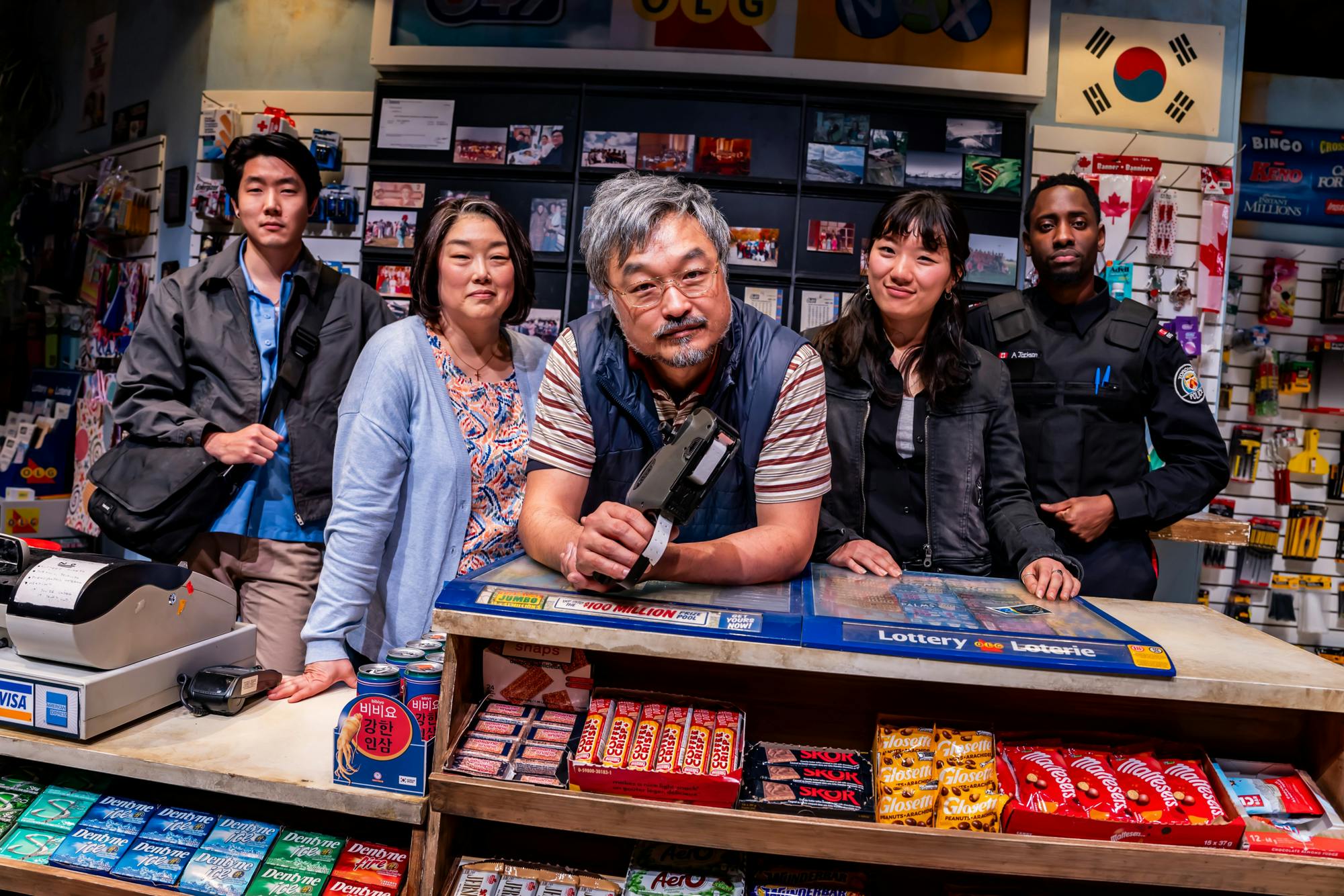
For fans of the TV sitcom “Kim’s Convenience,” the play delivers a sense of deja vu — it’s laugh-out-loud funny, brimming with witty banter and sharp humor. This play, which inspired the Netflix series, premiered in 2011 at the Toronto Fringe Festival. Playwright Ins Choi drew from his own experiences growing up in an immigrant Korean family in Canada. Adam Blanshay Productions presents the Soulpepper Theatre Company production in association with American Conservatory Theater, which runs at The Calderwood Pavilion from Nov. 6 to this Sunday.
Choi stars as the main character, Mr. Kim, or Appa (Korean for ‘dad’). Initially, Choi played Jung, the son, but now, as a father himself, he takes on the role of Appa. The narrative follows Appa as he runs a corner store in Toronto, navigating complex dynamics with his children, Janet and Jung. The story reflects the clash between his traditional Korean values and their liberal Canadian upbringing. Both children long for recognition and acceptance, while Appa seeks appreciation for the sacrifices he made to provide for them. Though centered around a Korean Canadian family, “Kim’s Convenience” resonates universally — it’s a story for kids who feel they’ve disappointed their parents and parents who feel unappreciated by their children, emphasizing the importance of family above all. As Kelly J. Seo, who plays Janet, put it, “It’s really a show you can watch with your family, your friends, anybody really. They can all resonate with a certain character or a situation that happens.”
Seo, also from Toronto and a first-generation Korean immigrant, strongly identifies with her character, Janet. “This is the first time I’ve seen my story on stage,” she said. Having played Janet for three years, she has truly found her own unique voice in this role.
This tour aims to present the story as more of a drama with humorous elements, compared to the comedic tilt it had in past tours. The blend of comedy and real-life drama is what makes “Kim’s Convenience” so genuine and heartwarming.
In one scene, despite Janet’s desire to pursue a career in photography, Appa insists she follow a more traditional path — ideally taking over the store — for stability. He views her photography ambitions as just a hobby and worries about her unmarried status. This tension provides comedic potential while also offering insight into Appa’s character as an immigrant parent. A particularly striking moment occurs when Appa, attempting to train Janet to run the store, poses the question “Steal or no steal?” after a Black man enters the store. Janet is appalled by her father’s overt racism, leading to a sequence where Appa outlines his absurd racial profiling logic. Appa says, “Brown guy, that’s steal. Brown girl, that’s no steal. Asian guy, that’s no steal. Asian girl, that’s steal. If you is the gay, that’s no steal. Easy. The gay is never steal.” He further goes on to describe what he calls a “cancel-out combo.” “White guys, white shoes, that’s a steal. Brown woman, blue jacket, that’s a no steal. But a lesbian — that’s a girl who is the gay — if she’s whistling, she’s a steal. But two lesbians? Surprise. No steal. Even if whistling. That’s a cancel-out combo.” Janet, playing into the insanity of it all, asks Appa about “a fat Asian gay man with long, straight hair, and a Black lesbian with a ponytail and cowboy boots, together steal or no steal?” Appa responds, saying that that scenario is impossible, since a “Gay Asian is never fat.” “Only skinny Asian is the gay. That’s rule. That’s how they doing like that.” The overt racial profiling and queer stereotypes could potentially go too far and undermine the show, however, their delivery is effortless and hilarious, leaving the entire audience gasping for air. Appa’s deadpan delivery and innocent charm strike the perfect balance.
Most of the play unfolds within the bodega, characterized by its pale blue walls, which are stocked with household products, snacks and beverages. The shop’s patrons enrich the play, all portrayed outstandingly by Brandon McKnight, who plays notable characters including the real estate agent Mr. Lee, “the Black man with the Asian last name,” as Appa jokingly remarks, and police officer Alex.
Tension mounts when Appa insists Janet call the cops, seeing a Honda parked outside, stemming from his ongoing resentment towards Japanese people. Alex’s arrival marks a pivotal moment as he is revealed to be Jung’s childhood best friend, serving as a reminder of the estranged father-son relationship. Jung, who left home as a teenager, has been estranged from his father, Appa, for over a decade, confiding only in his mother, Umma. Their conversations reveal his inner turmoil and yearning for reconciliation with Appa. A poignant scene occurs at their local Korean church, where Jung recalls cherished memories of singing with his family. At the same time, real estate agent Mr. Lee offers to purchase the corner store amid the neighborhood’s gentrification, Appa grapples with thoughts about his legacy and identity. Ultimately, he recognizes that his true legacy lies not in the store but in his children, having sacrificed his teaching career in Korea for their better future in Canada. On both ends, there is a longing for reconciliation.
The play highlights a transformative period for all characters. Janet stands up to her father regarding her passion for photography and falls in love with Alex, the police officer. At the same time, Jung reaches out to Appa and begins to rebuild his relationship with his father, and in the process, is offered the opportunity to take over the store. Umma, although having limited dialogue, plays a vital role behind the scenes, uniting the family and secretly meeting with Jung. This culmination of personal growth and reconciliation emphasizes the importance of family above all else, serving as a reminder to keep an open heart and leaving us feeling hopeful despite the complexities of family dynamics.