
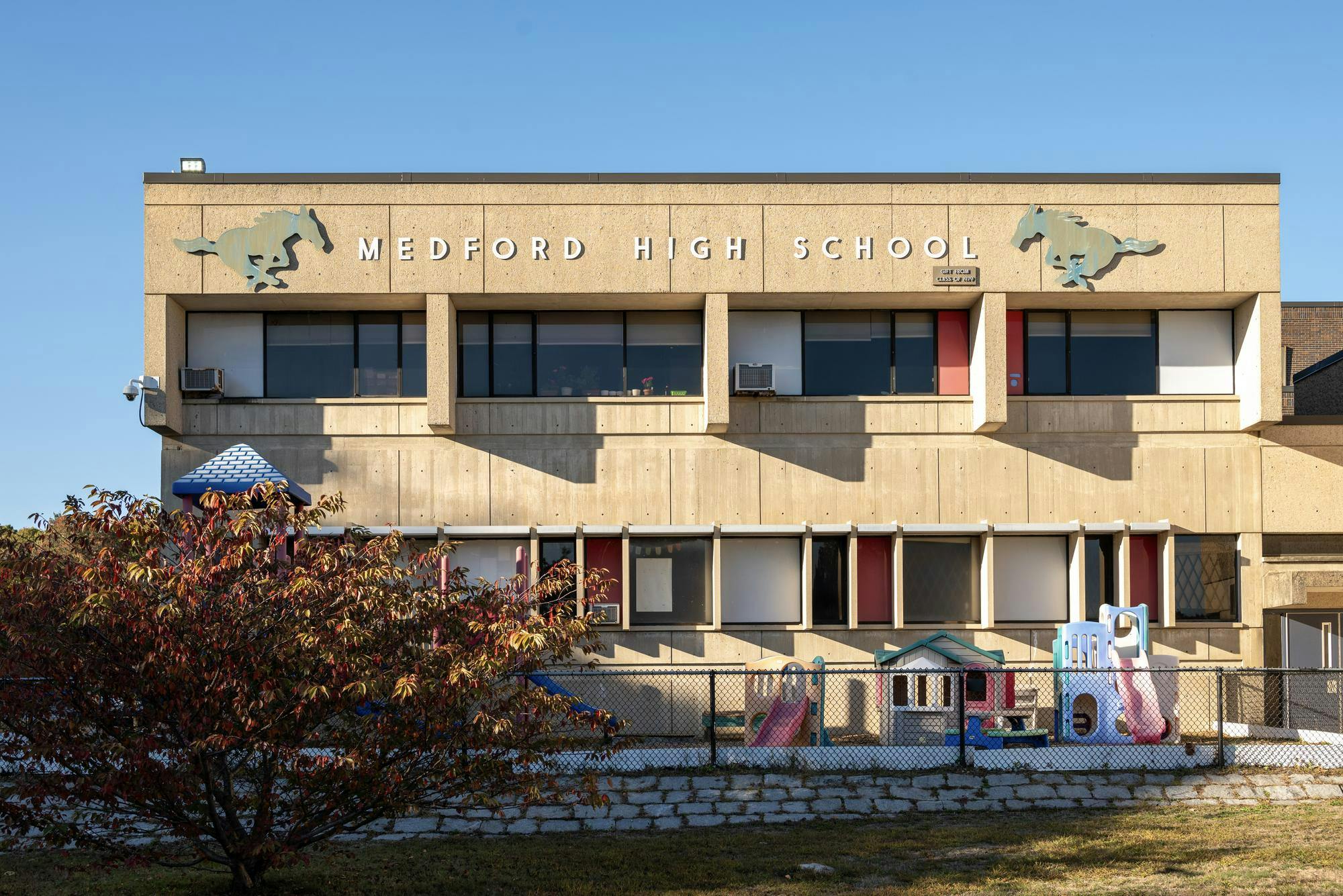
At a Medford School Committee meeting on Oct. 20, Interim Superintendent Dr. Suzanne Galusi presented her transition and entry findings report, highlighting the need for greater consistency — particularly regarding bureaucratic structures, greater coherence and a deeper sense of belonging across the district. Her findings emphasize the need for Medford Public Schools to strive for these goals as it navigates a leadership transition, facility needs and a major strategic planning process already underway.
“[‘Belonging’] is the district’s theme of this academic year,” Erika Reinfeld, a member of the Medford School Committee, wrote.
Medford School Committee member Aaron Olapade spoke about how Medford Public Schools can increase inclusion.
“Medford public school districts are just about 44% non white identifying when it comes to our student population, our teacher population, I think, is 3% non white identifying,” Olapade said. “Understanding that having a mirroring effect where there are teachers and there are professional staff at our schools that can understand the lived experience of students, like myself, is incredibly important.”
Olapade spoke about the importance of expanding a sense of belonging in Medford Public Schools.
“We want to create a sense of belonging for all students, regardless of their lived experience or their racial background, religious background, whatever it may be, because we understand that that is not a negative, it’s a positive,” he said.
To address these problems, Galusi conducted unstructured listening sessions within the community to learn about their needs. Galusi’s research centered around open conversations with those in the Medford public school district — her findings concluded that students were not being pushed academically.
While data shows that Medford roughly matches academic standards at the state level, Galusi believes that Medford should and can achieve more than that.
“Students looked like they were achieving, and their grades reflected such, but really they weren't meeting grade level standards, so teachers were lessening the rigor for them,” Galusi explained.
Another avenue of analysis on the standing of the schools comes from the Massachusetts Comprehensive Assessment System scores. MCAS scores are one indicator of student success and progress. They can be used to understand trends and patterns across the district and over time, and also as a comparison point for learning about how other districts have addressed challenges.
Olapade spoke of how students will likely take MCAS scores seriously, as the importance of both standardized testing — and testing in general — has been built into the education system. However, “a lot of the time [standardized testing] doesn’t actually prove that students are learning the content long term. It means that they’ve been able to prepare for short-term examinations, but not long-term retention of the content,” he said.
Implementing many of these important changes is now a much more achievable goal for the district due to an increased amount of funding from a variety of sources — such as the Every Student Succeeds Act (ESSA) grant, which, as Galusi explained, “drives a lot of our opportunity.” For this reason, various changes are being made as part of a broader agenda from the Medford School Committee, including lengthening the school day. This change can have a compounding effect that would lead to a larger amount of school hours per year for students.
“With the override funding we received in 2024 [we’ve] been able to extend the school day by about 15 minutes, which means that we’re going to have more student learning per class period,” Olapade said.
The Medford School Committee also faces the question of how to manage their operating budget and therefore how they decide to allocate their funds. Much of the work that they have to do is through the capital planning — which functions as maintenance for large infrastructure projects. Examples of such initiatives include an after-school program, which is self-sustaining due to a high number of parents directly paying for the service, which allows more enrichment and staff to be hired.
The school budget will be built off of conversations about the allocation of funding to these programs and with an emphasis on balance.
The school committee aims to start other initiatives, such as the recently created “Best Buddies program.” Increases in funding allow for the district to hire advisors for such programs, either by offering stipends to teachers or by hiring outside professionals.
Galusi believes that “it doesn’t matter if you’re in a kindergarten classroom or AP physics, the content might be different, but the spaces we’re creating for students to talk and struggle and learn should be the same.”



