In many ways, the artistic milieu that characterized 1970s New York is still being replicated today. Walk long enough around any neighborhood with hipsters, and you’re bound to find the likes of Patti Smith, Andy Warhol and Fran Leibowitz on a coffee shop table or bookstore display.
Perhaps overlooked in the modern era, though, is the legacy of the man who was there to document it all. That man is Peter Hujar, the portrait photographer who rubbed shoulders with anyone worth name-dropping in New York 50 years ago. His work has long been respected — particularly his celebrity portraiture, a repertoire which includes photos of Warhol, Susan Sontag and William S. Burroughs, among so many others — but recently Hujar’s legacy gained new life.
In 2015, Hujar’s picture “Orgasmic Man,” gained new prominence when it was chosen by author Hanya Yanagihara for the cover of her bestselling novel “A Little Life.” And in 2025, Hujar’s legacy has been revived in a wholly different way. Auteur Ira Sachs’ latest film, “Peter Hujar’s Day,” is a 75-minute cinematic portrait that documents a real conversation between Hujar and author Linda Rosenkrantz.
When Sachs, a fan of Hujar since he discovered his work after moving to New York City in 1991, stumbled upon a copy of Rosenkrantz’s transcript of the conversation (the original tape was lost) he knew immediately that there was an artistic project waiting to be unearthed.
“I think it’s a film about many things, but it’s also … about the process of making a portrait,” Sachs said in a post-screening Q&A at Harvard Square’s Brattle Theater, a movie house he’s been patronizing since 1982. “For me, that was as interesting as anything that was being said, or the relationship, which was just allowing myself as an artist to consider what is a cinematic portrait.”
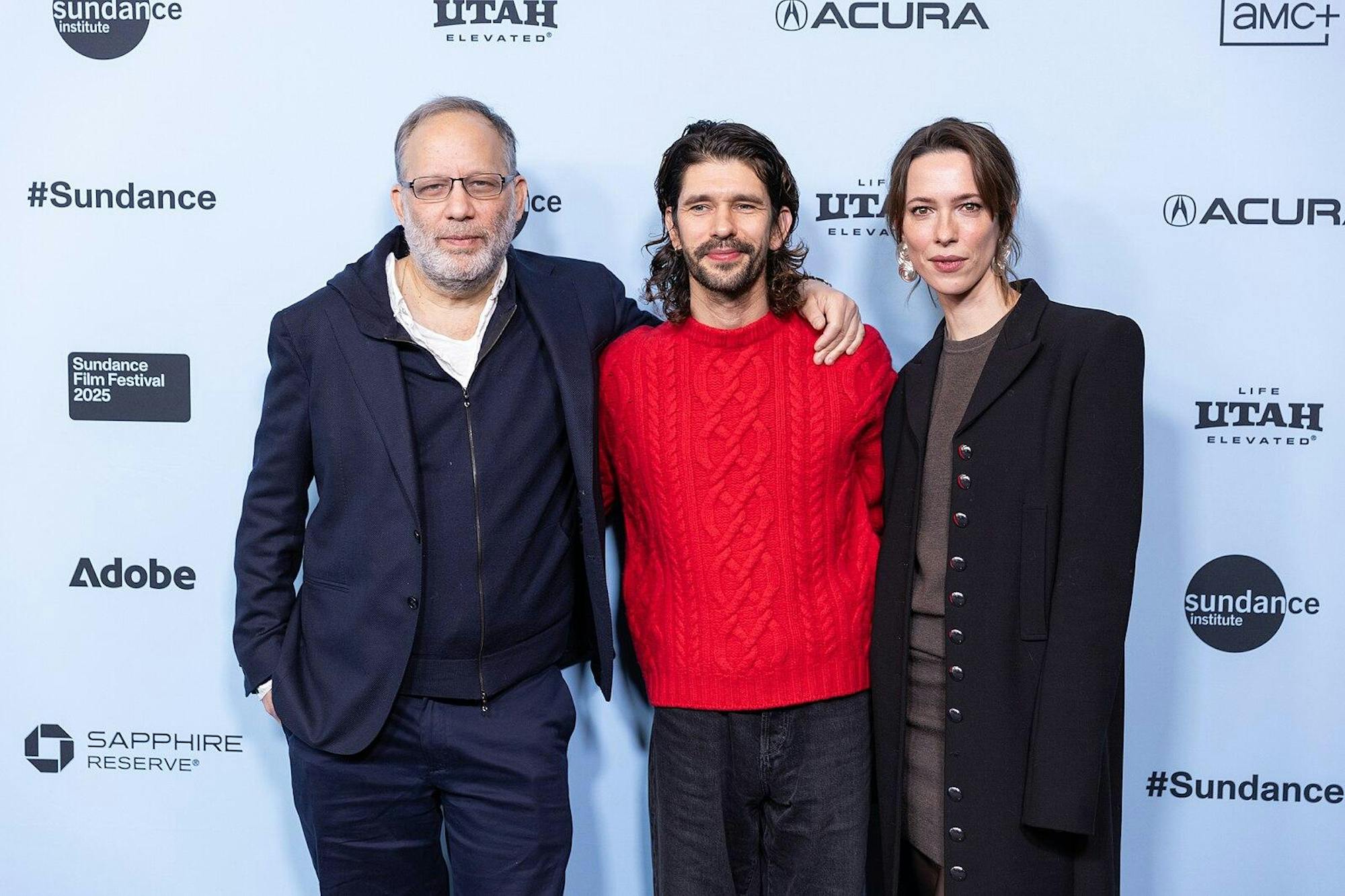
Ben Whishaw — whose last collaboration with Sachs saw him starring alongside Franz Rogowski and Adèle Exarchopoulos in “Passages” — is Hujar. Whishaw talks to Rosenkrantz — played by Rebecca Hall — throughout every stage of his day in a state of perpetual hyperactivity: often moving around, smoking like a chimney and explaining every detail with an almost impossible level of specificity. Despite being tasked with something like 95% of the script’s dialogue, Whishaw is resoundingly consistent; each facial tick is played to perfection, and every line is delivered at a uniquely alluring point on the continuum between pompous arrogance and charm.
Yet Sachs is aware that faithfully recreating an enigma like Hujar is an impossible task. There is no video footage of the artist, and the available audio is minimal. Beyond an interview with his partner David Wojnarowicz, the only other tape Whishaw could draw on was a recording of Hujar hypnotizing himself in an attempt to quit smoking.
“Somehow we created something which is not Peter, but sort of creates figments of Peter that the audience takes away,” Sachs concluded.
Sparse as Hall’s spoken lines may be, her presence balances the eccentricity of Whishaw’s Hujar. Each scene is a long take of the two interacting at a different location in Rosenkrantz’s apartment (though the real loft was on East 94th street, in Sachs’ version it’s a West Village studio courtesy of Westbeth Artists Housing, a New York nonprofit). Though largely silent throughout, Hall achieves an impressive level of intimacy and comfort in her interactions with Whishaw. No matter what Hujar is saying, she listens intently, and when a question is necessary to keep him going, she knows exactly what to ask. Rosenkrantz — now 91 and living in Santa Monica — recorded every line of Hall’s dialogue as a guide for her performance, but it’s clear that, like Whishaw, Hall very much made the character her own. It’s rare that two performers have such chemistry on screen, and it is the ease of their interactions that maintains the audience’s interest.
Though drawing heavily from real events — every line in the film was spoken, verbatim, by Hujar or Rosenkrantz — Sachs’ film is nonetheless far from narrative objectivity. There are hints of reflexivity throughout: The film starts — as did “Passages” — with a clapperboard, and later a boom pole hangs over the pair’s head as they engage in discussion. In these moments, Sachs inserts himself in a world where he could never be present — the world where one can mention that they interacted with Sontag, Allen Ginsberg and Burroughs in the space of a day.
Peter Hujar passed away from AIDS in 1987, 13 years after his interview with Rosenkrantz and four years before Sachs moved to New York to become immersed in the same artistic world Hujar helped cultivate. Like Sachs’ 2010 short “Last Address,” a film which silently documented the last residential addresses of New York artists who died from AIDS, “Peter Hujar’s Day” is an homage not only to a cultural community of days past but to the figures at its center.
In the end, these reflections on Hujar’s influence distill the film’s deeper purpose, offering one final insight into why this world still matters so profoundly. “[Hujar] was like an introduction to a world that I wanted to be a part of as a queer man, as an artist,” Sachs explained. “I still want to be a part of it because I’m always looking for ways to be strengthened in making work about things that are marginalized.”