
It was 6 p.m. on a Thursday in November, and I was heading to a hidden gem of Cambridge: the MIT Museum. Getting off the Red Line at Kendall/MIT, I was surrounded by darkness, but as soon as I walked through the doors to the museum’s After Dark Series event, I was met with a rush of light and excitement. A monthly adults-only program, After Dark lies at the intersection of art and science. Each month has a different theme, with past events ranging from artificial intelligence to rhythm, birds, oceans and beyond. This November’s session, “Sleep, Dream, Wake,” accompanied the launch of a new exhibition, “Lighten up! On Biology and Time,” which explores the connection between living organisms and cycles of light and darkness.
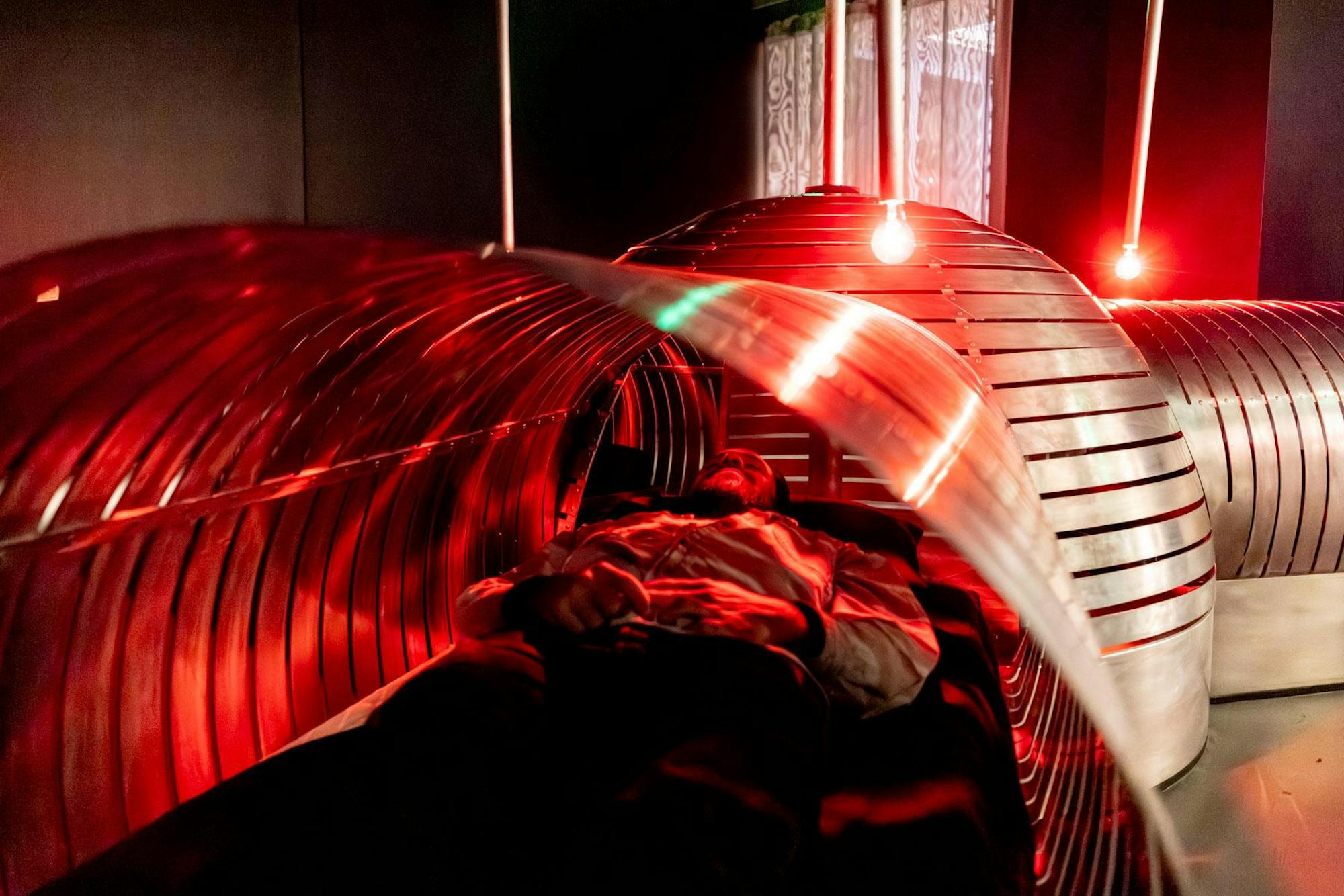
There was music and food, and as I entered, I saw a metal contraption that looked like it belonged in some distant future. In an interactive art piece called “Hotel Room #2: Communal Dreams,” three people at a time lie down in the apparatus while pulses of light, sound and motion guide them into a collective dream state.
Other art pieces included an installation titled “Light-Oriented Ontologies — The Beginnings” by Alan Bolgana. Bolgana uses a light-sensitive resin to create shapes that resemble something between crystals and microorganisms — an attempt to depict the earliest forms of life on Earth and the ways in which they were shaped by light.
As I continued through the exhibit, I saw two huge woven installations by Susan Morris. One of them, “SunDial:NightWatch_Sunshine,” is composed of three tapestries that document Morris’ exposure to light over the course of three years. The work visualizes the cyclical nature of our exposure to light and how it ebbs and flows with the seasons.
But the MIT Museum’s After Dark is more than just an art exhibition. Later in the evening, Dr. Charles A. Czeisler, a pioneer in sleep science and the Bardino Professor of Sleep Medicine at Harvard University, gave a lecture. When Czeisler began his research several decades ago, he focused on understanding the human internal clock — the circadian rhythm — and how it impacts sleep. What he did not consider initially was the profound impact this clock has on overall health. Since then, Czeisler has spent his career studying the connection between circadian rhythms and health and exploring ways to manipulate this internal clock. This internal clock is independent of light exposure — the cycle our body would revert to if we lived in complete darkness long-term.
Discussing data from one of his studies, Czeisler explained, “On average, women have an internal clock that cycles about six minutes shorter than that of men.” While this may seem insignificant, it has major implications — especially on Mars, where the length of a day is 24.6 hours. Even small discrepancies accumulate over time, causing internal clocks to drift further and further from what is healthy. For this reason, Czeisler has also researched methods of manipulating circadian rhythm. He demonstrated that bright light exposure at specific points in the day can “reset” someone’s circadian clock, a potential strategy for managing sleep patterns when humans go to Mars.
Czeisler also shared work demonstrating the effect of light on the circadian rhythms of blind people — work that faced pushback at the time. As it turns out, Czeisler and his team discovered that some people have specific photopigments sensitive to blue wavelengths. So even individuals who have lost all eyesight may still sense and respond to the presence or absence of light.
Following the talk, attendees engaged in cyanotype-making and played a mobile game designed by Dr. Olivia Walch, in which players try to control light exposure to synchronize a character’s circadian rhythm to their sleep schedule as quickly as possible.
From art and lectures to hands-on activities and refreshments, the MIT Museum’s After Dark series is a perfect way to engage with science in a nontraditional setting. Science becomes fun and accessible — not hidden behind complicated terminology or dense journal articles.
Sometimes college can make us fall out of love with science. Trust me, I get it — many late nights studying and endless assignments can wear anyone down. But After Dark gives students and researchers a chance to remember why they chose to pursue science. Beyond that, it offers everyone, scientist or not, a low barrier entry into the magical world of science. So fall back in love with science and catch the next After Dark — “Time Travel” — on Dec. 11 at 6 p.m. at the MIT Museum.



