
Believe it or not, Somerville was the first city in the United States to establish explicit legal protections for polyamorous and otherwise non-monogamous unions and families. Polyamory is also decidedly common in Somerville; in fact, Willie Burnley Jr., city councilor and recent mayoral candidate, is openly polyamorous and has advocated for said protections for polyamorous and non-monogamous unions.
Four polyamorous Somerville residents spoke to the Daily and 44 additional locals shared their thoughts on polyamory in Somerville through a survey.
Michael, a software engineer, has been polyamorous since 2015. For them, polyamory has always felt somewhat natural.
“It’s something that feels pretty intrinsic to me, and I don't think that I’d be able to do relationships any other way,” they said. “Orientation is the wrong word, but it’s the best one I’ve got.”
JB Segal has been polyamorous for the better part of two decades and also feels that polyamory, for him, is deep-seated.
“It has always seemed pretty innate. I first became aware of this tendency in my teens,” he said.
Cameron, another Somerville resident, finds that perspectives around polyamory have shifted; rather than being strictly identity-based, he finds polyamory can now be considered more of a practice or choice.
“A lot of earlier poly literature from when I was first exploring [polyamory] would say that people are hardwired to be polyamorous or monogamous,” he said. “Since then, the discourse has evolved into it being something that you can proactively choose as a value. … It can just be important to you not to restrict other people’s behavior. And that’s different from it being something that’s inherent to you.”
Cameron discovered polyamory after talking about it with a friend, finding it aligned with his lifestyle preferences and values.
“I heard about polyamory from a friend of mine I met at college who was polyamorous, and I immediately felt kind of defensive and threatened by that. [But] then as I got to know her and talked about it more, it started to really resonate with my own value set,” Cameron said.
Another local, K, has always felt polyamorous, though they didn’t understand polyamory at the beginning.
“I didn’t know what [polyamory] was,” they said. “[It] was just what we did, and we were gothy, anime dweebs. … It just made sense to be a kind of counter culture.”
Before they settled into a polyamorous lifestyle, K’s desire to have multiple relationships ended many of their past unions.
“I [cheated] on people that I felt really bad about, but … I [couldn’t] seem to not want [it],” they said. “[If] I had the language, maybe I could have said, ‘I want to do this with somebody else, and it has nothing to do with you.’”
A significant amount of overlap exists between the polyamorous community and the LGBTQ+ community. Out of the 21 polyamorous survey respondents, only three do not identify as LGBTQ+.
K mentioned that embracing polyamory felt like a byproduct of shedding other societal norms.
“I think [being polyamorous] came hand in hand with queerness [and] being nonbinary,” they said. “Once you shed one societal thing, all of them cascade away.”
Cameron agreed with this overlap and added that polyamorous people often belong to various other artistic groups.
“The queer community has a lot of polyamorous people, various artistic communities, people who play [Dungeons and Dragons] and do [live action role-playing] and stuff. There’s a lot of overlap between all these groups,” he said.
Segal also feels that many fandom and artistic communities skew polyamorous.
“Everyone I’ve been involved with in the past many years I met via the science fiction fandom community, where there’s also an overlap with the kink community,” he said.
Somerville’s policy surrounding polyamory has made it possible for polyamorous people to enter domestic partnerships with more than one person or to share things like insurance and homeownership. This quality makes Somerville an appealing place to live for polyamorous people; two survey respondents said that they moved to Somerville because of its policy surrounding polyamory and non-monogamous unions.
K recently welcomed a child with both of their partners and cited difficulty in including both partners on all of said child’s paperwork. K and their child’s biological parent are the default parents on all documentation, but they have to work to include the third parent in all things legal.
“It’s just death by bureaucracy,” K said.
They’ve been able to make it work, though, and share parenting duties between all three caregivers. And, by virtue of living in Somerville, a lot of this documentation has been made easier.
In fact, K recently entered a formal domestic partnership with their child’s biological parent. Though they only intended to enter a domestic partnership with one of their partners, the form presented to them in this effort featured enough lines for multiple partners.
“It was like, … ‘These below people shall enter henceforth into domestic partnership’: line, line, line, line, line,” K said, with each of the lines reflecting a member of this domestic partnership. “We have governmental support. That’s so mind boggling. … There is a room for us. We have a form, for God’s sake. It’s a form for me!”
Michael also cited Somerville’s policy as impactful to their life, mentioning a desire to share benefits. Local policy only stretches so far, though, and Michael discussed their internal conflict about deciding who in their life would benefit more from marriage.
“The people that I’m seeing are embroiled in a little bit of discussion because there’s potential for me to get married at some point for legal reasons with one or legal reasons with another,” they said.
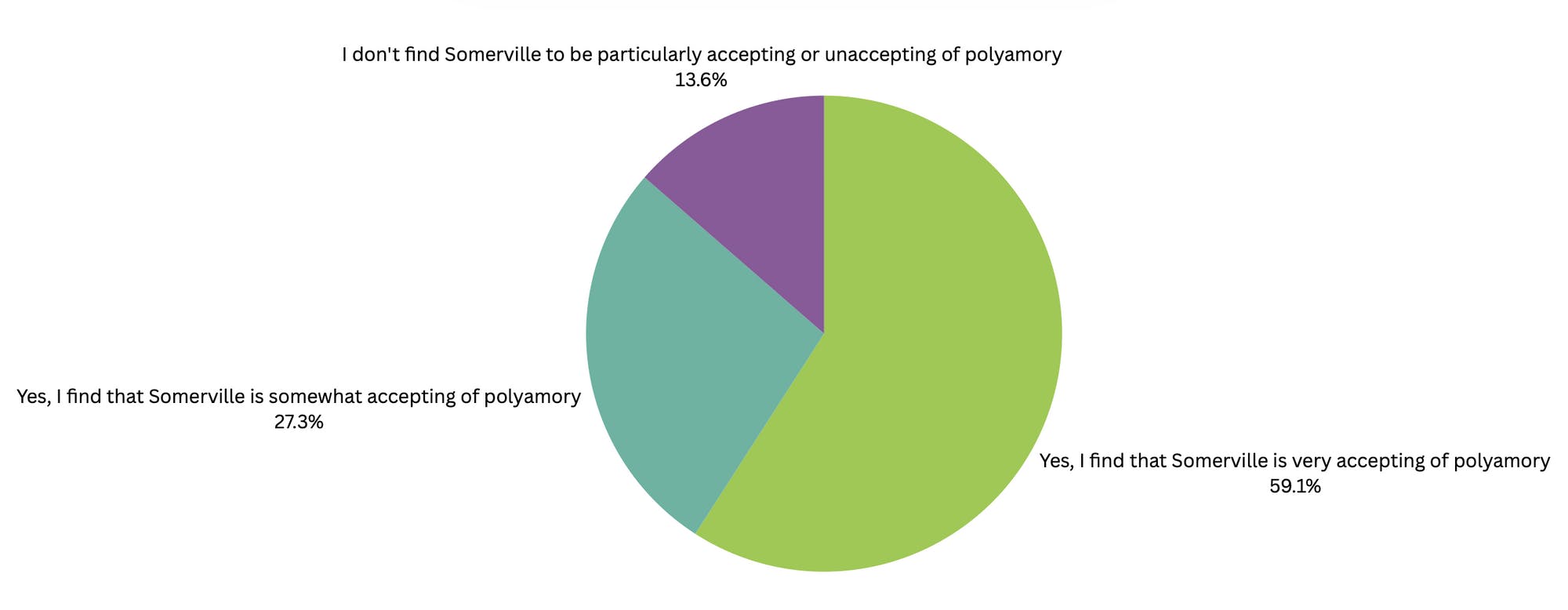
Above and beyond legal protections, local culture contributes a lot to the ability of polyamorous to thrive. 59.1% of survey respondents find Somerville very accepting of polyamory and non-monogamous unions and an additional 27.3% find Somerville somewhat accepting.
Cameron mentioned that he generally feels comfortable sharing their polyamory with the people they meet, depending on the context.
“In most settings, when I meet strangers, if [being polyamorous] comes up like, I tend to say, ‘Oh, one of my partners does XYZ,’ … because I want to be truthful and and also I want people to be aware that sometimes people have multiple partners,” he said. “If it’s a situation with an employer, I might withhold that information for a while, maybe the whole time.”
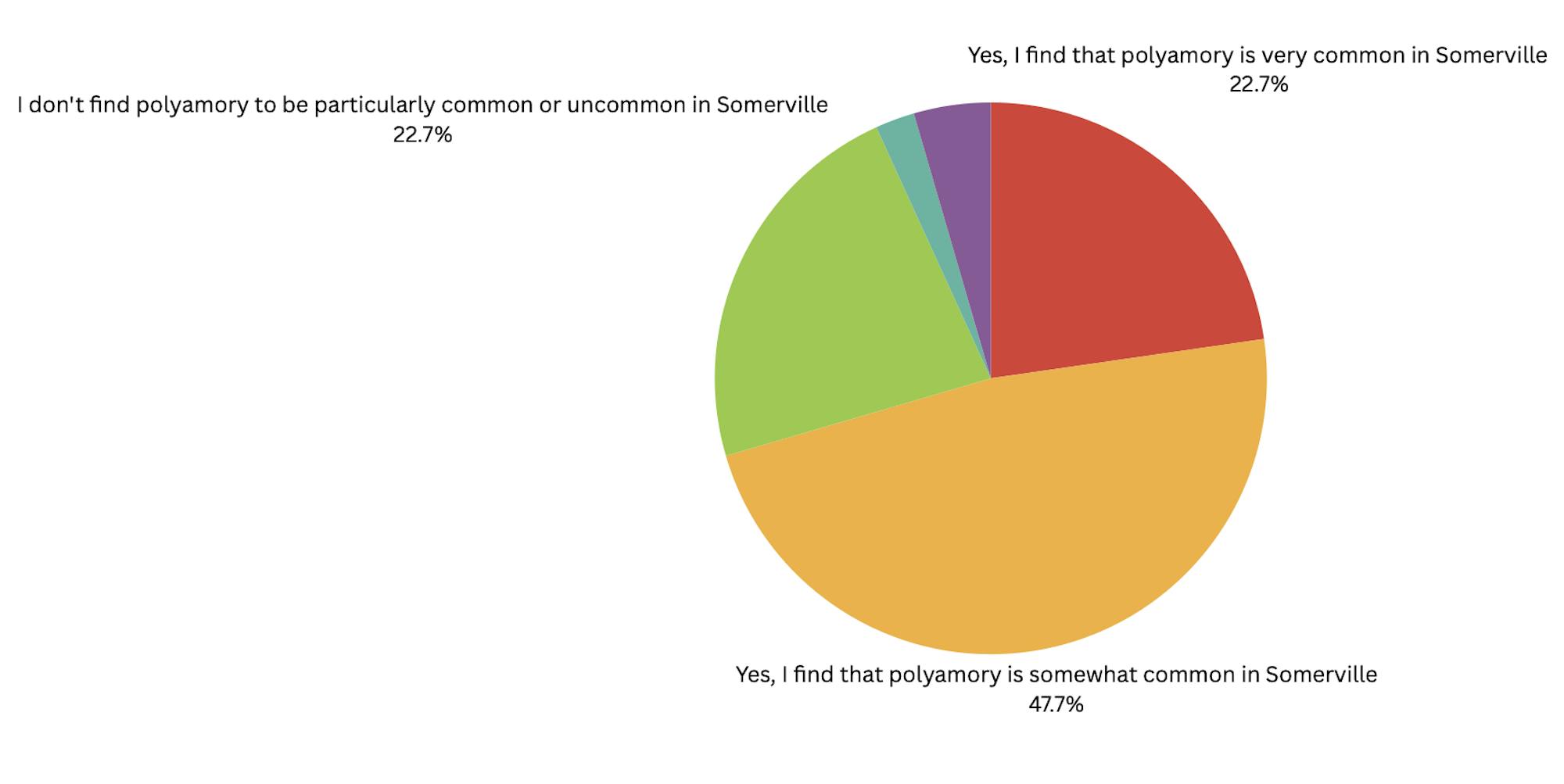
70.4% of survey respondents find polyamory to be very or somewhat common in Somerville, and Michael and Cameron noted that it doesn’t feel like a particularly unusual identity here.
“At least in my age range, [for] the people I’m around all the time, [polyamory] feels like a potential default in a way that it doesn’t in other places,” Michael said.
“You can encounter polyamorous people pretty much wherever, and you may or may not know, unless it comes up in conversation, but there, there’s just a high likelihood that they might be polyamorous,” Cameron said.
In addition to being polyamory-friendly, many cite Somerville’s LGBTQ+-forward culture as contributing to their desire to live there.
“Knowing that there is a high density of polyamorous and also a lot of LGBTQ+ people — that was attractive to me because it just felt like a place where I could be myself,” Cameron said.
Polyamory is so common and interconnected in Somerville that some people joke about (or even believe in) the existence of a city-wide polycule.
“There’s a joke that there’s a greater Somerville polycule. Everybody has had sex with one person that is connected to the greater mass. I don’t know if that’s true, but I think it’s true,” K said.
Segal even attempted to map out the Somerville polycule.
“Because I’m enough of a geek, … I started mapping out the polycule to which I am connected.” He didn’t find a city-wide polycule, but mentioned that an immunologist he’s connected to might be displeased at the number of connections he found.
For the interviewees, polyamory benefits their lifestyle in a number of ways.
“We’re never lonely,” K said. “We really don’t get sick of each other, because we’re always spending time with different people. … I find it much more refreshing than being monogamous in that way.”
K also added that having multiple partners has been “fantastic” in raising their child.
Segal offered a metaphor for those who struggle to understand polyamory; he suggested that loving multiple partners is no different than a parent loving multiple children.
Cameron said that, on an emotional level, having multiple partners is beneficial.
“If you have multiple people that you’re close to in your life, then you’re not dependent on one person to get your emotional needs met,” he said.
Michael said that polyamory will probably always be part of their life.
“Some people I know are planning to eventually settle in with one partner and maybe leave it open but not actively poly at that point. It really depends,” Michael said. “I don’t see a reason to go monogamous at some point. This is working.”
Michael also mentioned that polyamory, ultimately, should not be as big of a deal as people make it out to be.
“[Polyamory is] just a thing that people do. People are happy doing it,” they said. “There’s a lot of fear mongering and s---, but people are gonna date and love and have sex, and [it] just [is] what it is.”



