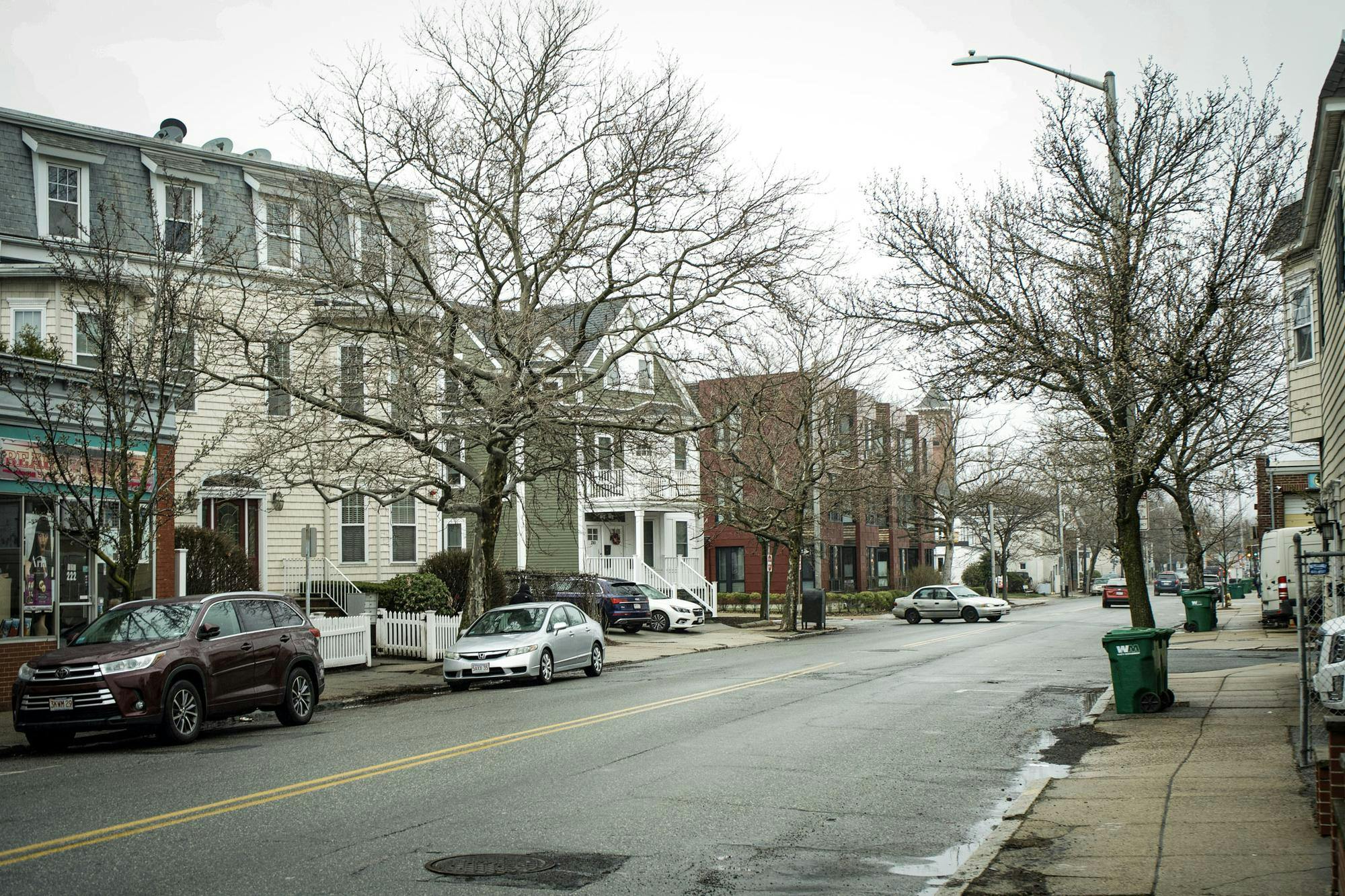
The Medford City Council again postponed a final decision on a proposed amendment to the city’s rezoning plan regarding the intersection of Salem and Park Streets in its Tuesday meeting. The amendment, supported by Mayor Breanna Lungo-Koehn, would reclassify the area as lower-density MX-1 rather than the current MX-2 designation.
Areas zoned as MX-2 allow buildings up to four stories by right or up to six with incentivized zoning, whereas MX-1 limits construction to three stories, or four with incentives.
In July, Lungo-Koehn indicated she would extend the city’s contract with zoning consultant Innes Associates only if the MX-2 designation were revisited. She then asked the council in September to start the amendment process.
The council previously postponed the vote on the amendment during the Nov. 12 city council meeting to give the mayor more time to present a public proposal for how the zoning project would proceed.
At Tuesday’s meeting, several councilors suggested that the mayor had not provided such a plan and criticized her intervention on the issue altogether, likening it to a “quid pro quo.”
After Nina Nazarian, the mayor’s chief of staff, read aloud an email to councilors detailing the mayor’s commitments to advance the zoning process if the amendment is passed, Councilor Emily Lazzaro questioned why the document couldn’t be made public for residents.
“If you could read it in a public meeting, why could the mayor not release it from her office?” Lazzaro said. “That’s what we asked for, she didn’t do it.”
Councilor Anna Callahan argued that the council should not move forward with the reconsideration at all, and that the mayor should not be directing zoning decisions. She said the responsibility falls on the City Council.
“What is happening right now is the mayor has decided that if we do not do what she has decided she thinks should be done in zoning, which is not her purview, she will hold up the entire zoning process,” Callahan said in the meeting.
By designating the intersection as MX-2 in March, the City Council went against one of 12 recommendations made by the Community Development Board, which suggested a MX-1 designation.
City Councilor Matt Leming said in an interview that the effort to upzone the intersection was just a small component of the city’s larger rezoning plan.
“[It was] the only time that City Council rejected any recommendation by the Community Development Board in the entire rezoning process thus far,” he said. “For some people, it was just something to point to that they could use to oppose the entire rezoning process.”
The debate over the intersection largely focuses on community concerns about last year’s attempt by Habit Opco, a substance abuse treatment provider, to open a methadone clinic — a proposal that was withdrawn after strong opposition.
Both proponents and critics continue to debate whether a clinic would be permitted to open under MX-2’s definition of a “neighborhood medical office.” All medical offices and clinics would be prohibited under MX-1.
Nick Giurleo, a Medford resident and former City Council candidate, claimed that MX-2 allows neighborhood medical offices by special permit, a use which is prohibited under MX-1.
“The definition of ‘neighborhood medical office’ is likely broad enough to encompass a methadone clinic. This is why people, including me, have been saying that a methadone clinic is possible under MX-2,” he wrote in a message to the Daily.
Leming dismissed the likelihood of that outcome, stating that any sort of clinic in areas zoned as MX-2 would be required to meet multiple other standards, including staffing numbers.
“There’s not any [real] possibility that any drug treatment center will open up there,” he said.
Leming added that the mayor has put undue pressure on the council and delayed progress on the years-long zoning project.
“This was something that the council was talking about in March 2025, and then it was November 2025 and the council is still talking about the exact same thing,” Leming said. “I don’t think it’s a healthy way to go about a process like this, and I don’t think that we should show that we’re particularly supportive of this way of doing business.”
Leming also criticized the mayor’s lack of direct communication with councilors, adding that he only learned of her “ultimatum” through a press release.
“That sort of communication to me is just deeply frustrating,” Leming said.