
Many of those who settled into the red-cushioned seats at their go-to movie theaters in 2022, armed with buttered popcorn or slushies, would have been met with an ad for the U.S. Air Force between movie trailers for upcoming blockbusters. In came the droning of a fighter jet and a cinematic shot of it swooping around mountaintops and through arid plains spotted with cacti. The advertisement barely shows any faces under the helmets, possibly to encourage viewers to imagine themselves in the cockpit. The command to “aim high” lingers on the screen at the end of the ad, followed by the URL of the Air Force website.
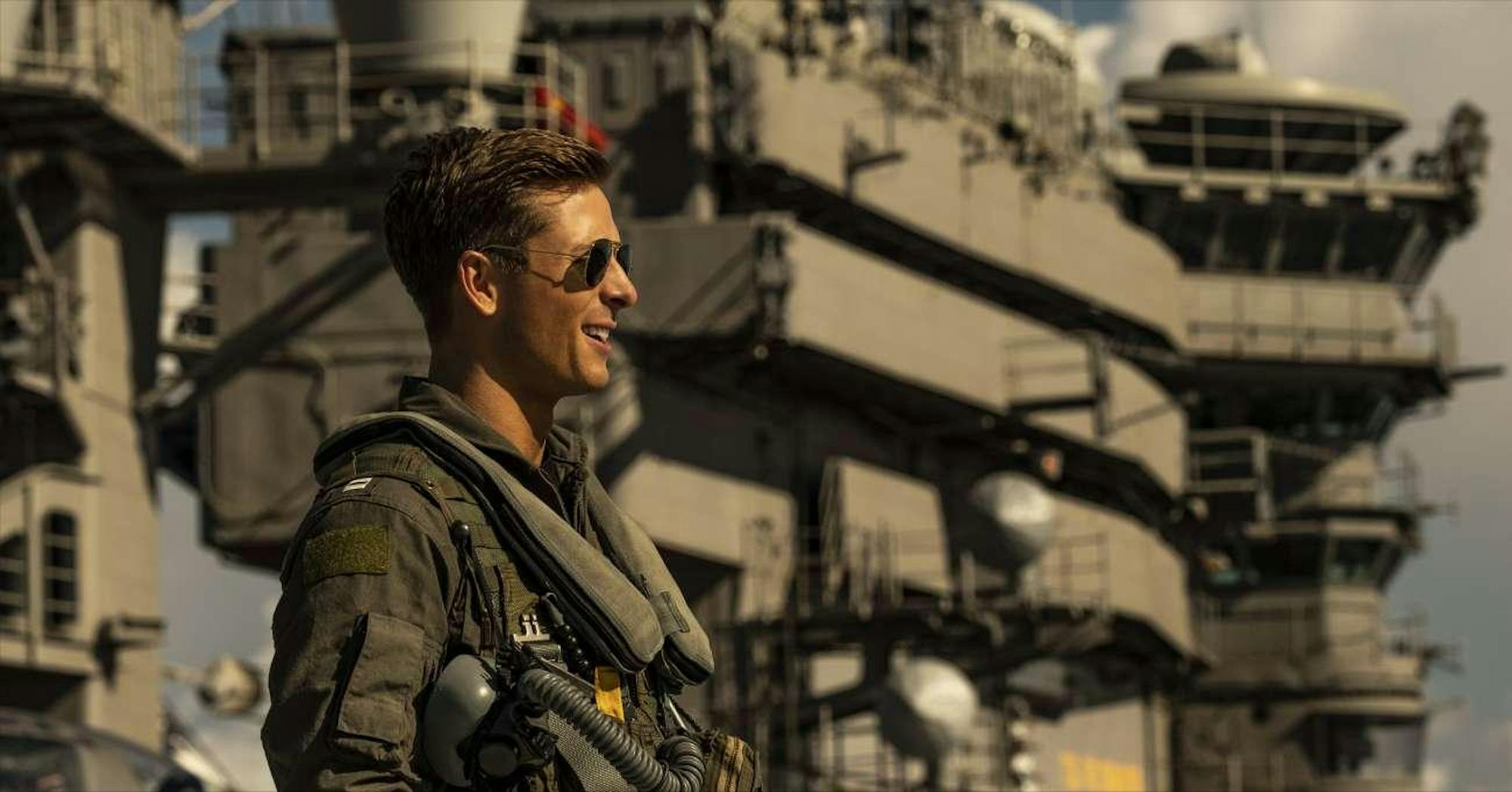
The recruitment advertisement played in theaters at the same time as “Top Gun: Maverick,” the sequel to one of the most successful military movies in American cinematic history. “Top Gun: Maverick” lived up to its predecessor’s success, making nearly $1.5 billion in the box office worldwide and securing its place as the highest-grossing film of Tom Cruise’s career.
The franchise belongs to a broader genre that is the male version of the ‘chick flick,’ or as journalist Gloria Steinem called it: the “prick flick.” These movies tend to glorify violence, specifically in the context of a war, and are a Hollywood staple. Other examples include “Saving Private Ryan,” “Captain America: Civil War” or “Fire Birds” — as well as virtually any Tom Cruise movie.
It’s no surprise that Hollywood produces hundreds of war movies, especially considering how many Americans have served and fought over the generations; the depicted events are pertinent to many citizens. What distinguishes “Top Gun” from the rest is its close work with the Pentagon as a recruiting tool.
The U.S. Department of Defense has a Community Engagement Office which, according to the website, “supports studios and production companies in the production of scripted and unscripted films, television shows, and video games.” In the case of “Top Gun: Maverick,” they exchanged use of their F-18 aircrafts and other military gear for artistic and script control. The original “Top Gun” was also “intimately guided” by the U.S. Navy, according to Roger Stahl at the Los Angeles Times. After further research, researchers involved with the LA Times unearthed documents proving the Department of Defense’s direct control of over 2,500 American movies and TV shows.
Unsurprisingly, many are unhappy with the editorial presence of the U.S. military and the entertainment industry’s apparent operation as its propaganda machine. The most exciting (or upsetting) part is that it works. Over the course of the year following the original release of “Top Gun”, military recruitment rates increased by 500%.
Not only did “Top Gun” present a glamorized version of service in the American military, but it sometimes presented a false one. In the franchise, there exist trophies and pilot rankings, which were completely fabricated and served to aid the triumphant arc of the story, making the military look much more appealing. In fact, the movie is so overtly supportive of the American military that future “Full Metal Jacket” star Matthew Modine declined the role of Maverick because of his pacifist views, believing that it would serve as a massive tool of recruitment.
So the franchise’s role as a tool of recruitment and close involvement with the Pentagon is no secret, but the question its existence poses is a crucial one: What happens when we mix entertainment and military recruitment?
The “Top Gun” franchise is operating within the military-entertainment complex, which is a term that essentially summarizes the economic and creative role of the Department of Defense in entertainment production. The complex makes it so that portraying the U.S. military in a positive light is a financial decision, essentially rigging the field so that moviemakers are inclined to make pro-American war films. This is, of course, not limited to just film and television; “Call of Duty” is an excellent example of the complex’s presence in the video game industry.
When parents complain that video games make their children more inclined toward violence, it may not be a complete exaggeration, since these entertainment forces have historically boosted military recruitment.
While the military-entertainment complex and franchises like “Top Gun” are undeniable successes in terms of recruitment rates, it may be worth considering their impact. What does it mean to bombard viewers with Air Force ads in a relaxed, virtual entertainment setting — where all violence appears on screen, many moons away from the viewer? What messages of heroism and sacrifice do we send to children, especially young boys? The truth is that — for better or for worse — joining the Navy or the Air Force will not transform you into Tom Cruise.
The most famous line of the original movie, now a cultural touchstone, is Maverick’s statement that he “feel[s] the need … the need for speed.” Maybe we should be asking ourselves whether that ‘speed’ is dangerous, and who exactly is telling viewers that they ‘need’ it.



