
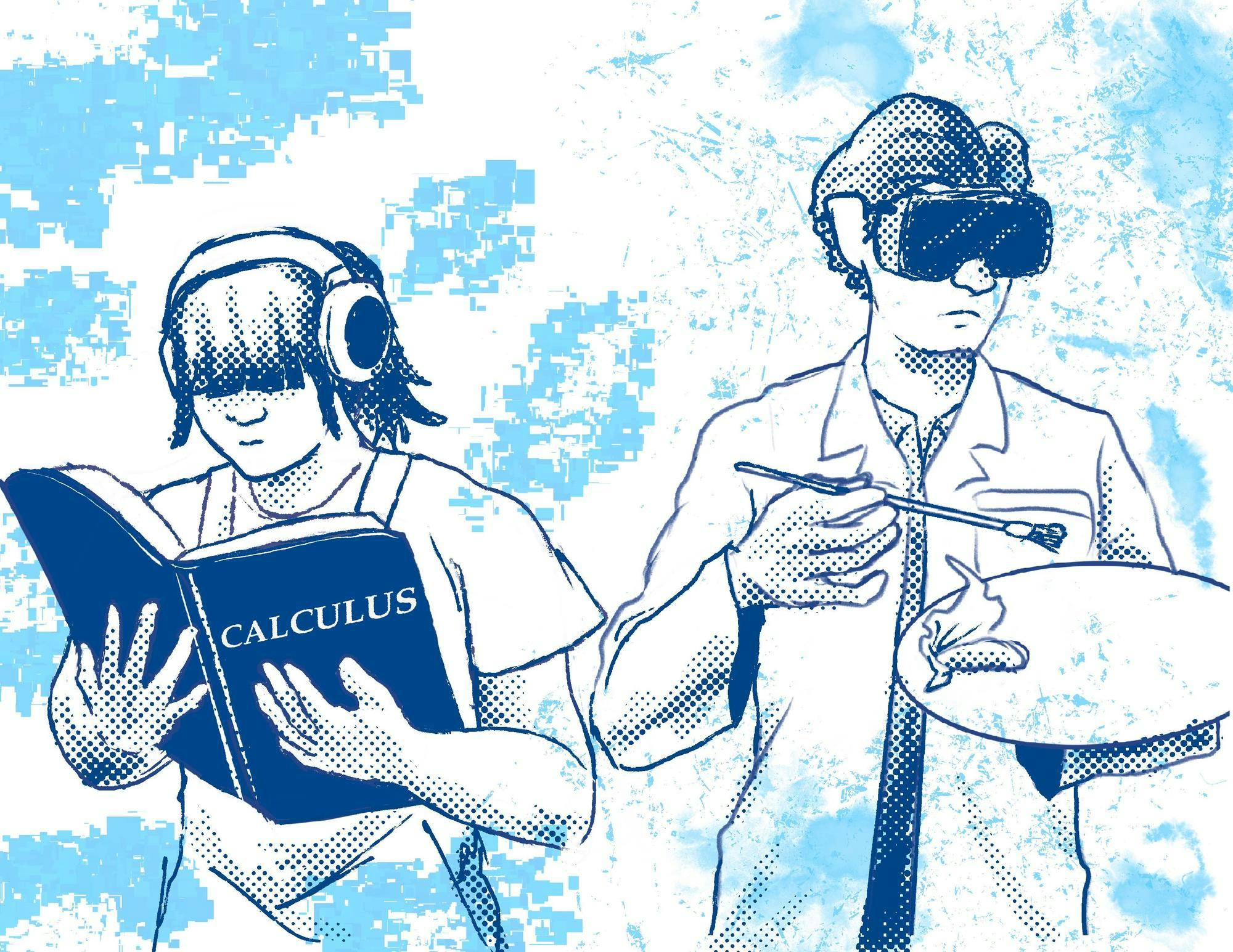
Distribution requirements are a core part of the Tufts liberal arts curriculum. While fulfilling them may feel like a burden for students, the university offers courses specifically tailored for humanities majors who need to fulfill natural science or mathematics requirements, and STEM majors who need to complete their humanities or arts requirements.
Senior Laëtitia Maybank believes that distribution courses catered to non-majors end up being invaluable.
“If you’re going to require us to have to do a distribution requirement, I don’t like that the courses are easy or that they’re jokes,” Maybank said. “If you’re going to force me to take a course, I want to get something out of it.”
Maybank, majoring in classics and political science, is taking a math course called “Symmetry” this semester. This course was designed by the late Tufts Professor Marty Guterman, who was a beloved member of the math department from 1966 until 2003. He intended for the course to be for non-math majors looking for a way to fulfill their requirement without applied math.
“The symmetry class was his life’s greatest work. It was to make math accessible to people that don’t do math,” Maybank said.
While a math course may initially seem irrelevant for someone studying classics, after starting the class, Maybank attests that what she is learning in “Symmetry” is not so different from her own major.
“I translate a lot of Latin and ancient Greek. Fundamentally, that is a puzzle that I need to solve [in] the same way [I figure] out at a rosette or a symmetry group,” she said. “It’s very similar thinking.”
Being in a community where students are pushed to take classes in other departments besides their own allows Tufts students to meet peers from drastically different disciplines.
“A bunch of my friends are pure math people … and two of them are in the graduate level group theory class,” Maybank said. “It’s been fun because I’m able to talk to them with a degree of knowledge about the things that [they] are doing in the sense that I am able to understand what a coset is, what a generator is, what a finite set is.”
Professor Linda Garant, who’s currently teaching “Symmetry,” shares a similar passion as the course’s original creator, explaining that she tries to cultivate a sense of excitement for math among her humanities students.
“I’d like [my students], if they don’t already feel this way, to understand that math can be really interesting and fun,” Garant said.
She claims that the type of thinking she encourages in “Symmetry” is actually quite similar to the critical thinking skills propagated in humanities courses.
“It teaches you a lot of rigor in your thought, how to be very precise in what you express,” Garant said.
In addition to “Symmetry,” Garant also teaches “Math of Social Choice,” another course created by Guterman tailored to non-majors. Students who have taken either of these classes have often emailed her months and even years later, sharing how their experiences of taking a math class to fulfill a requirement ended up opening their eyes to seeing mathematical patterns in their everyday lives.
“I’ve definitely had students email me later with a picture saying, ‘Isn’t this a symmetry pattern?’ … Or to say, ‘Now, even when I’m driving down the street, I look at the side of a truck [and] I think about a symmetry pattern,” Garant said.
In “Math of Social Choice,” Garant spends a significant amount of time on voting, and exploring how to collect people’s preferences and use them to make a decision. In fact, one of her students who went into politics post-grad messaged her to talk about how material from her class — a class initially taken just to satisfy a requirement — ended up being extremely applicable and relevant to his career working on a local campaign in Maine.
“He was pretty sure that if a different voting method had been used, his candidate would have won,” she said.
Taking “Symmetry” and “Math of Social Choice” helps Garant’s students to visualise and contextualize the math that surrounds them in everyday situations. It reveals that the divide between subject areas created by the distribution requirements may be inherently fluid.
On the other side of things, engineering students like senior Bipro Dhar, a biomedical engineering major, are required to take humanities classes in order to fulfill their humanities, arts and social science distribution requirement.
Dhar had the opportunity to take more elementary-level courses to fulfill his HASS requirements, but chose to take the English course “Of Monsters and Microscopes” because he was intrigued by Professor Jess Keiser’s teaching style.
“I decided to get some recommendations from friends, and they told me about Professor Keiser and how great he is as an English professor,” Dhar said. “I decided to take his class, and it was really fun. … I [loved] the participation aspect because in English [courses], you can think more and be more analytical.”
Upon taking the course, he soon discovered that he was learning useful skills he could apply to his senior capstone project as part of the engineering program.
“Right now, there are BME classes where it’s a lot of writing,” Dhar said. “[In] a certain class called BME 0006, which is “Scientific Reading, Writing and Presentations,” [we] have to write a 20-page paper. … Taking “Of Microscopes and Monsters” … really helped me hone in my skills on how to write analytical texts.”
When asked if he supports the HASS requirement, Dhar responded positively.
“Engineers should take more English classes, and I think it should be a requirement,” Dhar said. “I know we have [First-Year Writing] that’s required for engineers, but I know you can place out of it with AP credits, [and] I think more people should take English classes.”
Garant attests to this by claiming the importance of getting a well-rounded education in a liberal arts university.
“A degree at Tufts is not job training, it’s a degree about thinking deeply,” Garant said.
There is a lot that students from all backgrounds can get out of and are getting out of the distribution requirements. When approached with an open mind, the line between taking a non-major class just to fulfill a requirement and taking a class to add depth to your respective career path can be blurred. The distribution requirements can allow students at Tufts to expand their line of thinking down unconventional paths and emerge with a college degree that has brought them more than what it says on their diploma.



