With the holidays approaching, I find myself bracing for accusations of being the ‘woke’ sibling — the one who has been influenced, if not wholly indoctrinated, by the radical ways of his liberal arts college. In all honesty, this may not be far from the truth. But rather than being radicalized by some higher-education agenda, I’ve merely found myself among peers having conversations that reflect political awareness, intelligence and urgency. This bloc embodies a hunger for institutional change and a willingness to actually take action that, I would argue, form the bedrock of our ‘American experiment.’
This voting bloc, which consists of an election-swaying combination of political awareness and social mobilization — to say nothing of the fact that it almost exclusively contains first-time voters — has long been valued by political candidates. And yet, I, along with every student I spoke with, can’t ignore the tangible disconnect between our ideas, values and agendas and those of the policymakers governing our lives.
With the future of our democracy at risk, Gen Z college voters — like us at Tufts — are a crucial group for a candidate to win over. We are a demographic with distinct voices and priorities.
And to put it bluntly: Gen Z is impatient. I am referring here to a sense of political impatience with the status quo. As Kamala Harris recently put it: “[Members of Gen Z have] only known the climate crisis; they missed substantial parts of their education because of the pandemic. … It is very likely that whatever they’ve chosen as their major for study may not result in an affordable wage. … [Gen Z is] rightly impatient with … the tradition of leadership right now.”
The question, then, is whether current politicians have successfully engaged this hyper-political, essential, ‘impatient’ bloc of voters.
To answer that, one must first understand the issues that live in the heart of this voting bloc. Most emphatically, college-aged voters are simply looking for ‘action’ — for results. Our leaders are widely perceived as stagnant or misguided in their actions.
Avery Ohliger, a sophomore studying history, political science and ancient world studies, hails from rural Pennsylvania. He described watching a representative from his district who — after running on an anti-congressional stock trading platform — turned around to become an “egregious” participant in it.
“He lied to his entire constituency,” Ohliger explained.
Having been shaped by such experiences, Ohliger expressed disillusionment with politicians’ empty promises. “[Politicians] need to follow through on their promises,” he expressed. “One of the biggest issues is holding the people that we elect into office accountable.”
Lydia Du, a sophomore biology major and political science minor from New York City who plans to attend medical school, echoed that frustration. She said her interest in courses such as “Introduction To American Politics” has helped her track what she called “the erosion of democracy.” Du echoed Ohliger’s sentiment — emphasizing her exhaustion with our current political leaders’ priorities.
“I feel like we talk about the economy all the time, and I get how it relates to affordability, but I could not care less about the stock prices,” she said with a frustrated laugh. “None of us can afford stocks right now. We’re worried about paying rent next month, [we’re] worried about the price of gas, the price of groceries — and then they’re talking about how all the AI companies are doing. I don’t care. I do not care at all.”
Du described becoming politically roused by the insurrection on Jan. 6, 2021, and the blatant desecration of the dignity of American politics. “Growing up in the U.S., there’s a pledge of allegiance every morning. Everyone knows that when the national anthem is playing at sports games, you’re supposed to be silent and reverent. So in my head, … places like the White House [and] the Capitol [felt] almost sacred.”
She continued: “Seeing a place that is such a pillar of your life … under siege like that was just so unfathomable.” College-aged voters like Du are tired of the lack of dignity and respect being shown toward both themselves and their country. “How did this happen?” she asked. “How did we end up here?”
From Ohliger’s perspective, the heart of the problem is political extremism and polarization — “[a] more extreme kind of politics.”
“We’re really in a problem where we get hung up on these political points where we’re going to … divide one side or the other,” he said. “[We will] not really actually come together on anything.”
Du concurred. “[Politics is] a lot, and it’s very divisive, especially [along] the party divide.” Du even described how the alarming state of modern politics has compelled the people around her to pay closer attention. “They’re like, ‘Wow, things are so bad. I need to go find out what is happening,’” she said.
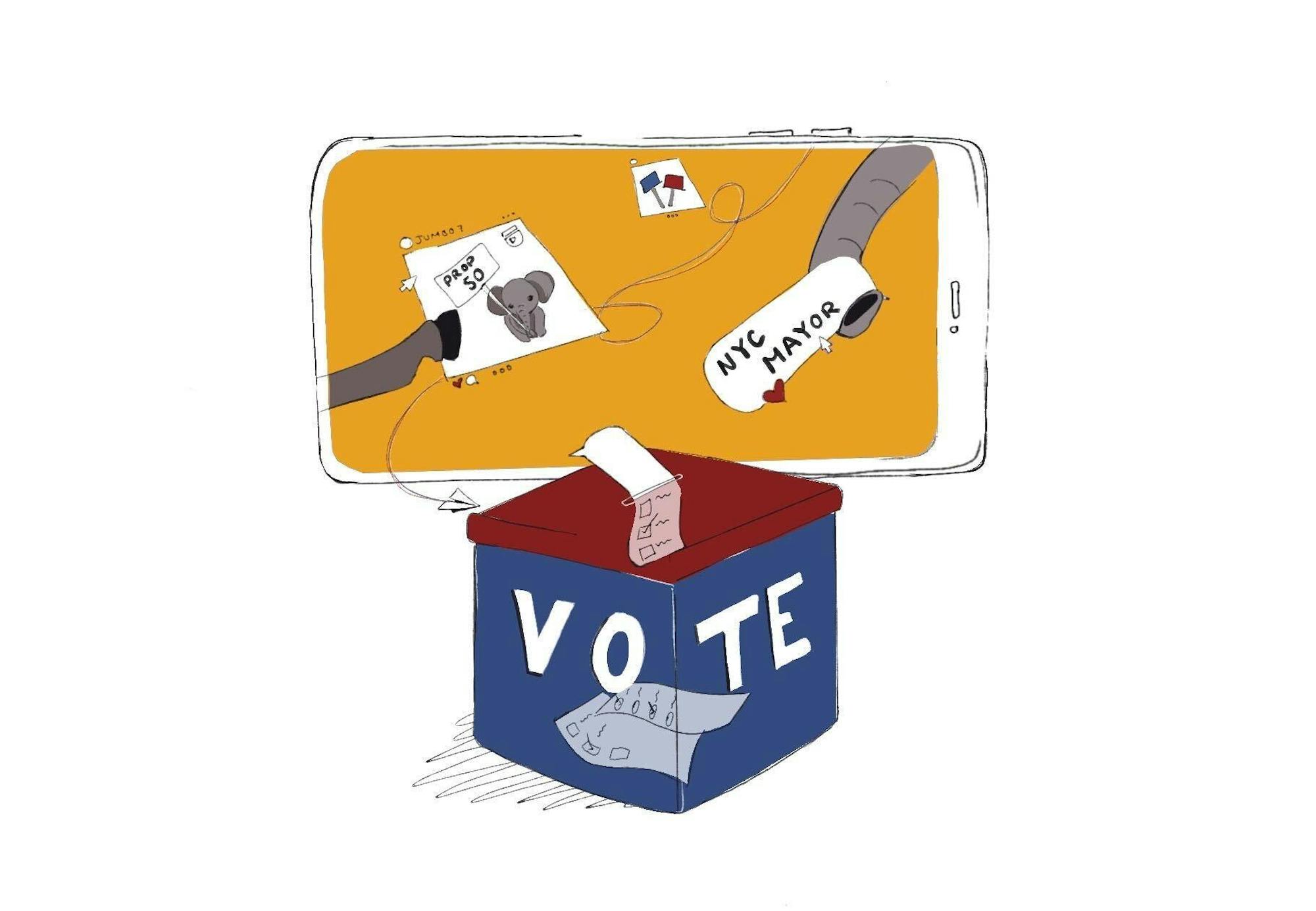
Despite frustrations, some students also described a growing sense of hope — one that was reignited on Nov. 4, the day of several key off-year elections. In New York City’s mayoral election, gubernatorial races in New Jersey and Virginia and California’s Proposition 50 vote, unprecedented voter turnout and major leftward shifts in many districts illuminated a resurgence of a galvanized progressive voting bloc.
So what is it about these candidates (or propositions) that motivated liberal voters to turn out in such great numbers?
Across my conversations, one answer emerged: candidates who connect directly with constituents. Junior William Brentani wrote in a statement to the Daily, “I feel like a lot of times politicians just don’t listen. Especially when they’re in safe districts, they often just do the bare minimum, which is really unfair to their constituents.”
Brentani, an international relations major from San Francisco, voted in a different key election this cycle: the Proposition 50 vote. Proposition 50, led by Democratic Gov. Gavin Newsom, is a redistricting proposal that could lead Democrats to gain more seats, created as a direct response to Texas’ attempted redistricting. Proposition 50 passed with overwhelming support, with some programs calling the election in mere minutes.
Proposition 50, landslide vote or not, was a bold response. “They thought we were going to write an op-ed, have a candlelight vigil, maybe do a rally,” Gov. Newsom said at a rally in San Francisco before the vote. “They poked the bear, and the bear is poking back.” However, in many ways this willingness to confront the federal government epitomizes much of what people think the democratic party lacks.
“Prop 50 is a lot bolder and riskier, and it makes me feel more excited about the future,” Brentani wrote.
Taking an aggressively anti-Trump stance seemed to be a successful strategy for several other candidates as well — with New Jersey being a particularly interesting case.
Junior Lula Duda, a New Jersey resident studying history, recalled Governor-elect Mikie Sherrill — then a Congressional candidate for New Jersey’s 11th district — visiting her high school years earlier.
Duda, then a middle schooler, jokingly recalled the experience: “I just remember being like, ‘Oh, I’m so jealous the high schoolers got to meet this person who’s going to be in Congress.”
Sherrill would end up winning the congressional seat. However, just over a year ago, she announced her campaign for a new position: Governor of New Jersey, running in the general against the Trump-aligned Republican Jack Ciattarelli.
Sherrill’s victory was, like in California and New York City, unexpectedly resounding; she not only won by a significant (and underestimated) margin, but she won the election with an unprecedentedly high turnout.
Few races, however, saw a more notable and tangible presence of this newly motivated voting bloc than New York City’s mayoral race, which not only saw millions of people vote but also ended with the election of a self-described democratic socialist mayor.
Du, a New York City voter, said “[Zohran Mamdani] has that … ability to connect with people.” She used his Veteran’s Day schedule as an example. “For the Veteran’s Day Parade recently, people are like, ‘Oh, the mayor-elect always goes to march in the parade — he didn’t do that. Instead, he went to go visit facilities that directly work with veterans, and [talked] to actual veterans instead.”
Authenticity, transparency and action — that is what these electoral victors have in common; that is what will win the college-aged vote. “It might take some time,” Du admitted. “But I think it’ll be okay.”