
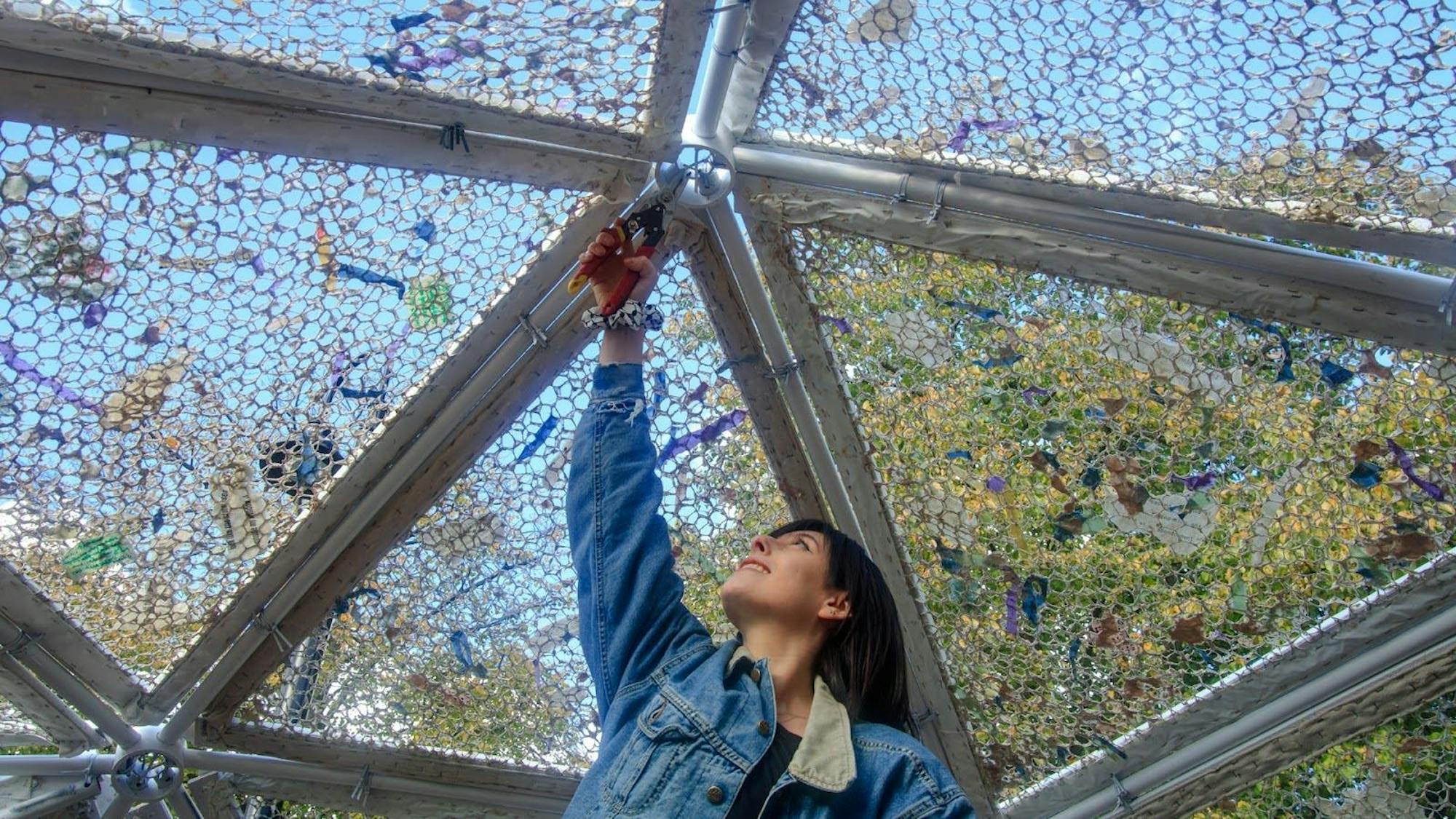
Somerville celebrated the unveiling of “Letters Rewoven” on Nov. 8, a new public artwork by local artist Anna Fubini at Lou Ann David Park. The piece was created through the combined efforts of community members, who wrote messages on scraps of paper that were turned into a pulp mixed with wildflower seeds. The mixture was then plastered onto the sculpture’s panels and will eventually grow into flowers. The installation was supported by the Somerville Arts Council and will remain on display until spring 2026.
Fubini frequently works with themes of deconstruction in her works. She told the Daily that she views life as “a constant process of unlearning and questioning why we know the things we know and reexamining them.” For her first large-scale public work, she leaned into this sense of impermanence.
“I kind of completely turned the idea of public art around,” Fubini said. “I don’t need to have it be something that’s going to hold up over time.”
Since the piece would live outdoors, Fubini worked to ensure that “Letters Rewoven” has “not just a net neutral, but potentially [a] net positive” environmental impact.
“I always hate the fact that potentially creating something that has a message about the longevity of society or community is using materials that can be detrimental to that,” she said.
For Fubini, the project was rooted in capturing the voices of Somerville residents.
“From the beginning, it was the idea of … the written words of people being taken and their words becoming material,” she said. “It could be an amalgamation of the voices of the community — [giving them] visual structure.”
She collaborated with Brenda Echeverry, founder of Art & Soul Clinic, to organize the community writing sessions.
Echeverry described Art & Soul Clinic as a “service that supports the community through spiritual care, emotional care [and] creative care.” She believes that creative health fosters one’s ability to be vulnerable without fear of being shut down.
Echeverry told the Daily that she and Fubini crossed paths often and eventually began discussing Fubini’s vision for the installation.
“[Fubini] was realizing, I kind of need support with the facilitation [of the writing sessions],” Echeverry said. “[Fubini wanted] to infuse some more therapeutic prompts [into the sessions] — or [at least have] a facilitator that has some background in how to support people emotionally.”
In alignment with the message of “Letters Rewoven,” Echeverry designed the workshops around the theme of transformation.
“I thought a lot about how the installation itself is meant to grow,” she said. “It’s like this complete destruction, but then something new comes of it, just like we are generating and putting out words, [and then] having the chance to crumple it up, rip it up, that in itself feels good. And that’s not often explored … having a product and taking it apart.”
Fubini stated that the reception to “Letters Rewoven” has largely been positive.
“I think that at every stage you get a lot of curiosity, which is great,” she said. “Anytime you engage with a public-esque type of forum and/or space, people will say whatever they want. … But overall, I think working with Somerville was great. It’s nice because I think Somerville is a city, along with Cambridge, that invests a decent amount into public arts and engagement, so it wasn’t a completely foreign concept.”
“Letters Rewoven” was funded through a grant from the Somerville Arts Council, which received $15,000 from the New England Foundation for the Arts for a temporary public art project. They focused on giving this opportunity to an emerging artist who wanted to break into the public art space. The council reviewed over 30 applications before selecting Fubini’s proposal.
“I believe the strengths [of Fubini’s piece] were the community engagement component of the project,” Somerville Arts Council Event Manager Iaritza Menjivar said. “There was the public art component … something that you haven’t really seen before, at least not in Somerville.”
“I would say Fubini’s work also really embraced that temporary [aspect] too, in the nature of how it functions,” Somerville City Planner and Arts Development Manager Michael Rosenberg said. “So it fit really well. But ultimately, it was very hard for the decision-making process.”
Fubini believes that cultivating local public art in Somerville helps artists flourish everywhere.
“Larger cities like New York and [Los Angeles] have dominated the art scene for a long time. For Boston to be a place where not only are there a lot of local artists working, but also they are supported by the city and by the local government, is super important,” Fubini said. “It sends a message that the arts [are] worth investing in. [The arts are] not something that is a luxury … it is investing into … community building and economy building,” she said.



