
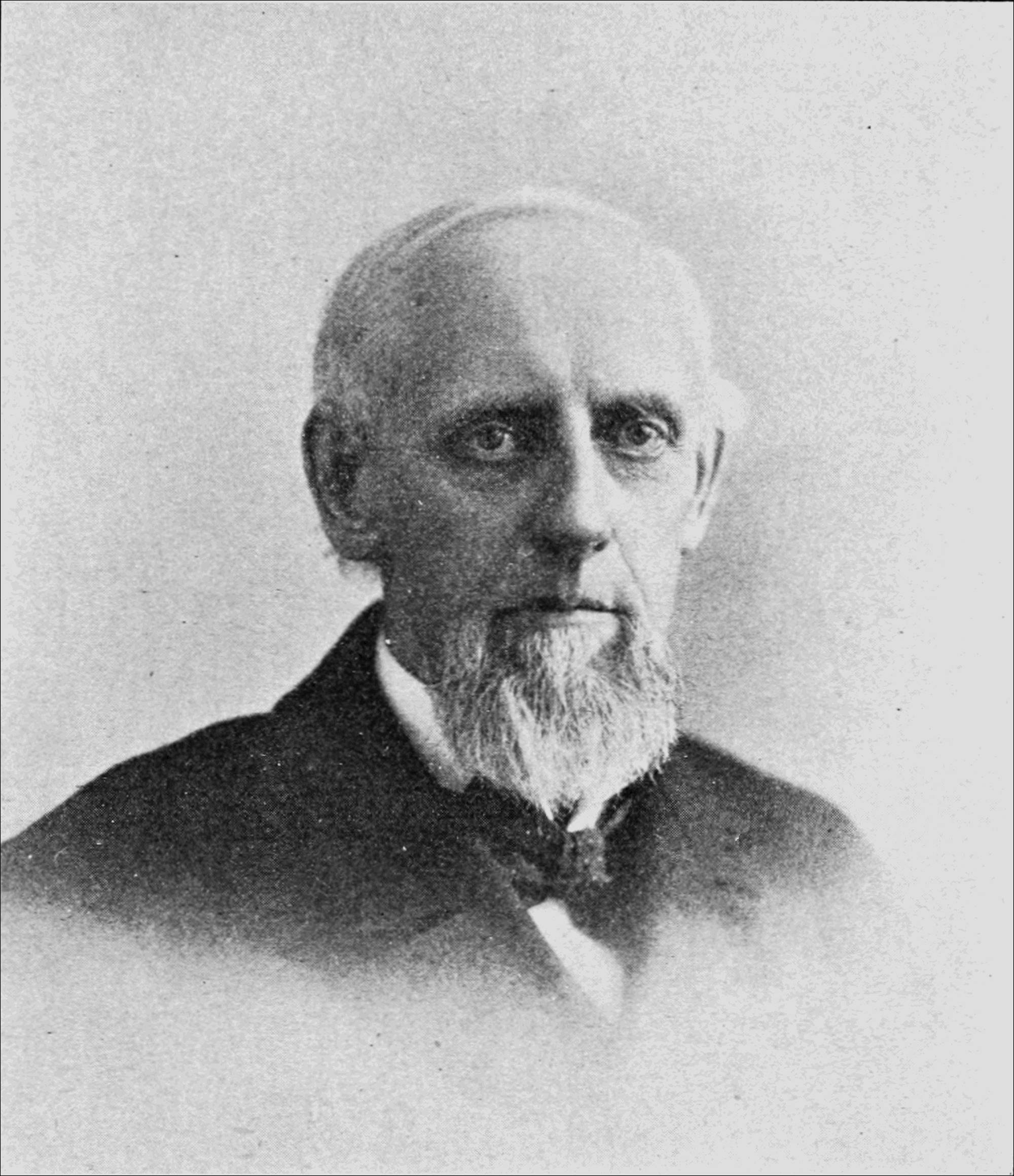
Since 1852, numerous inventions and discoveries have been made at Tufts University. While recent patents receive significant recognition, earlier patents remain equally important and should not be overlooked. One of the inventors of these patents was Amos Dolbear (1837–1910). Following an unusual academic journey, Dolbear became the inventor of various machines, including models of wireless telephones and the electric gyroscope, which his son later described as “the first successful electric motor-driven gyroscope ever built to demonstrate the Earth’s rotation.”
Scientific American wrote on June 18, 1881: “Had he been more observant of Patent Office formalities, it is probable that the speaking telephone, now so widely credited to Mr. Bell, would have been garnered among his own laurels,” highlighting the conflicts Dolbear faced in claiming his patents during a period when similar inventions were emerging.
Dolbear was born in Norwich, Conn., on Nov. 10, 1837. As a child, he worked in both a shipyard and a printing office where he discovered his interest in “freehand drawing, geology and mineralogy and began the study of astronomy, although without the assistance of teacher or textbook,” according to a eulogy published in The Boston Globe.
After working a few labor-intensive jobs, Dolbear decided to further his education by enrolling at Ohio Wesleyan University. Following his graduation, he worked at several institutions including the University of Michigan, the University of Kentucky and Bethany College before finally taking a job at Tufts in 1874 as chair of the Department of Physics and Astronomy.
At Tufts, Dolbear studied the conversion of sound to electricity, also known as wireless communication. According to the Tufts archives, “[his] research on the static telephone was conducted in his laboratory on the top floor of Ballou Hall, and the first transmissions using the device were made from Ballou to his house on Professors Row.”
Dolbear made his first invention in 1865 when he created the “first telephone receiver using a permanent magnet and a diaphragm made of ‘Tintype.’” In 1876, Alexander Graham Bell patented his telephone model, leading to the case “American Bell Telephone Company v. Amos E. Dolbear et al.” case between the inventors which ultimately ruled in favor of the American Bell Telephone Company.
While Bell’s model contained an “electrical machine, consisting of a magnet, a metallic diaphragm near the magnet, a magneto-coil to influence the magnet, which coil is connected with the line wire and with the ground,” Dolbear removed this mechanism and placed the end of the telegraph wire directly to the ear.
Scientific American noted that Dolbear’s invention helped create clearer sound, improving the voice heard at the other end of the telephone. He continued his work by patenting a magneto-electric telephone in 1878, an electrostatic telephone in 1879 and a mode of electric communication in 1886.
Despite losing the patent case against Bell, Dolbear’s work was renowned. He was honored with a silver medal at the Paris Exposition in 1881 and a gold medal at the Crystal Palace Exposition in 1882. Scientific American described him as “[ranking] among the most prominent of American scientists.”
A 1910 article in The Boston Globe stated that “[by] many, he was considered as the originator of the telephone.”
Although Dolbear’s telephone patents could not directly lead to modern telephones, his experiments — including sending the first wireless communication between Tufts buildings — remain a fascinating part of the university’s history.



