
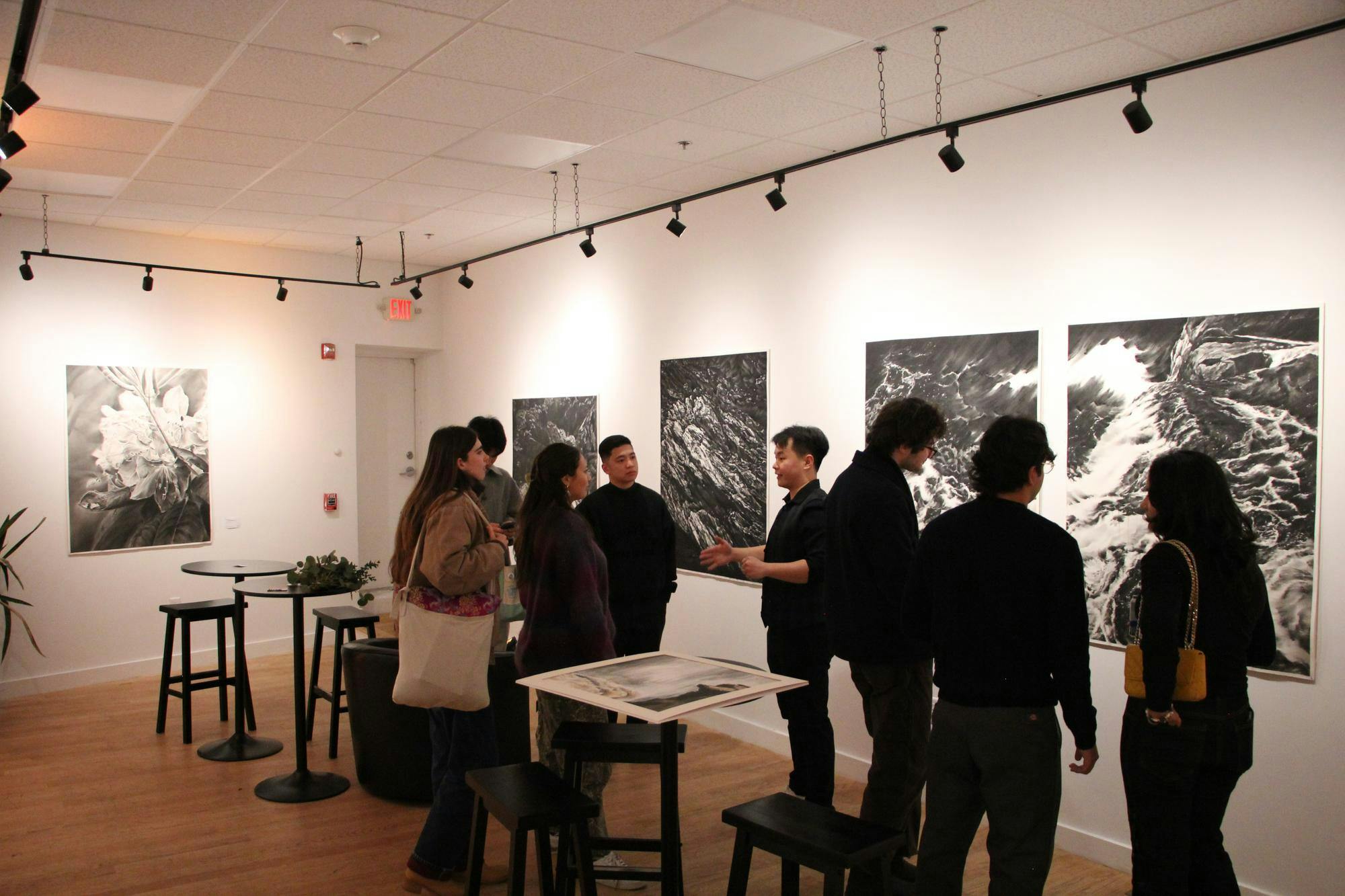
Bass music pulsed through the intimate space on a Saturday night in January. On the left were a series of abstract oil paintings. Large, charcoal landscapes, mainly depicting flowers, waterfalls and rocks, covered the rest of the wall space. People milled about, many in quiet conversations, as they stood and considered the works.
Allen Wang, a senior at the School of the Museum of Fine Arts at Tufts University, moved constantly throughout the exhibit, shifting from one conversation to another. He was beginning to lose his voice. It was opening night, the culmination of hours of work.
The exhibit, titled “Held In Silt: On Pressure & Refusal,” is an homage to the Loess Plateau located in Wang’s birthplace of Shanxi, China. Inspired by the land, culture and people, Wang explained the questions and ideas he sought to explore through his works, particularly the landscapes.
“[The landscapes are] trying to find the balance between natural preservation and human intervention. When we preserve the land, are we also losing anything? And if we are, what are we losing?” Wang said. “It’s about the land that’s constantly collapsing and constantly eroding. It’s about changing environments [and] generations between human and land, especially the ones that are shaped by endurance and erosion and resistance.”
The exhibit also contains a single portrait of an old man staring directly at the viewer to reflect the importance of the village people.
“People have been living in [this land] for centuries … far before [when] the government started to purify and restore the land,” Wang said. “I remember when I was little, when I went back to the village … I asked [the people] why they just never left the village. They just gave me a small laugh … but now, through this work, I realized that it’s because they also became the land itself, in a way.”
Looking back at his artistic development, Wang attributed his interest and passion for art to his parents and childhood environment.
“When I was little, my parents were struggling financially, so they didn’t physically have time to take care of me. That’s why, when I was young, they sent me to a professional art studio. … So that became my after-school environment,” Wang said.
By linking environmentalism, the Loess Plateau landscapes, his childhood and a tumultuous few months, Wang summarized his motivation for making art.
“Now I’ve found my purpose of making art, and that purpose is [to connect] myself back,” Wang said.
To do this, Wang makes purposeful choices for his mediums and subjects. He utilizes charcoal for its connection to pressure, silt and the earth. He grinds the charcoal into a powder that he then applies with makeup sponges and brushes. The charcoal dust is applied gradually in layers, and it often trickles downwards or smudges.
For the subjects and textures in his art, Wang searches for and photographs his own source images to reference for his drawings.
“I do take my own field trips across New England,” Wang said. “It was like a personal search for those textures. So I was really going through the deepest forest trails. Sometimes I have to climb, or sometimes I have to literally jump into the water to have the perfect shot.”
All of the thought, effort and wet shoes were worth it for Wang, as these works gave him an outlet to express and explore his emotions during a period of financial uncertainty. One piece, titled “A Gift to My Mother,” depicts a bee flying toward a cluster of flowers. Wang wanted to comfort his mother and thank her for her nurture through his art. Another piece in the exhibit, titled “Anger in July,” provided Wang with an outlet for his frustration and fears, which became a breakthrough in abstraction for him.
Wang continued to explain the personal importance of this series, especially after enduring financial struggles that forced him to drop out of Tufts’ combined degree program, and left him uncertain of whether he would be able to finish his degree at SMFA.
“This work helped me to advocate for myself. … With the help [and] the support of many, I was able to continue my last year of school. That’s also why the works have so much emotion behind them,” Wang said.
All of his choices, struggles and triumphs brought Wang to the moment when he finally celebrated his exhibit surrounded by his friends, professors and Tufts community members.
Brianna Taborda, a senior studying mathematics, was one of the attendees at the opening event last Saturday.
“The mood and the ambience of the lights [were] really, really nice,” she said. “I’ve known Allen since my first day of pre-orientation at Tufts, so it’s really cool to see him have all of this [success] and see all these people that I’ve met throughout the years all here in support of him.”
For Justin Kamal (E’24), knowing Wang personally has allowed him to understand the emotions behind each piece and see how Wang’s resilience has shaped his art.
“After having conversations with [Wang], I really could see when the inspiration came [to him] and why he felt drawn to these pieces — why he was moved to make it this way,” Kamal said.
From inviting a friend’s band to perform, to hosting another as a henna design artist, Wang ensured his community was a vital aspect of his exhibit, involving as many people in the celebration as possible.
“I had this idea of inviting my friends in because I want to make it collaborative. I want to make it more than just an exhibition,” Wang said.
After reflecting back on the exhibit’s opening and the people who celebrated with him, Wang is ready to be back in the studio to make more art.
As he moves forward into applications for Master of Fine Arts programs, his final months of senior year and his thesis, Wang hopes that his art will leave people reflecting on the theme of resistance.
“Resistance can be as easy as to resist from troubles, from difficulties [and] from uncertainties. But also the word resistance can be something more; it can be some sort of spirit,” Wang explained.
“Held In Silt: On Pressure & Refusal” will be showing until Jan. 30 at EventThem Studios, located in Medford at 344 Salem St. In the next few months, Wang’s art will be exhibited at the Bromfield Gallery in SoWa from Feb. 4 to March 1 and the Laconia Gallery from April 14 to 21.
Wang wants to thank Luna Smith, Marcelo Trisano of the band FM Collective and Lamb Rest Band for their contribution to the opening.



