
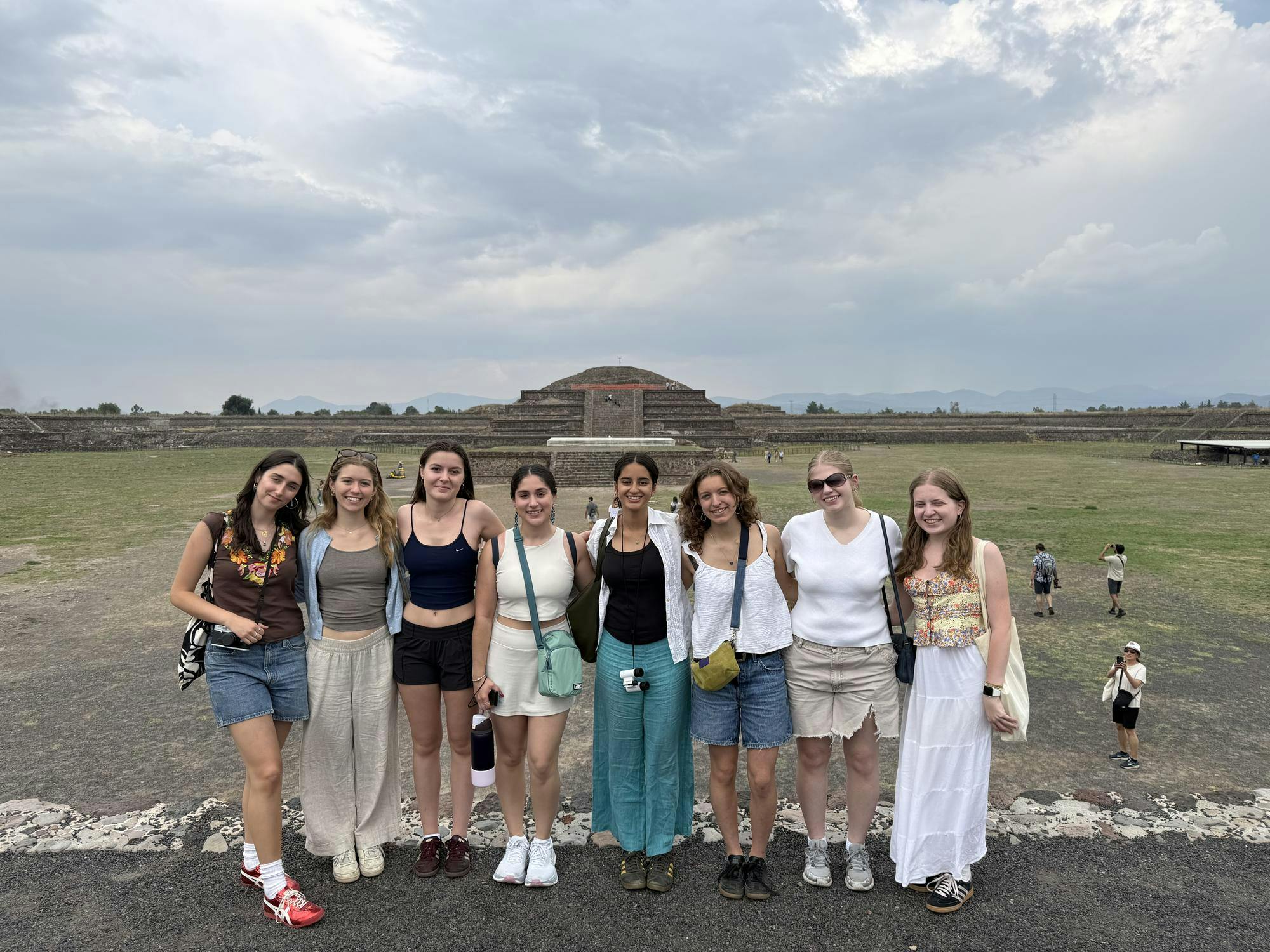
Research trips offered by the Initiative for Global Leadership give Tufts students opportunities to apply their academic studies in real-world settings. The IGL, a resource housed within the Jonathan M. Tisch College of Civic Life, offers these programs during spring break or the summer through Tisch College–affiliated student organizations such as Women in International Relations, Latin American Committee and Middle East Research Group.
According to Heather Barry, global strategy adviser and head of the IGL, more than 2,000 students have been sent on trips to over 95 countries. In the spring and summer of this year, students will travel around the world to places such as Oman, Copenhagen, Chile, Nairobi and Cape Town.
“The IGL [offers] a very student-centered education … [that] gives students the opportunity to go [abroad] individually, in pairs or in a group,” Barry said. “The real focus is on [the] rigorous preparation and then going out and testing if what you’re thinking is right, or [understanding] … the thinking of an expert.”
Third-year combined-degree student Olivia Ballentine has been on two IGL research trips — one to Mexico City in 2025 and one to Dublin in 2024.
“[I thought] an opportunity to travel and use the things that I study would be really exciting, especially because I [had] agency over what [I was] researching,” Ballentine said.
The IGL also funds trips for students in smaller groups unrelated to larger student organizations. Barry shared that a group of students took a year off from their studies at Tufts to participate in a research trip to Bosnia and Herzegovina. They interviewed 60 nongovernmental organizations about the outcomes of the International Criminal Tribunal for the former Yugoslavia. The students then wrote a report and held a conference in Bosnia and Herzegovina centered on their findings.
According to Barry, these experiences in data collection and human rights research contributed to the students’ academic careers as they went on to gain Ph.D.s.
“These are often transformative experiences for the students. … That opportunity to really engage with people and learn, you can't replicate that in the classroom,” Barry said. “Whether [it’s] a field that they choose to go into or [just] an experience, it informs [their future].”
The IGL developed fairly recently and has since overseen the affairs of numerous student organizations. In 2022, the IGL started transitioning its programs into Tisch College after Tufts closed the Institute of Global Leadership, which was founded in 1999 to support global education and scholarship.
“[The IGL] grew out of the Education for Public Inquiry and International Citizenship class,” Barry said. “As EPIIC grew … we were looking for more opportunities to send students [abroad].”
The trips are fully sponsored through gifts and donations from outside the university. Students have their flights and accommodations paid for by the IGL and can also request supplementary funding from the Undergraduate Research Fund for food, souvenirs and other activities.
Ballentine explained that the IGL’s support extends beyond financial assistance. “IGL and Tufts in general support students so much with the research they want to do [and] the ideas they might have,” Ballentine said. “It’s a ‘create-your-own adventure.’”
Beyond funding and logistical support, the nature of each research project can vary widely depending on the committee. Students have researched many creative, unique and personalized topics.
“[My research was] on Brazilian hegemony in Latin America … as opposed to the U.S.-Chinese dominance currently in the region,” sophomore Alejandro Álvarez Acuña, president of the Latin American Committee, said.
There are few guiding criteria for research topics, making the options seemingly limitless. For students traveling as part of WIIR, it is required that their research question explores how women are impacted by a specific issue. Students see this not as a limitation but as an opportunity to approach pressing global topics from different perspectives.
“[My research was about] the Jewish community in Mexico City and how that related to foreign policy and anti-semitism after Israel’s war on Gaza started,” junior Chaya Ortega said.
While going abroad may seem exciting, the reality is certainly academically demanding. Students who participate in the trips must write a literature review on existing academia about their topic before traveling. After the trip, they complete an extensive research paper presenting their findings.
“The 20-page paper during the summer was a little bit daunting, but it was [also] really rewarding,” Ortega said. “I feel like the Jewish community in Mexico is not really super well known outside of Mexico. If [my paper] could give some more insight into their views or their experiences, I would be proud of that.”
In addition to hands-on research, students also have opportunities to share their findings with academics and the public. Through the IGL website, students can publish reports, photographs and reflections. Undergraduate students can also submit their papers to academic journals at other institutions and organizations.
However, some students have struggled to find outlets for publications. “It’s difficult to find places or journals or wherever to have that research land. The IGL doesn’t do a great job of providing opportunities or places in which we could send the research. Essentially none of my research has been published,” Ballentine said.
To address these concerns, the IGL plans to expand the reach of student research. “What the students are interested in doing is creating an online research journal,” Barry said. “That’s what we’re going to be working on doing with the trips that went this past summer and the trips that [go] this summer.”
For now, the research papers remain available on the IGL website. Regardless of audience, the trips highlight Tufts’ commitment to experiential learning and global engagement. By combining academic theory with on-the-ground research, students are encouraged to challenge assumptions, develop independence and engage critically with global issues.
“You actually get to understand [your topic],” Acuña said. “You are [researching] hands-on and learning from people who are experts in the field [and you] don’t necessarily have the confinement of academic restraints.”



