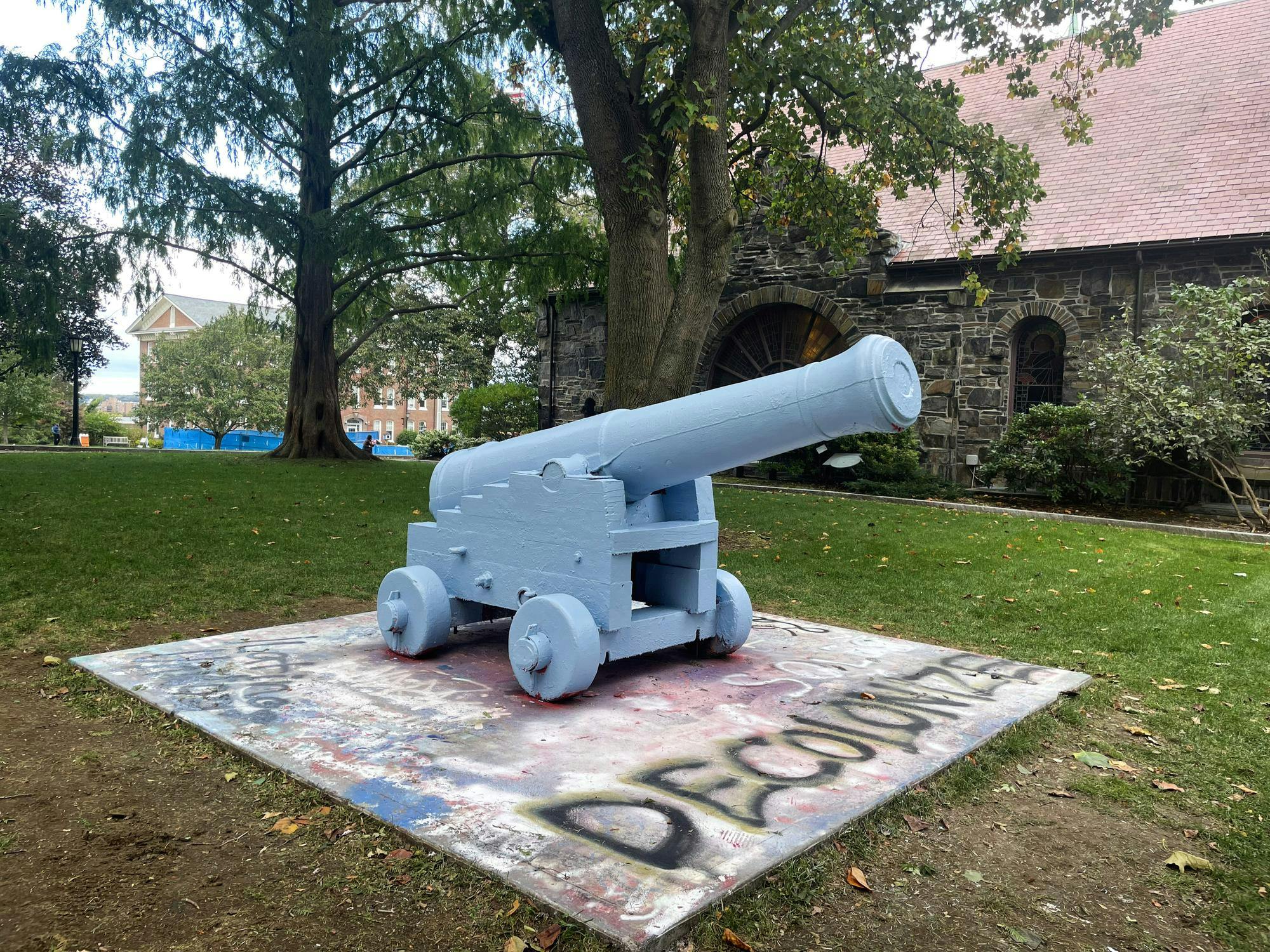
Between Goddard Chapel and Ballou Hall, overlooking President’s Lawn, stands the Tufts cannon. This piece of history is constantly adorned with political, cultural and prideful messaging painted by student groups, making it a centerpiece of free speech on campus. Yet, at the start of the 2025–26 academic year, the decades-old tradition of ‘painting the cannon’ embraced a new policy. In a September email, Camille Lizarríbar, dean of students for the School of Arts and Sciences, announced that free speech and expression through the cannon would take on a new form: The cannon would be subject to “periodic cleanings.” In practice, this meant repainting the cannon light blue every Thursday as a weekly ‘reset.’
While the cannon has long served as a platform for students to express sentiments regarding current events at Tufts and around the world, the tradition is not limited to political groups. Sports teams, affinity groups and performance organizations also participate. However, the new policy set by the administration stated that the new policy was intended to encourage students to share their thoughts and opinions “without necessarily having to cover up someone else’s message,” according to the Dean of Students Office.
Although students were notified about the new approach to free speech in September, widespread confusion emerged after the Philippine Student Union’s message — painted on a Wednesday night — was covered the following day.
“It's a big part of our tradition, and the fact that it was painted over, especially during Filipino American History Month, was shocking,” said Jonas Apacible, an executive board member of the Tufts Philippine Student Union. Apacible noted that PSU was the first organization to paint the cannon in the 1970s in protest to a grant given to the Fletcher School by the Marcos dictatorship, launching the tradition that followed. When a PSU executive board member reached out to Facilities after the repainting, they were told it was due to the new policy. Further inquiries to the administration led to more questions than answers.
“They were also saying [that] it was a student-led initiative and [tied to] TCU. But then when we asked TCU they [said] ‘No we don’t have any resolutions on this,’” Apacible continued. “It felt like the university was kind of withholding information and taking a stance that [was] aligned with student ideas.”
That statement aligns with Lizarríbar’s statement that the practice followed “numerous conversations last year in which students had indicated to us that they felt intimidated and feared being labeled, stigmatized or ostracized for painting over another group’s message.” Lizarríbar also referenced Tufts’ commitment to institutional pluralism, which limits the university’s ability to make official statements on current events.
Even with the policy now widely known, many students remain uncertain about what prompted the change, as the administration has offered limited public explanation. The year 2025 saw major global events unfold, drawing national attention to student activism and sparking difficult, often controversial discussions on campuses across the country.
Tufts Friends of Israel, a student organization that supports Jewish students and encourages dialogue surrounding the Israeli conflict, opposed the policy, citing flaws in its implementation.
“On every other night [after Thursdays], the tradition works exactly the same as it always has: Students paint over one another’s messages as part of the normal process. … Instead of expanding expression, the policy introduces the risk that messages can be erased under the label of ‘routine cleaning.’”
FOI emphasized the importance of keeping the cannon tradition as it has always been: student-run. The group noted the long-standing practice of groups ‘guarding’ their messages overnight to preserve them.
“The cannon has always been a student-driven tradition with simple rules: You paint it at night, and someone else can repaint it later that night or the next,” FOI wrote. “That open exchange is exactly what has made the cannon one of the most visible expressions of free speech on campus.”
Nationally, universities have faced heightened scrutiny under the Trump administration as students navigate activism and current events. Since the beginning of the year, institutions such as Northwestern, Brown, the University of Pennsylvania and Harvard have received threats of federal funding limitations. According to the New York Times, many political leaders have criticized these universities over affirmative action, high tuition costs and DEI initiatives, as well as perceived liberal ideological leanings among faculty and students.
Bailey Kelly, a sophomore and secretary of the College Democrats of Massachusetts, said the new policy conflicted with the free speech values that influenced their decision to attend Tufts. While they acknowledged the national and global context in which the decision was made, they emphasized how disheartening it felt.
“There was a deliberate reason for those rules being put in place, and that was affected by the Trump administration and the way that they’re going after university funding in relation to DEI programs and practices. It is very obvious that our administration is scared of those things,” Kelly said.
However, they maintained that while those threats are serious and valid, Tufts’ commitment to protection at the expense of student’s free speech is “weak.”
“It goes against the things that I think all Tufts students … value,” they said.
Additionally, it contradicts the values that shape organizations like the College Democrats of Massachusetts, strengthening their frustration.
While the university did not directly mention Trump’s crackdown in its statement regarding approaches to free speech, its vague explanations, combined with the national context, has led many students to come to Kelly’s conclusion.
“The cannon really [belongs] to the students,” they said. “It helped foster, and continues to help foster a close community. … In political times like this, that’s … increasingly important.”
Opposition to the policy is not limited to left-leaning groups. In a statement by Tufts Republicans, the student organization noted its firm disagreement to the policy, stating that it implies that Tufts students are “incapable of handling an open exchange of ideas” and expressed its frustration with administrative interference with a student tradition.
“Part of the value of the cannon is speaking up even when your message is unpopular, knowing it may be painted over quickly. As a minority voice on campus, we understand that better than most,” the statement continued.
The cannon is known to be a hub for activism and expression despite the policy, which has been in effect for four months. While free speech may take a new form, students regularly paint over the historical piece with messages they deeply believe in. Kelly emphasized the importance of the tradition, maintaining that, despite a new approach that may be unpopular among students, Tufts still enjoys marginally more freedom of speech than other institutions.
“Anger is definitely a fuel for action,” Kelly said. “We can still make ourselves visible. … And if it’s going to get painted over on Thursday, paint it again on Friday.”