
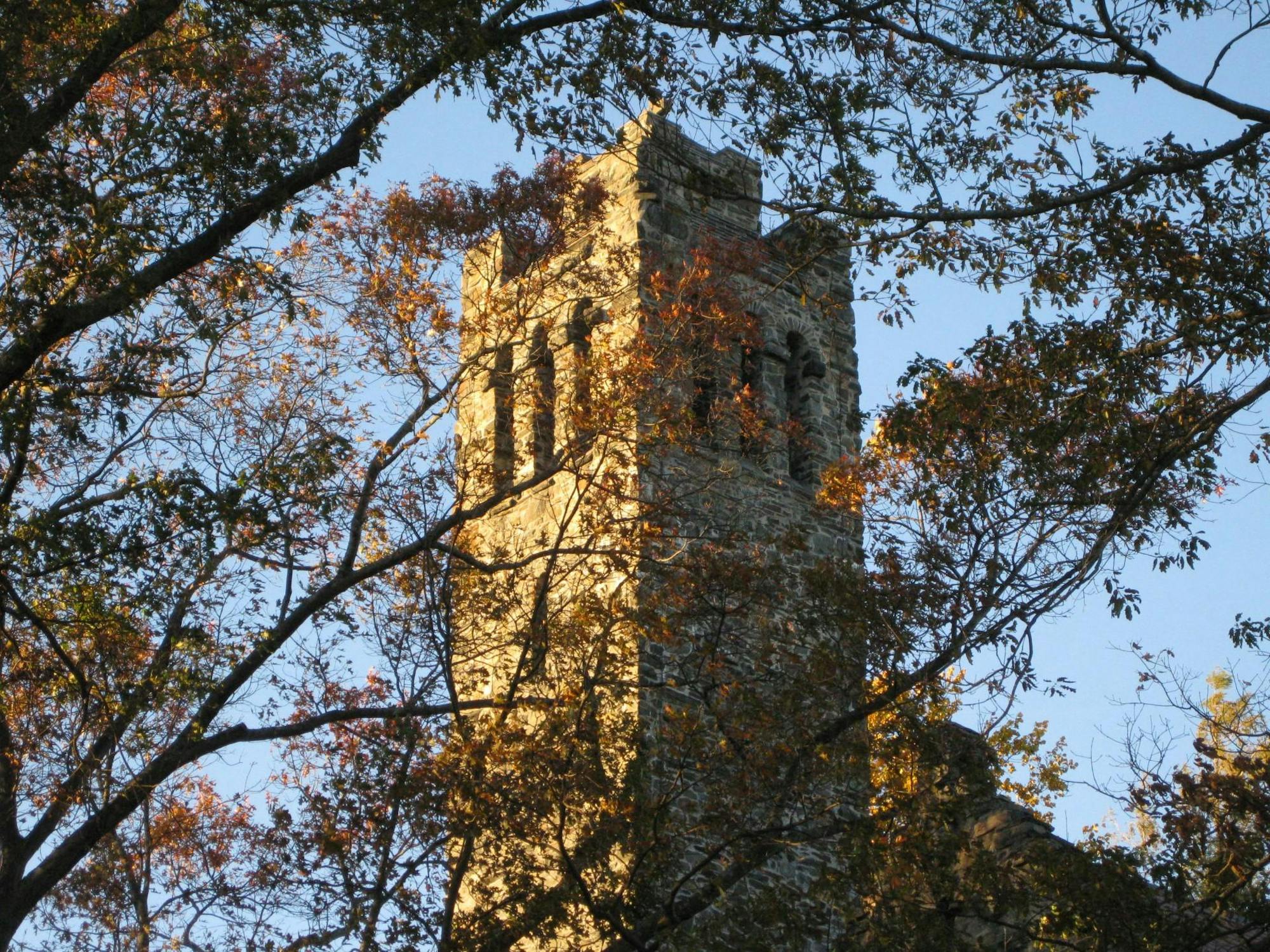
In 1876, Eugene Bowen graduated from Tufts College known by peers and faculty as the most prominent bell ringer of his class. Goddard Chapel had not yet been built, and a single bell rang atop Ballou Hall. This bell’s historical record is wide-ranging, even including a memorable prank from the 1880s in which Tufts students tied a calf to the bell rope so the bell would ring for hours.
50 years after his graduation, Bowen returned to his alma mater to carry on his legacy as a passionate bell ringer by gifting a set of nine bells for the Goddard Chapel tower in 1926. These became the basis for the Tufts carillon, which still rings daily at 5 p.m. A century later, the Tufts University Chaplaincy and student carillon players continue to preserve the bell-ringing tradition, connecting today’s Tufts students to the university’s history.
“For the students that are … involved, the carillon is something that is really important,” Alexander Stone, a sophomore carillonist, said. “[It’s] something that they’re really enthusiastic about because it’s such a powerful instrument. It really changes how a song feels.”
While definitions vary, the carillon is a percussion instrument played with a keyboard that connects to at least 23 bells. The carillon in Goddard Chapel has 25 bells and has been controlled with an electronic keyboard located next to the organ since 1964.
Every day at 5 p.m., the carillon plays a hymn tune from a prerecorded list. In addition, the Chaplaincy organizes one carillon concert per semester open to all students and community members.
“My favorite part of all this is introducing the carillon to students who are new to playing it,” Suzanne Cartreine, Chaplaincy music director, wrote in an email to the Daily. “It’s very accessible to anyone who’s played piano, and it is fun to see people’s enthusiasm for the bells and excitement at being able to play them.”
One of Cartriene’s responsibilities as music director is helping students adapt their songs to the carillon’s scale. Most concerts average five to 10 performers with varying piano and carillon experience. Friends and community members gather to hear the half hour of powerful music from the tower. At the end, Cartreine often leads an informal jam session with the audience.
“[The carillon] is something that … brings people together. … Even if you don’t play the piano or … the carillon, you still … hear the little melody that’s been selected no matter where you are on campus,” carillonist Mallika Sinha said. “It’s easy to feel separated from other people on campus, and it’s just a nice reminder that we are all … at one school together.”
The carillon harnesses its 25 bells to the fullest extent, giving musicians a feeling of grandeur and power when they play. Students most commonly use classical music, as it translates more easily to the bells. At the most recent Halloween concert, songs ranged from Claude Debussy’s “Clair de Lune” to music from “The Nightmare Before Christmas” (1993) soundtrack. However, the carillon has its limitations: The bells cannot play every note found on a piano, and there is a slight delay between the keyboard and the sound.
“You have to know a little bit about music theory, because [on] the carillon, we only have 25 notes,” Stone said. “A lot of classical music [utilizes] a whole piano, so you have to shift the notes around. … I had to rewrite half [of ‘Für Elise’] because it uses such a wide range [of notes].”
Despite these limitations, the university has relied on bells since its founding. For most of Tufts’ history, the bells rang far more frequently than they do today to signify the start and end of classes, football victories and other events. The tradition began with a simple handbell rung by Jarvis Wright (A’1859) from 1854 to 1856, before trustees purchased a designated bell for Ballou Hall in 1857. In 1908, the class of 1898 gifted the first bell to Goddard Chapel, which is said to include metal from the original Ballou Hall bell. Bowen later gifted his set of nine bells, and an additional 15 bells were later gifted in memory of Tufts Vice President John Tilton in 1964, bringing the carillon to its current total of 25 bells.
The carillon has garnered students’ attention, complaints and awe for the past 100 years. A quick skim through the Tufts Archival Research Center’s newspaper archives reveals numerous humorous poems regarding the bells, along with other historical tidbits. These records highlight the bells’ long-term significance in student life.
One of the most entertaining stories appears in the Tufts Weekly’s Dec. 1, 1926 issue, in which a Tufts student named Charles Anthony wrote to the editor complaining about the bells. Anthony claimed that the poorly played hymns at breakfast “impair the gastric juices.” He advocated for an electric keyboard and equated the bells’ improvement to Tufts’ rise to prominence.
“We have a real chance to add one blessed vital note of beauty and distinction to the Hill, which is at last emerging from its growing pains and beginning to realize that truth … divorced from expressed beauty is a sordid distortion of practical idealism,” Anthony wrote.
General consensus among current Tufts carillon players would most likely disagree with Anthony’s claims. Both Sinha and Stone emphasized that the carillon’s quirks add to its character and value.
“[The carillon] is a little bit janky in a very loving way,” Sinha said. “It’s a great setup, but there’s a little bit of a lag between when you press a note and when you hear it, and if you try to play too fast, then the sound gets jumbled together.”
“It doesn’t really need to be perfect to be beautiful. … The point is to feel the music,” Stone said.
As students return to campus in 2026, many are unaware of the historical and powerful musical instrument that they pass each day. This semester, carillon student leaders hope to expand awareness by working with other student organizations, playing during Parents and Family Weekend, being featured in an upcoming Aidekman Arts Center sonic art installation and advertising to host communities.
“A lot of people don’t even realize that there actually are bells. Some people I have talked to … thought it was a recording or … that someone’s up in the tower hitting away at the bells,” Sinha said. “That’s part of why the concerts are also nice. It’s outreach [and] … a cool bit of music history.”
At first glance, the unsuspecting Goddard Chapel bell tower and the sounds it produces may seem like a mundane tradition. However, for piano players and nonmusicians alike, the carillon offers an opportunity for students to engage with a dynamic instrument whose echoes carry the stories of Tufts’ campus from its very beginning.



