
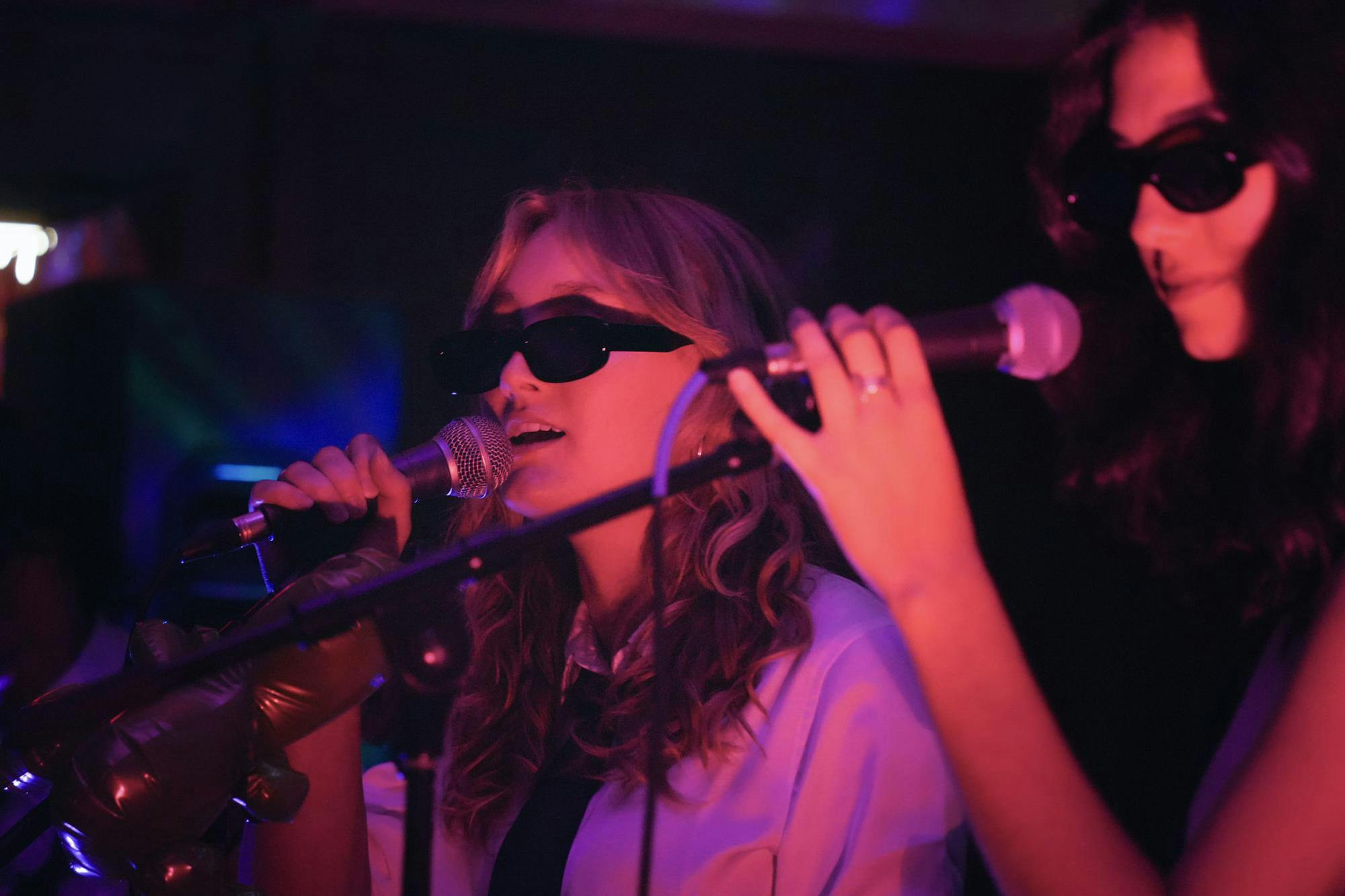
The annual Winter Formal at the Joyce Cummings Center on Jan. 18 was a resounding success. With live music, catering, photo ops and dancing, it proved to be a great start to the new semester. But most attendees did not get to witness the months of planning, rehearsals and communication that went into the night.
Junior Angie Zhang and sophomore Austin Schiffer are two Tufts University Social Collective event coordinators and help plan many of Tufts’ large-scale events, including Fall Fest, Homecoming Block Party, Tuftonia’s Day and Winter Formal. Zhang stated that a large team was required to pull off these events.
“There’s like 14 of us split up into individual committees that specialize in different aspects of different kinds of events,” Zhang said. “So [for Winter Formal], [Schiffer] and I pretty much planned the entire thing.”
These months of work culminated in nearly 12 hours of supervision during the event itself. According to Schiffer, he and Zhang were at the JCC from 1 p.m. to at least midnight setting up, overseeing and cleaning up the event.
The formal also featured two student bands, Cutting Corners and Residential. When it came to selecting the bands, Schiffer noted that experience was vital. “We felt it would be a good basis to start with bands that … we had seen perform before, especially in this kind of setting, [so that] we knew that they could handle it,” he said.
However, according to Zhang, the overall selection of the bands was largely by chance.
“[Schiffer] knew somebody in Cutting Corners, and I knew somebody in Residential,” Zhang said. “We know they’re good, and we want[ed] to give them this amazing platform to perform in front of students.”
Sophomore Spencer Kluger, a drummer for Cutting Corners, commented that while they found out they were confirmed to perform around a month before Winter Formal, the inability to practice together due to winter break posed a bit of a challenge.
“We had a month where we were all apart,” Kluger said. “So we [played] over break alone, just keeping our skills up to speed. And then when we got back to campus, … we forced a bunch of practices into that week.”
However, Kluger noted that it doesn’t usually work this way. “Normally, let’s say we have a gig three weeks from now, we’ll plan our practices around it, have those few weeks and then play it,” he said.
For Kayla Rosenblum, a sophomore and vocalist in Cutting Corners, the hardest part of performing at Winter Formal was memorizing lyrics to a large number of songs. “We want to try to have the lyrics memorized as much as possible for the performances, which is really difficult with 12 to 14 songs,” she said. “We try to get our setlist down as early as possible, but it usually ends up getting tweaked [in the] days leading up to the performances.”
Rosenblum also reflected on seeing Residential’s performance. “They’re really good. I really enjoyed them. … They had a really good setlist. I’m looking forward to [playing] with them more in the future,” she said.
Zhang agreed saying, “I think they did amazing. … [Both bands] chose great setlists, and people really, really enjoyed it.”
While picking the bands was an easy decision for Zhang and Schiffer, the communication and budgeting proved to be quite a challenge. Zhang emphasized the number of tasks that had to be completed before the night of the formal. “We communicated with all of the vendors [and] caterers for food, we did the communication with the bands, we communicated with facilities about getting lights set up [and] we did all the decorating,” she said.
Zhang also noted the difficulty of estimating how much of the budget to allocate to different aspects of the event. “Normally, for all of our events, food consists of half if not more than half of the budget … and then second is facilities,” Zhang said. “It’s hard with facilities, too, because they don’t give you an exact number beforehand … so you have to give enough wiggle room for that as well.”
For Schiffer, the contingency budget — the money that is set aside in case something goes wrong — was especially helpful when it came to spending.
“It’s nice to know [that] we’ve already put this money aside, so it can give us a little bit of security,” Schiffer said.
At the start of the formal, Zhang was initially concerned over the small number of attendees. “The first 15 minutes, I was so worried because [Residential] was playing, essentially, to an empty ballroom,” she said. “But after we got past that hump, it was amazing.”
Rosenblum agreed, saying, “TUSC did a pretty good job. … They had brought some of the food into the room where the music was [and] that definitely helps to pull in a bit more of a crowd.”
For the bands, events like Winter Formal are a great way to connect with the audience.
“Something I really appreciate about Tufts is how community-building it is and how, at least with the people that I’ve met, everyone’s very open to meeting new people and really branching out. … Being on stage, … I see people coming together and dancing and singing along and holding hands. It’s really cute,” Rosenblum said.
Kluger also appreciated that events such as Winter Formal allow him to play for a wide variety of new faces. “Some of my friends have been to so many of the shows we played [at] — they know what we can do. But it’s fun to see people I’ve never seen before in the crowd having a good time. It feels good to spread that joy to more people,” he said.
“Having my peers as the people in the audience cheering me on and hearing my name get called out or the names of everyone in my band, it’s very nice to hear. It’s very encouraging,” Rosenblum agreed.
What began as months of spreadsheets, emails and rehearsals culminated in a night of shared celebration — for the event coordinators, the performers and — of course — the attendees themselves.



