
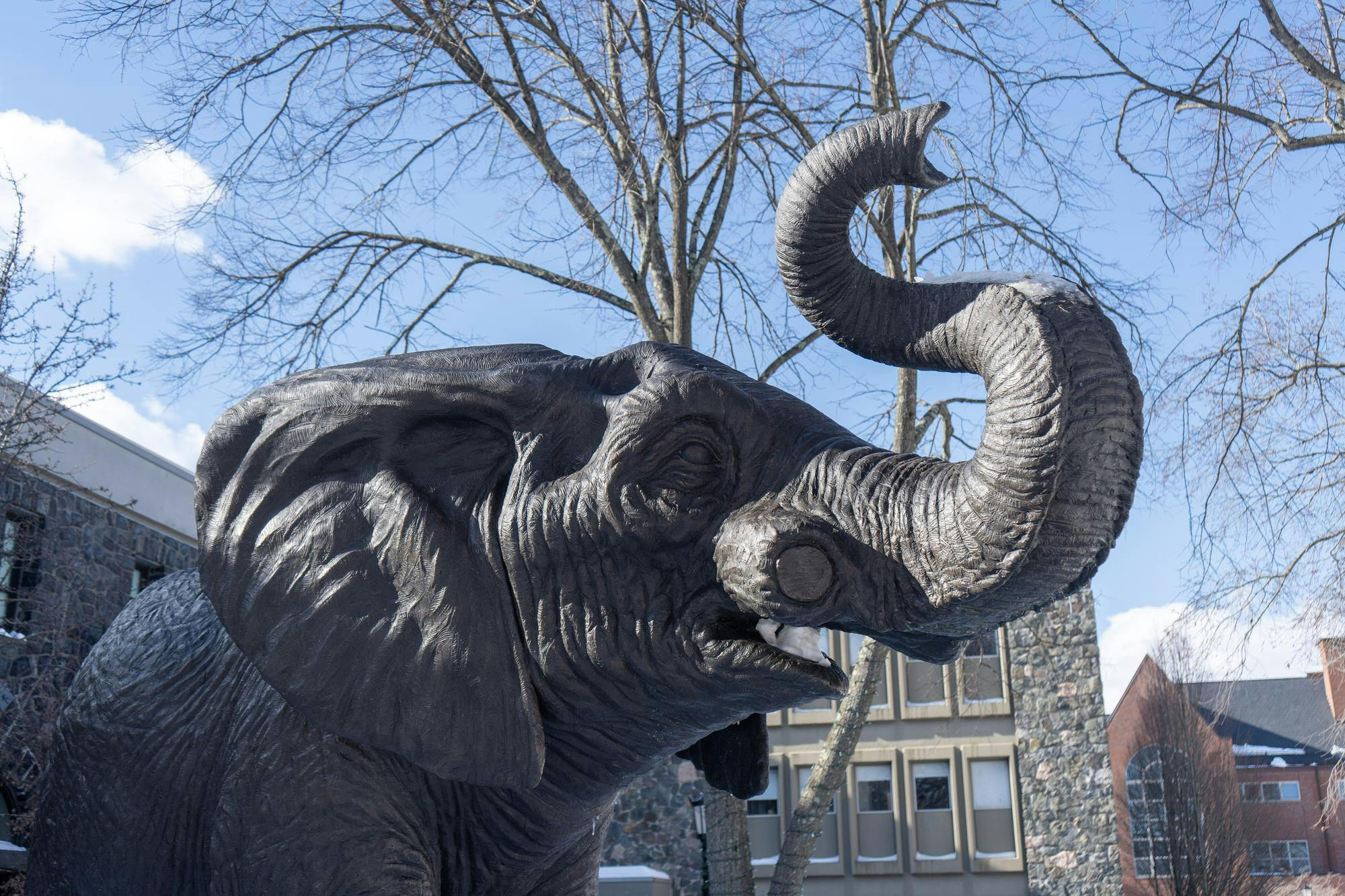
Senior Jack Wilan was digging through records of Tufts history in the Tufts Archival Research Center last fall when he became fixated on the story of Jumbo the Elephant.
Wilan wasn’t looking to learn about Jumbo, Tufts’ beloved mascot who was once one of the most famous circus attractions in the world. Instead, he was looking for information about class year distinctions in the 1900s, the topic of his research project for the archival research seminar “Tufts in American History.“ But after encountering Jumbo in story after story dating back over a century, Wilan quickly latched onto the mascot and its significance to Tufts’ history.
“[Jumbo is] one of the few throughlines of the identity of the university,” Wilan said. “[Both] Tufts students today and Tufts students 100 years ago, 150 years ago, would recognize [Jumbo] as an integral part of the university.”
Like most students at Tufts, Wilan was already aware of Jumbo’s surface-level history, a legend repeated on campus tours and baked into the university’s identity. Jumbo was the star performer of showman Phineas T. Barnum’s legendary traveling circus show “The Greatest Show on Earth” from 1882 until 1885, when he was struck and killed by a train in St. Thomas, Ontario, Canada. Barnum, one of Tufts’ primary benefactors at the time and a founding member of the Board of Trustees, donated Jumbo’s hide to the Barnum Museum of Natural History in 1889, now known as Barnum Hall, a building he had personally commissioned.
Lacking an official mascot, Tufts students adopted Jumbo as their unofficial mascot before it was officially recognized by the school in the late 20th century. Throughout the years, students developed several traditions regarding the beloved stuffed elephant, including dropping pennies into his trunk and pulling on his tail for luck before exams.
Even after Jumbo’s hide was destroyed in the 1975 Barnum Museum fire, the mascot’s influence continued to permeate the Tufts campus. Today, Tufts athletes touch a peanut butter jar of Jumbo’s ashes for luck before games, and Jumbo’s taxidermied tail is by far TARC’s most requested item for students to see.
In his research, Wilan began to wonder where the rest of Jumbo’s remains were — namely, his skeleton. A quick search informed him that Jumbo’s skeleton had never been in Tufts’ possession, and had instead been donated by Barnum to the American Museum of Natural History in New York City. While the museum previously displayed the skeleton in their Hall of the Biology of Mammals until its closure in 1969, the bones were last found in 2017 to be sitting in the museum’s storage facilities in Brooklyn.
“On one hand, we have this once living being, Jumbo the Elephant, with a fascinating story … that students here and alumni and professors and even the administration legitimately care about and are interested in,” Wilan said. “And at the same time, you have an actual skeleton, which has been in storage since forever and has no plans to be shown at all. There’s a real opportunity here to bring Jumbo back, to bring the story … of the real elephant back to the university.”
With this, Wilan’s campaign to bring Jumbo’s skeleton to Tufts was born. While he recognized the improbability of the university possessing the bones permanently, he envisioned the museum loaning them to Tufts for a temporary exhibition on campus. Wilan sent an email to the Office of the President with his proposal, and was led to TARC director Dan Santamaria and Director of Tufts University Art Galleries Dina Deitsch.
While Wilan was able to speak with both administrators last December, he expressed that he was met with concerns over a lack of space and funding impediments, leaving him unsatisfied.
“[Jumbo] is the one thing that everyone in this university actually cares about and integral to our story … and your problem is that you don’t have space?” Wilan said.
However, according to Santamaria, these constraints cannot be bridged, especially considering that Tufts has not had a natural history museum since the Barnum Museum and is not properly equipped to care for the skeleton.
“Natural history artifacts of this size and scope require specific experience and expertise beyond staff at the Tufts University Art Galleries or in TARC,” Santamaria wrote in an email to the Daily. “There is also no exhibit space appropriate for display of an elephant skeleton on the Medford campus. The cost of safely transporting, storing, reassembling, and providing security for the skeleton would be extremely high.”
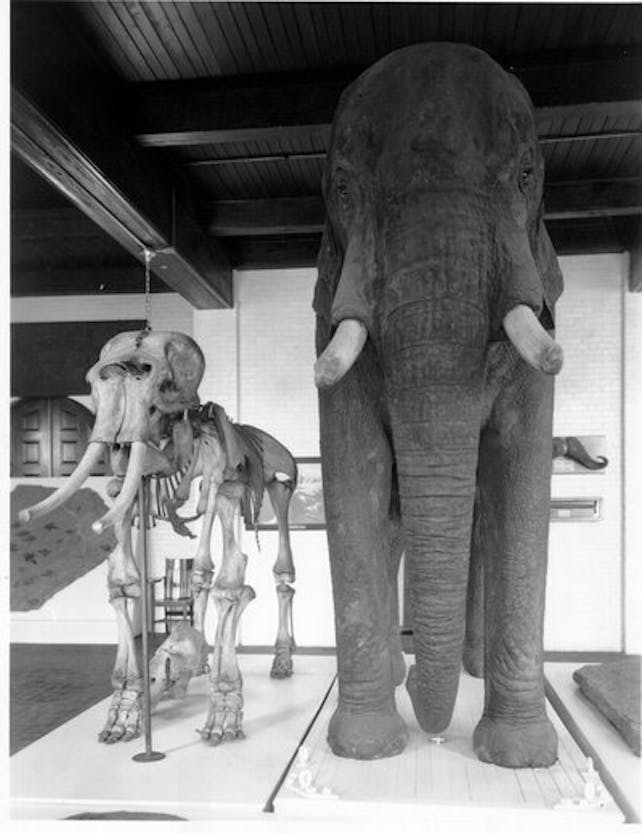
Stuffed Jumbo stands next to an elephant skeleton (not Jumbo) in the Barnum Museum.
Santamaria also noted that the likelihood of the AMNH loaning the bones of Jumbo to the university is extremely low, as Andrew McClellan, a professor of history of art and architecture, had already made a similar inquiry in 2014 while working on a Jumbo-based exhibition. He was told that Jumbo was a ‘type specimen’ for the species of African elephants and could not be loaned.
After a string of rocky meetings, the project appeared to have hit a dead end. That’s when Deitsch’s assistant pulled Wilan aside and informed him that another student had also reached out to her recently about a potential exhibition to honor Jumbo’s legacy.
Stephen Strout, a Tufts graduate student in the Educational Studies program, first became aware of the history of Jumbo over the summer while teaching a Tufts College Accelerator Seminar. The course, titled Critical Animal Studies, examined the relationships and systems of oppression between humans and animals. While creating the curriculum for the course, Strout included Jumbo as a site of exploration for discussion on humane animal education.
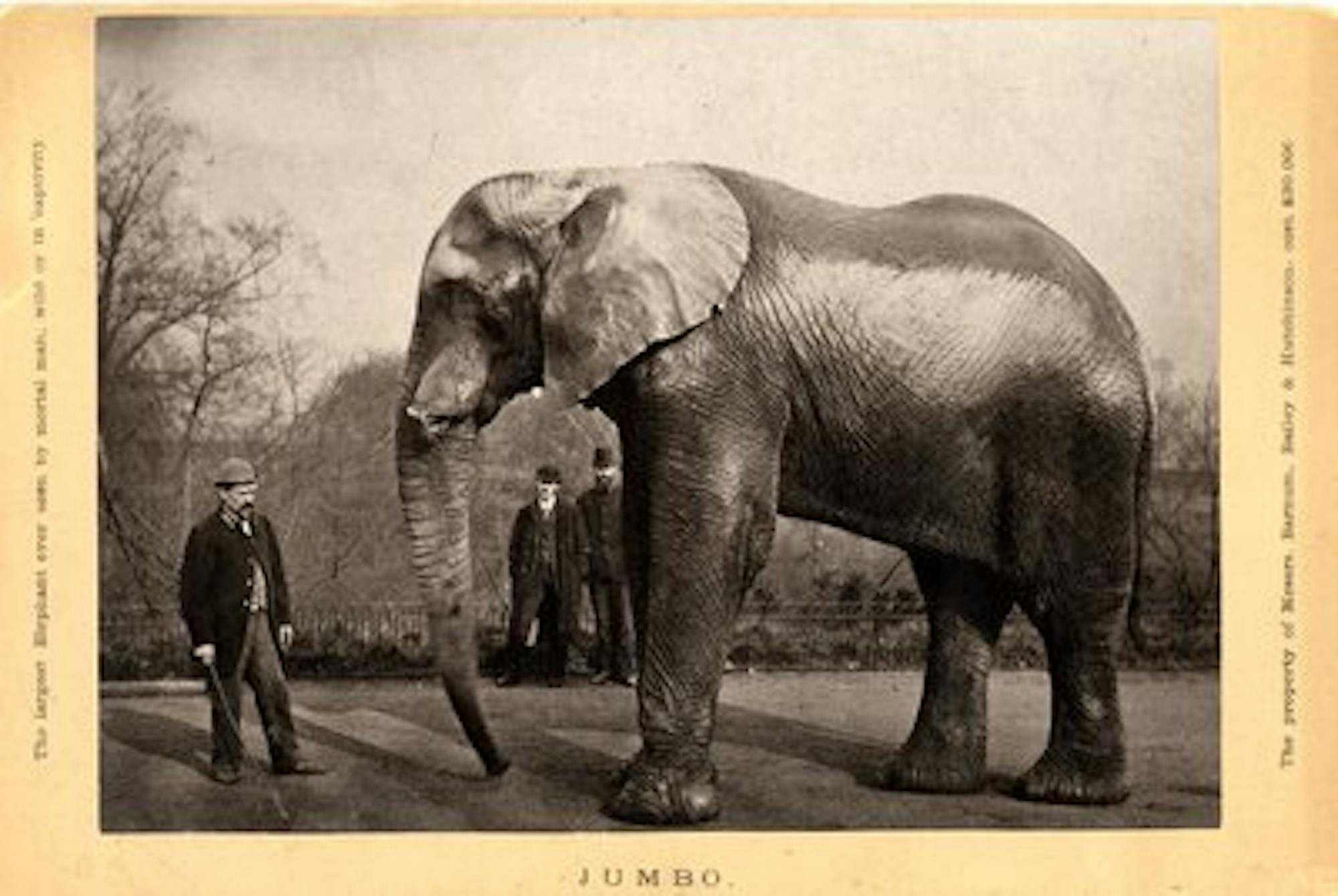
Jumbo and his trainer are pictured in 1882. Caption on side of photograph: “The largest Elephant ever seen by mortal man, wild or in captivity.”
However, upon learning that P.T. Barnum’s treatment of Jumbo was consistent with cruel practices towards circus animals at the time, Strout wondered why Jumbo’s nuanced history lacked visibility on campus. He especially noted the lack of information on the plaque next to the statue of Jumbo outside of Barnum Hall.
“You go to read that plaque, [and] it’s this cryptic nod to P.T. Barnum donating Jumbo, as if Jumbo is this entity that can be donated, and then Jumbo is positioned outside of Barnum Hall, the very man that kept him in chains,” Strout said.
According to Strout, finding more information on Jumbo’s background and history required digging into the archives, like Wilan did.
It was then that Strout connected with Four Paws, an animal welfare organization looking for a home for a sculpture of another elephant named Madhubala who had been rescued from inhumane zoo conditions in 2024. According to Strout, Four Paws had expressed interest in rehoming Madhubala to Tufts towards the end of 2025 as a nod to the university’s pachyderm mascot. However, according to Strout, Four Paws also requested that Tufts institutionally acknowledge the complexities of Jumbo’s story as a traveling circus animal should they acquire Madhubala.
Although Strout was met with opposition, he connected with Wilan in January, where he found reassurance in learning of Wilan’s shared concern for Jumbo’s representation on campus.
“When you’re met with apathy, you’re made to feel like you’re caring about something stupid … but meeting [Wilan] is like, okay, he’s coming at it from a different angle [of] returning Jumbo, but he’s also very interested in Jumbo’s true story,” he said.
For both Wilan and Strout, the motivation to center Jumbo’s history and legacy on campus largely stems from a feeling of a lack of school spirit and identity.
“I do think a lot of students here generally feel a lack of school spirit,” Wilan said. “There’s not a strong [school] identity … but Jumbo the elephant is actually one of the few things that I think people do feel strongly about.”
Strout agreed, stating, “This school lacks identity more than any other academic institution I’ve ever been at. But you meet the students, you talk to the students … I’m so inspired by how awesome these people are, but they are not uplifted in the way I think they should be by the administration.”
Wilan’s decision to campaign for the exhibition of Jumbo’s skeleton comes after his frustration with a series of administrative decisions surrounding longstanding traditions at Tufts. This includes the university’s decision last fall to paint over the Tufts cannon weekly after announcing an adoption of institutional pluralism and the demolition of the former Zeta Psi house in 2025, a fraternity that had been active on campus from 1856 until it was disbanded in 2021 for violating Tufts’ COVID-19 guidelines.
Wilan expressed frustration with what he viewed as a lack of response from both students and administrators to these significant changes regarding Tufts traditions.
“As a student of history, it’s just upsetting to see no one giving a s---,” he said. “There’s just a lot of easy things that can be done [to] build spirit and build community.”
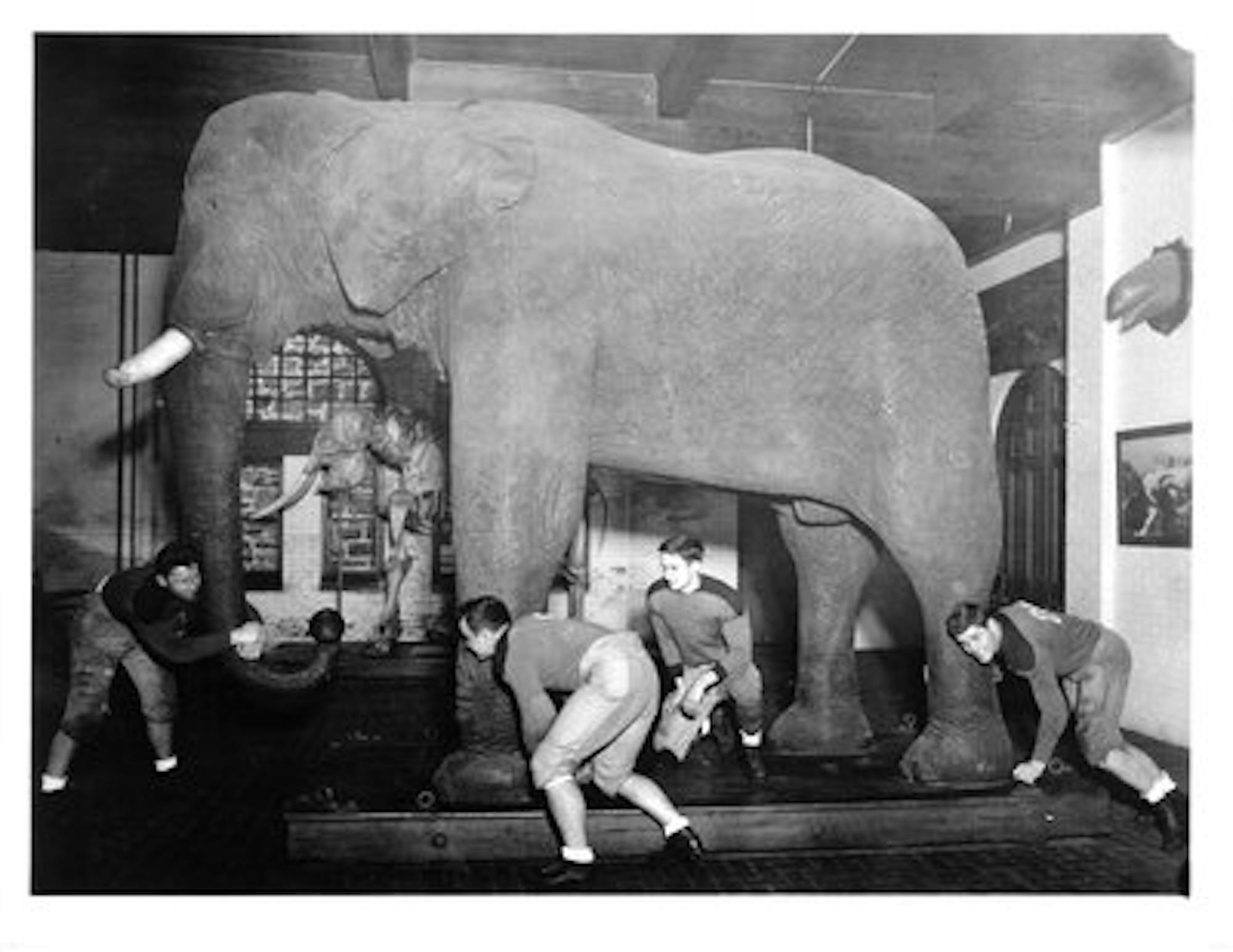
Football players circle around stuffed Jumbo statue in 1935.
Wilan and Strout both acknowledge that bringing Jumbo’s skeleton or Madhubala’s sculpture to Tufts are not easy tasks, and that significant costs and efforts would likely go into achieving such projects. But both students expressed a desire for the university’s administration to engage with the conversation in a deeper way than Wilan and Strout experienced in initial meetings.
Their next steps in bringing Jumbo’s skeleton to campus are to gauge student support and general interest in the campaign. Wilan has drafted a petition that he plans to start collecting signatures for around campus, while Strout plans to take the petition to the Cummings School of Veterinary Medicine at Tufts. Additionally, Strout aims to continue to be in talks with administrators at the Cummings School of Veterinary Medicine to lobby for the adoption of Madhubala’s sculpture.
Santamaria agrees that other means of honoring Jumbo’s complicated history are worth pursuing.
“[Jumbo] is a beloved mascot and symbol of community and connection but also an example of the impact of western colonization and of animal cruelty. I agree that it would be beneficial to tell the story of Jumbo in a more nuanced way,” he wrote.
According to Santamaria, TARC is currently in the planning stages of a digital exhibit on Jumbo and would be interested in collaborating with students and faculty on campus to create the exhibit.
However, Wilan continues to advocate for the retrieval of Jumbo’s bones, arguing it has potential to unite the Tufts community.
“We have a passion for this university. We have a care for the university, for the spirit of the university, for the story of the university, for the story of Jumbo the elephant. There’s a real story to be told, and there’s a skeleton that’s [been] sitting in storage since the ‘70s. How do we inspire any sort of action?” he said.



