Editor’s note: The Daily’s editorial department acknowledges that this article is premised on a conflict of interest. This article is a special feature for Daily Week and does not represent the Daily’s standard journalistic practices.
At the heart of journalism are stakes. At the Daily, this often takes the form of stakes for the school, the writer, the subject matter and members of the greater Tufts community. During some of the most tense moments at Tufts and in the world around us, the Daily holds itself to the highest standards of reporting. It prioritizes objectivity and a commitment to providing information for the university community, even when its subject matter may be highly sensitive or controversial. Yet, in the past year in particular, writers have been faced with tackling difficult topics as current events have begun to hit closer to home.
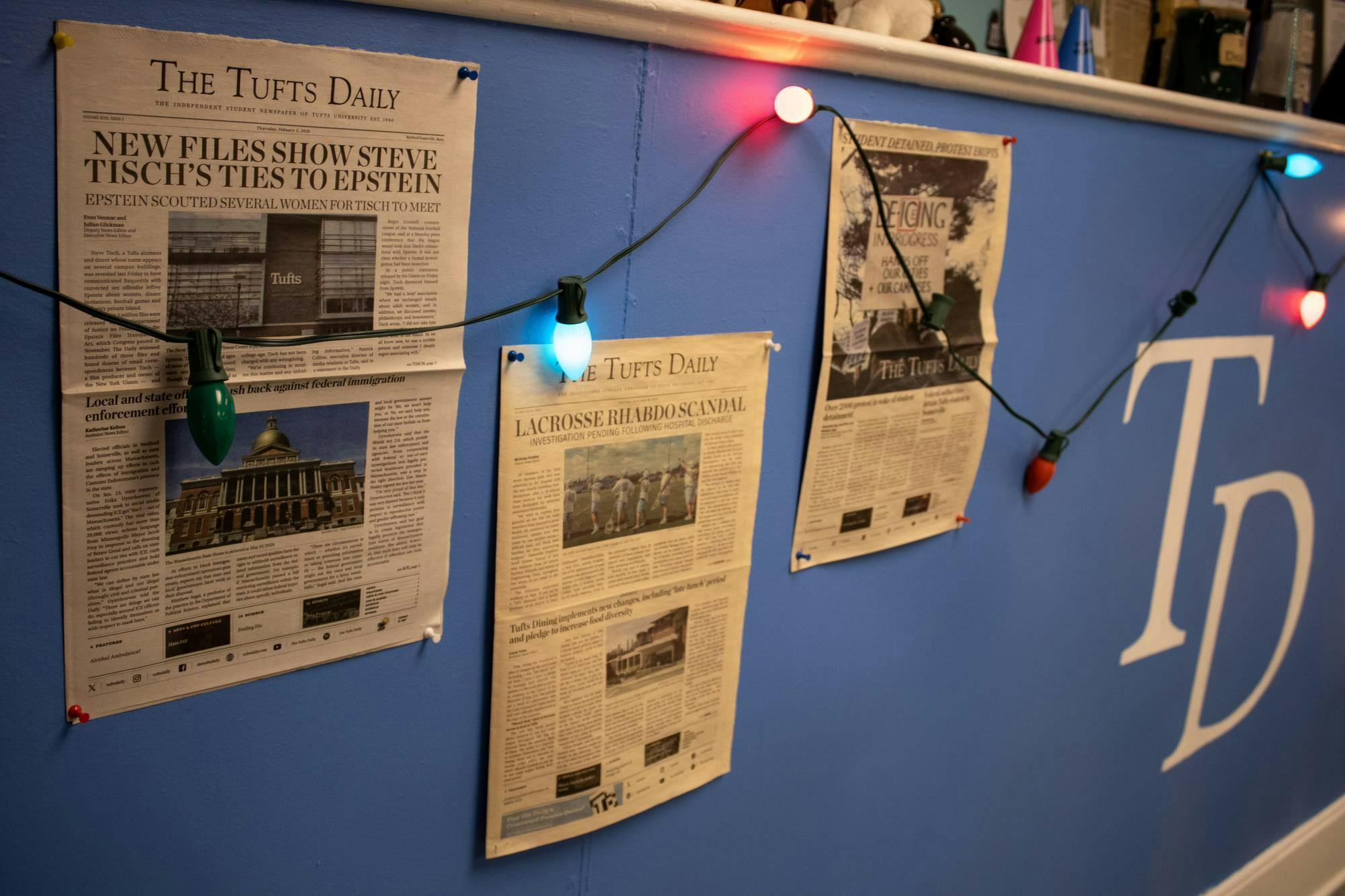
It is one thing to write about domestic or international events that seem far from the reach of stakeholders and administrators at the university. Yet, as Tufts has faced numerous implications of the current Trump administration within the past year — including the detention of now-graduated Ph.D. student Rümeysa Öztürk (AG’26), Steve Tisch’s (A’71) presence in the Epstein files and threats to university funds — the stakes feel higher than ever and will likely remain so.
Approaching these topics is never easy, but the Daily’s leadership tries to equip writers with the tools necessary for objectivity in the news section. Junior Samantha Eng served as executive news editor for the spring 2025 semester, during a pivotal moment for the Tufts community regarding national immigration policy. Upon Öztürk’s detainment, the news team grappled with how to provide information to the larger Tufts community in an accurate and timely manner, given the sensitive nature of the issue and the fact that it became a national headline. Eng emphasized the importance of consistency during the process.
“I [would] triple check everything because I didn’t want anything to be incorrect, but the goal is [to] do that for any article,” Eng said. “That’s why we adhere to the process that we do, because when something happens that’s suddenly high stakes, we treat it the same way we would anything else.”
It is this commitment, Eng believes, that made her “ready” to handle the reporting of Öztürk’s detention. However, she noted nuances that made the process different from other articles, including the difficulty of obtaining interviews from the larger Somerville community. Anonymity was prioritized out of concern for safety.
“Rümeysa was also targeted because of an op-ed that she co-authored in the Daily. And so I think people knew that it’s not like the Daily [doesn’t have] visibility,” Eng explained. “[What] you say in our publication could really matter, and it could really be consequential to your safety and your life.”
Shifting to more recent events, the article and subsequent explainer video surrounding the Steve Tisch scandal shared a different kind of sensitivity but was still highly consequential. Current executive news editor and sophomore Julian Glickman elaborated on the process for covering the article, noting that while The Athletic had already covered the story, it was essential that the matter was handled with care given its potential impacts on Tufts’ reputation. However, he had to grapple with his own opinions while producing the piece.
“[The Tisch family] are donating money to the university … in most cases, for a good cause — building a gym, building a library, scholarships, stuff like that,” Glickman noted. “[Steve Tisch] also hasn’t been convicted of anything [or] charged with any crime. But obviously this is disgusting behavior. So I think there was that balance of, how can we be fair and be forward to get a point across?”
Additionally, as a news writer, sharing information that is intended to be objective can often receive feedback expressing a preference for one side. Glickman recalled seeing Instagram and Facebook comments that heavily criticized Tisch and feeling slightly concerned that readers thought he conveyed a similar critical impression while writing the piece.
“In those cases … my reaction is [that] some people don’t realize that news is supposed to be really impartial,” Glickman said. “People think journalism is about taking a stand, and I personally don’t think that’s the case.”
Sophomore Zach Halverstam, executive investigative editor, also recalled having questions surrounding personal beliefs arise while writing. In particular, he noted a piece he wrote last year that covered a Tufts visit by Mick Mulvaney, President Donald Trump’s former chief of staff. As a student with opposing views to this speaker, he reflected on how he approached the writing process.
“How am I making sure this is nonpartisan, and [is] just a good article that people in the Tufts community can get?” he said.
Halverstam also received hateful messages after writing both the piece on Mulvaney and one on the NCAA’s new policies regarding transgender athletes.
“I do my best to deal with it. It’s never fun to receive it. But if anything, I’m happy that people are [reading] it,” Halverstam said.
Yet, writers are often reminded that despite the important work they voluntarily take up to provide information to the larger community, they are still students.
“Rümeysa’s detainment was a big ongoing story that didn’t really wait for my life to go on,” Eng said. She noted the difficulty of balancing a full workload of classes, managing the rest of the news section and dealing with the added pressure of monitoring such a high-profile case.
Halverstam mentioned conflicts of interest when it came to investigative journalism, especially as writers are often active participants in the subjects they are investigating.
“I’ve done some stuff where we’re writing about residential life, and it’s kind of hard to write [about] people that control your housing,” he said.
Despite moments like these, Halverstam emphasized the valuable experiences he has gained from working at the Daily. Similar to Eng, he noted difficulties balancing workload as a full-time student while also often sacrificing other commitments for the publication. However, he has found the work to be rewarding and loves his role as an investigator.
“It’s very exhilarating work, and it’s something [you] don’t get before college,” he said. “The fact that the Daily allows recent high school [graduates] to go in and talk to politicians, do off-the-record interviews and cover these really contentious topics is a great opportunity,” he noted.
Halverstam recalls what first drew him to the investigative section. “I found that it was doing really interesting work where you’re going deep into the Tufts community … [and] having really interesting conversations,” he said. It is this that grounds him in the reporting process.
“This is a really sophisticated operation. … This is real journalism,” Halverstam said.