
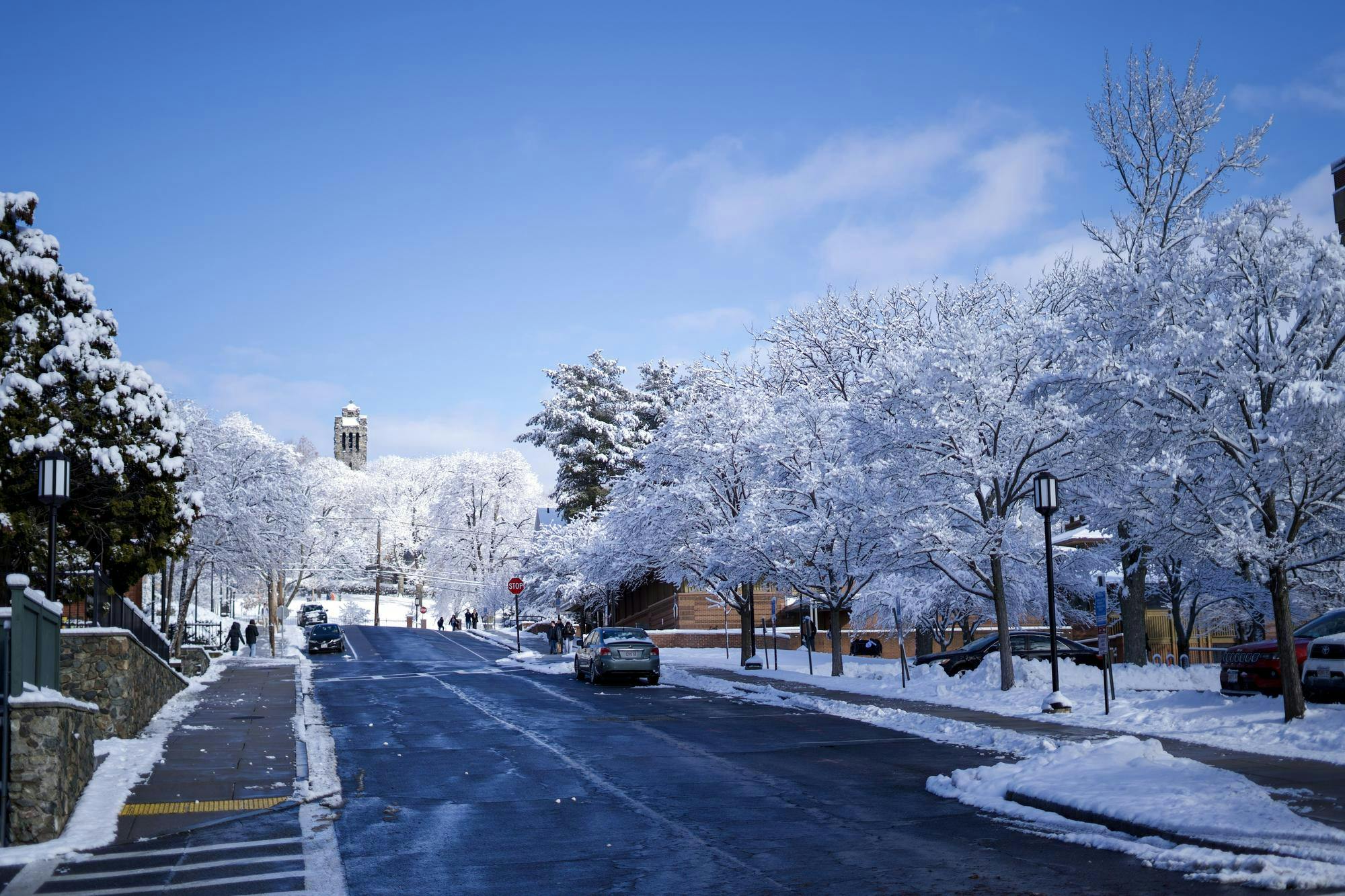
Medford and Somerville were hit with more than 20 inches of snow in late January, marking the largest snowfall in the area since 2022.
The university closed all campuses at noon on Jan. 25, and remained closed all day Jan. 26, canceling classes as facilities teams worked to clear roads and sidewalks. The cities of Medford and Somerville declared snow emergencies that same weekend.
Large weather events require a cross-departmental response. According to Vice President for Operations Barbara Stein, Tufts’ snow removal effort involves collaboration and communication among Grounds, Facilities, Public Safety, Parking & Transportation, Emergency Management and contracted vendors. The university also coordinates with the Departments of Public Works in Medford and Somerville, as well as the MBTA.
By the end of the storm, however, not all residents were satisfied with plowing efforts on and off campus, particularly on residential streets. In a video posted to social media, Somerville Mayor Jake Wilson acknowledged the backlash and encouraged residents to report unplowed streets. He said delays on residential streets were due to a focus on high-traffic areas and schools.
“We’re seeing the emails, comments and messages about streets that still need plowing. Definitely report unplowed streets to 3-1-1 so DPW is made aware,” Wilson said. “The top priority in snow clearing is always high-traffic streets, with neighborhood residential streets next on the list. The city will continue plowing private ways as a courtesy to residents as we’re able.”
Grace Munns, Deputy Director of Communications for the city of Somerville, wrote in a statement to the Daily that the city is responsible for public roadways and sidewalks, while private property owners must clear sidewalks adjacent to their properties.
“Tufts maintains its campus buildings, certain internal road surfaces and internal pathways,” she added.
Stein wrote in a statement to the Daily that storms of this magnitude require significant time and resources to manage safely. She said the layout of the Medford/Somerville campus makes snow removal especially challenging.
“Medford/Somerville is a dense campus with roadways, parking lots and sidewalks that make finding places to move large amounts of snow more challenging and time consuming,” Stein wrote. “There are over 10 miles of snow and sidewalks.”
Stein also noted that main campus roads — such as Professors Row, Packard Avenue and Latin Way — are prioritized first for clearing, along with main entrances and emergency exits to residence and dining halls, ADA-accessible curb cuts and accessible parking spaces.
“Clearing secondary walkways and less traveled stairways can occur after the main paths are cleared,” Stein wrote.
Similarly, Munns wrote that Somerville DPW “has a carefully sequenced snow removal plan that prioritizes keeping major roadways and emergency routes passable first so that fire, police and medical services can respond safely.”
In preparation for storms, university officials said updates are provided to the community immediately after decisions are made. The university primarily monitors storms using information from the National Weather Service.
“We receive updated forecasts throughout the day and participate in NWS briefing calls to understand the severity, timing, and potential impacts,” Patrick Collins, executive director of media relations at Tufts, wrote in a statement to the Daily.
Both Tufts and Somerville officials emphasized that snow response plans must remain flexible.
“The storm required rapid mobilization across departments while conditions were still evolving. Forecast shifts and the duration of the storm required [Somerville] crews to adjust timing and deployment in real time,” Munns wrote.
Stein echoed that sentiment, noting that “response needs are based on each individual storm.”
After storms, the university and its surrounding communities grapple with the damage caused and evaluate their response.
Yolanda Smith, executive director of public safety at Tufts, told the Daily that she considers a storm response “successful” when the “groundwork behind the scenes [is] strong.”
She cited clear communication, adequate staffing, preparation for conditions worse than anticipated and the restoration of normal operations as safely and efficiently as possible.
Stein wrote that moving forward, the Public Safety team “would like to receive feedback about areas that may be a higher priority to student life to ensure ground priorities are aligned with student usage.”
Munns noted that after every major storm, the Somerville Department of Public Works conducts an internal review to identify opportunities to enhance and improve strategies for future events.
When asked what information might have been helpful to know earlier during the storm, Smith acknowledged the unpredictability of severe weather.
“I jokingly wish Mother Nature could be more precise about snow totals and timing — but we know that’s not reality,” she wrote.



