“The cure is where the disease is not, and the disease is where the cure is not.”
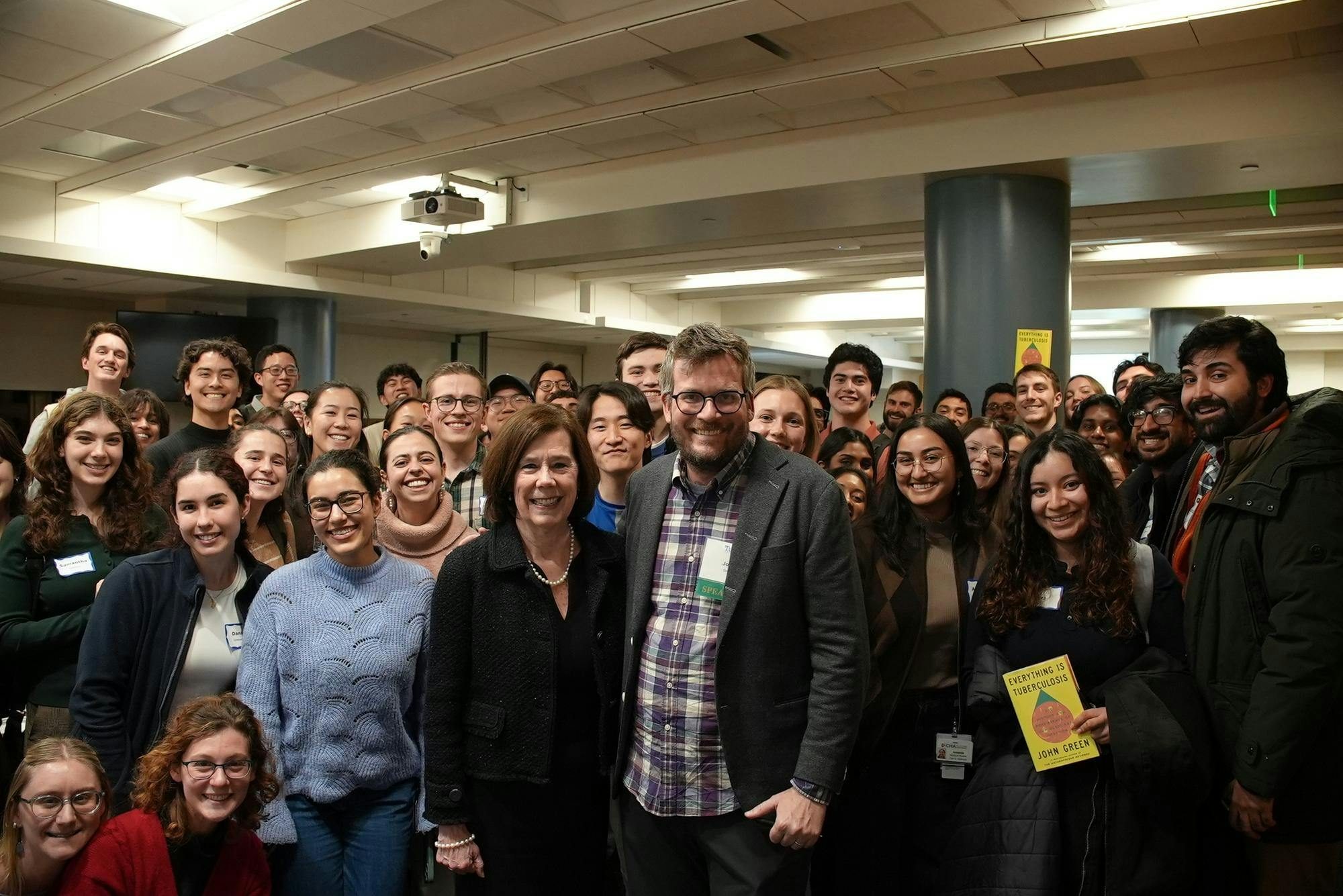
This is one of the standout lines in highly acclaimed author and internet personality John Green’s 2025 nonfiction book “Everything is Tuberculosis.” The book, which explores the history and social impact of the world’s deadliest infectious disease, was the 2025 selection for the Tufts University School of Medicine and Tisch College’s MD Common Book Program. This program, for all first-year medical students, aims to connect incoming classes and facilitate discussion through a shared academic experience in the form of a book.
The program typically culminates in a lecture event featuring a guest speaker, which is why on Feb. 4, many members of the Tufts community found themselves sitting in a packed auditorium at the School of Medicine — in front of Green himself.
“Everything is Tuberculosis”’s unassuming, brightly colored cover makes it difficult to predict the grave themes of disease, public health issues and inequity inside. However, it also contains a thorough dose of hope, for those afflicted with the disease and the health care professionals who treat it, that there is a cure — the issue merely lies in access.
Like many readers, I picked up the book thinking it would be history-focused and filled with copious references to 19th century deaths. As it turns out, before writing the book, Green felt much the same — he was surprised to discover that not only is tuberculosis a contemporary issue, but it is still the world’s deadliest infectious disease, killing over a million people each year. With such major leaps forward in medicine since the 1800s, Green sought to answer: What is stopping us from eradicating it?
Green first became interested in the issue of tuberculosis during a 2019 trip to Sierra Leone, originally intending to learn about the maternal mortality crisis there. During a visit to a tuberculosis hospital in Lakka, he met Henry Reider — a 17-year-old who, due to a combination of childhood malnutrition and tuberculosis, resembled Green’s own 9-year-old son.
Reider’s story impacted Green so profoundly that upon return, he found himself diving deep into the nuances of medical care, access to antibiotics, history and the barriers preventing patients from receiving treatment for a disease that has been curable for decades.
“My hope is that readers will emerge from the book feeling both encouraged — our investments in global human health have paid off to a remarkable degree — and also infuriated that we are allowing over a million people to die annually of a disease we’ve known how to cure since the mid 1950s,” Green wrote in an email to the Daily.
Within the School of Medicine, many young professionals similarly hope to make an impact on the global health care field. Green — a childhood staple who gained fame through educational YouTube channels like Vlogbrothers and Crash Course and is now a global health activist and bestselling author — was a highly anticipated guest. The event, titled “A Conversation with John Green: Everything Is Tuberculosis,” sold out in mere hours.
“We got a lot of early questions before we had even confirmed John Green to speak, [like] ‘Oh my gosh, could he speak on campus? I grew up reading his books,’” Jessica Byrnes, senior communications manager at the Jonathan M. Tisch College of Civic Life, said.
Green came to Tufts as part of the Dr. Maurice S. Segal Lecture series, hosted jointly by The Fletcher School and the School of Medicine. The lecture series aims to encourage dialogue and address global challenges. The event was also part of the Tisch College Solomont Speaker Series.
For Helen Boucher, dean of the School of Medicine, the importance of events such as this one lies in rounding out students’ medical education.
“If we don’t value people, if we don’t value communicating well with people and meeting people where they are, we won’t be good physicians. So I think that this was a beautiful example of the importance of the humanities,” Boucher said.
In the auditorium, the crowd buzzed in anticipation. Professor Ramnath Subbaraman, an infectious diseases physician and epidemiologist specializing in tuberculosis, introduced Green, dubbing him “the best thing to happen to TB.”
However, Green views the real heroes as the people treating the disease on the front lines.
“Healthcare workers support the health of individuals but also the health and well-being of our communities, and through their work, our societies get stronger,” Green wrote. “That said, navigating unfair systems always leads to burnout, and one must navigate very unfair systems to deliver healthcare in the U.S. and globally.” During the panel, his advice to medical professionals was to “find something to feed you,” both emotionally and intellectually.
Green additionally weighed cynicism against wanting to help others, highlighting the intense burnout many health care professionals experience with so much stacked against them. This sentiment resonated deeply and was echoed by multiple Tufts medical students both before and after the panel.
“You can’t [solve] burnout for us, but that inspiration is why I’m here. I need to be re-inspired to come back to this field, because it does take from you,” fourth-year medical student Hasan Khan shared, reaffirming the importance of events, books and motivated individuals such as Green in sustaining inspiration for many health care workers. “He’s not a physician himself, but he’s the person that does remind me of the humanist side of medicine,” Khan added.
Subbaraman highlighted the necessity of humanism in today’s medical sphere, where health care workers are being laid off in increasing numbers and funding for global health care programs such as the U.S. Agency for International Development has been dramatically slashed. For Subbaraman, witnessing care by medical professionals who hope to improve patients’ lives is inspiring in this current moment. “What really gives me energy is getting to the ground where these conditions actually exist,” Subbaraman reflected. “You really see the motivation of people to try and continue to move things forward.”
The event branched into a range of topics, touching on international health care, the power of online communities and the politics of information. Despite such a large internet presence, Green acknowledged the limitations of his reach. He highlighted the statistic that only 2% of his surveyed Vlogbrothers audience voted for President Donald Trump, explaining the difficulty in “reaching across the aisle” due to public health care mistrust, the structure of online communities and the algorithms that power them.
However, online communities can also spark meaningful change. In 2023, Green and his ‘Nerdfighter’ fanbase successfully pressured major health care corporation Johnson & Johnson not to enforce a secondary patent for its tuberculosis medication Sirturo in 134 low-income countries, directly leading to lower costs and wider access to tuberculosis care. For many, this was confirmation that collective action and effective lobbying can create tangible change.
“I think a lot of med students took from this conversation the idea that we’re more than just people who diagnose and treat,” first-year medical student Shawn Noronha said. “As medical students here at Tufts, we have this course … that really tries to introduce us to a lot of these topics, where it’s not as simple as: ‘Figure out what’s wrong with the patient, treat the patient.’ A lot of times there’s these systemic barriers or individual barriers that prevent them from getting treated.”
Subbaraman also emphasized this holistic approach to patient care. “What I’m hoping students walk away with is this idea that we’re all interconnected, that we should be thinking about people elsewhere, and that should be part of our moral and ethical understanding of the world,” he said.
Subbaraman went on to explain how manufacturing locations, stakeholder interests and patents all drive up the cost of basic care for tuberculosis. More recently, low-income countries have taken the lead in domestically producing generic medications with great success and lower costs.
“This just speaks to the need to have empowerment in low and middle-income countries to be producers of these technologies, and not just consumers of them,” Subbaraman said.
After learning about these global and seemingly impenetrable issues through Green’s book and talk, one might wonder: Where does the world go from here?
“While there are (very!) discouraging trends when it comes to issues like vaccination rates and overall trust in the healthcare system, I think there are real reasons to be optimistic, and I wanted to emphasize those to the students at Tufts. The year I graduated from college, over 12,000,000 children died under the age of five. Last year, fewer than five million did. That’s real cause for hope,” Green wrote.
With the immense complexity of these looming global health issues, change is not solely in the hands of medical professionals.
“Scientific innovations are critical, but scientific innovations have zero impact without advances in healthcare delivery and implementation,” Subbaraman said. He recommends students “engage in educational opportunities that can intersect with these global problems.”
Throughout the event, Green also emphasized the importance of hope.
“It’s not the end of the story,” he said. “Today is the middle of the story of humanity.” He stressed the importance of valuing lives equally and creating systems to support those values.
“We make more progress when we value the lives of people who are not being adequately valued by the social order,” Green said. “There is cause for hope.”