
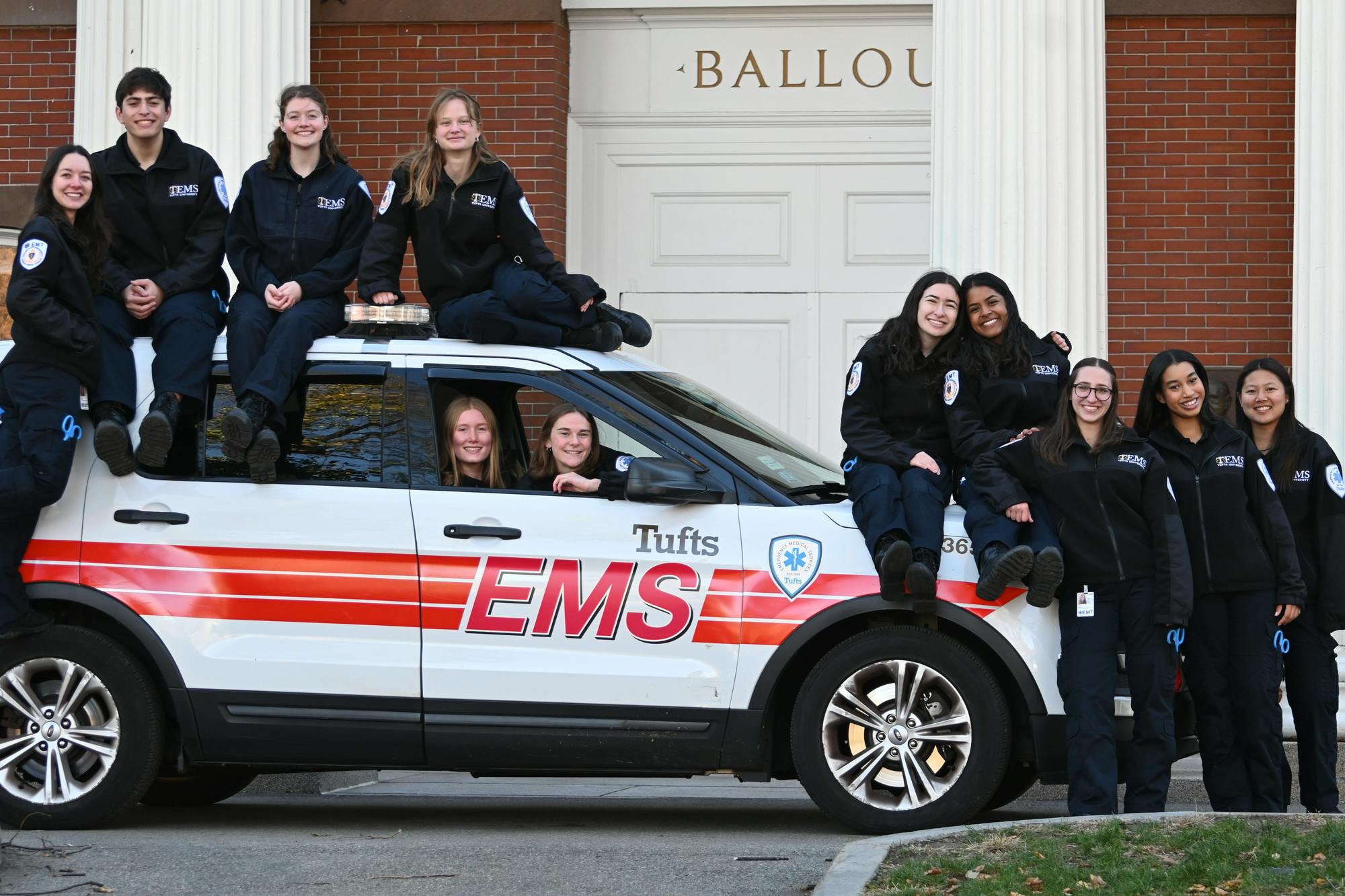
For many new students at Tufts, the idea of living on their own for the first time is intimidating. They are now responsible not only for their studies, but also for laundry, meals and even their own physical health. One thing that can be particularly frightening to experience while away from home is a medical emergency.
Tufts Emergency Medical Services, also known as TEMS, is intimately familiar with helping students through these situations. At Tufts, a member of the TEMS team is often the first face someone sees after having a medical emergency and calling for help.
Unlike traditional EMS response teams, TEMS is student-run and campus-based, making it easier for students to do EMS work while also taking classes. While TEMS members receive guidance and work closely with the Tufts University Police Department and the organization’s medical director, Dr. David Schoenfeld, the group is otherwise run and operated entirely by student volunteers.
“A lot of the time, you think of EMS [as] kind of rough around the edges. You’re only interacting with these providers for a short amount of time. It can be intimidating,” junior Sarah McVey, TEMS’ director of operations, said.
“Having a student EMS organization is really impactful because … there’s less of a power dynamic when you are treating or talking to a patient, and I think there’s an element of comfort that we can provide to a patient that an adult working at [an] outside EMS might [not necessarily] be able to provide,” McVey explained.
According to junior Katherine Harbaugh, the current executive director of TEMS, their Friday and Saturday nights are “heavily loaded” with intoxication-related medical calls “in front of [Delta Tau Delta] or Theta Chi.” Through these public encounters, TEMS has developed a reputation on campus as an ‘alcohol ambulance.’ Many students are unaware of the breadth of calls TEMS responds to or the amount of training required to become a member.
“The most public calls happen to be when people are intoxicated outside of a frat,” Harbaugh said. “People don’t really know [about] the other types of calls that we see.”
Students can apply to join TEMS in both the fall and spring of their first or second year. While the application process is fairly involved, including an interest form, written test, practical exam and interview, the only requirements are a Massachusetts-valid EMT-B license, Basic Life Support CPR certification and a valid U.S. driver’s license.
Since TEMS is student-run, the organization emphasizes the educational aspect that goes along with learning and growing as an EMT. Harbaugh, for instance, had no prior clinical experience before applying.
“I was rather intimidated … at first because everyone seemed so impressive and competent, and also much older,” Harbaugh said. “I didn’t even know if I was [planning] to use my license when I first got it because being an EMT sounded so terrifying. … Some people love the idea of being thrown into the deep end on their first day, … but I liked the idea of TEMS, knowing I could … work my way up and really focus on fine-tuning my skills and patient interactions.”
Because TEMS requires no prior EMS experience and accepts only underclassmen, the organization takes care to ensure that every new member receives thorough preparation before responding to calls.
All new TEMS members complete a rigorous training program upon acceptance, covering how to respond to a wide range of medical emergencies, and handoff procedures with outside ambulance services that transport patients to hospitals.
After initial training, the entire TEMS team participates in monthly training sessions with the student director of training and quality assurance as well as with Dr. Schoenfeld. Members also complete a high-acuity training session each semester.
Senior Ellie Pantekidis holds the title of the TEMS’ highest clinical position and is responsible for independently leading calls and helping train new members. With her experience in this role, and as the 2024 director of training and quality assurance, she is particularly familiar with the education and training that goes into the organization.
“At its core, TEMS is a very learning-based organization,” Pantekidis said.
While TEMS’ campus-based jurisdiction is highly convenient, some students struggle to choose between joining TEMS and working for outside EMS due to the financial barrier posed by TEMS’ volunteer model. Balancing academics with one to three unpaid 10–14-hour shifts per week can be difficult, especially for students who need paying jobs. While there are some paid opportunities for TEMS members, such as teaching assistant roles for the EMT certification course at Tufts or working campus events like Spring Fling, TEMS remains a volunteer organization. As part of an effort to increase accessibility, TEMS members are working to reduce financial barriers to EMT certification.
“We … have a really great initiative right now … the Tufts Emergency Care Course Scholarship … [which] covers the lab fee associated with the emergency care course,” Pantekidis said. “Our hope … is to help make the [organization] more equitable and accessible.”
Another deterrent for some students is TEMS’ reputation as a service that responds primarily to intoxication calls.
“Sometimes TEMS gets a rep for just responding to intoxication calls. But really, we [also] do a lot more medically-based emergencies, like allergic reactions, respiratory etiology or trauma,” Pantekidis said.
“It is tough to have misconceptions about something you’re a part of. But I am completely fine with people not knowing everything that we do, because it just speaks to how serious everyone is about patient confidentiality,” Harbaugh said.
Confidentiality is especially critical for mental-health related calls, which TEMS frequently responds to. McVey recalled one such call and how TEMS’ student-run structure shaped the response.
“There was one call for mental health that we did, and there was … potential … for … self-harm. Getting to that call, I was … filled with gratitude that they felt that they could call somebody for help,” McVey said. “I like to think that the fact that fellow students are going to be showing up to offer assistance is a little bit comforting.”
“You understand the experiences of Tufts students in a way that outside people [can’t]. You get a sense for the community here, the events on campus, the classes, the rigor of the courses in general,” McVey explained. “Just knowing what they’re going through, … and knowing that we understand the situations they’re facing, being a student at Tufts … I think it’s really helpful.”
Correction: This article was edited to include an additional quote from Katherine Harbaugh. This edit was made on March 8.



