
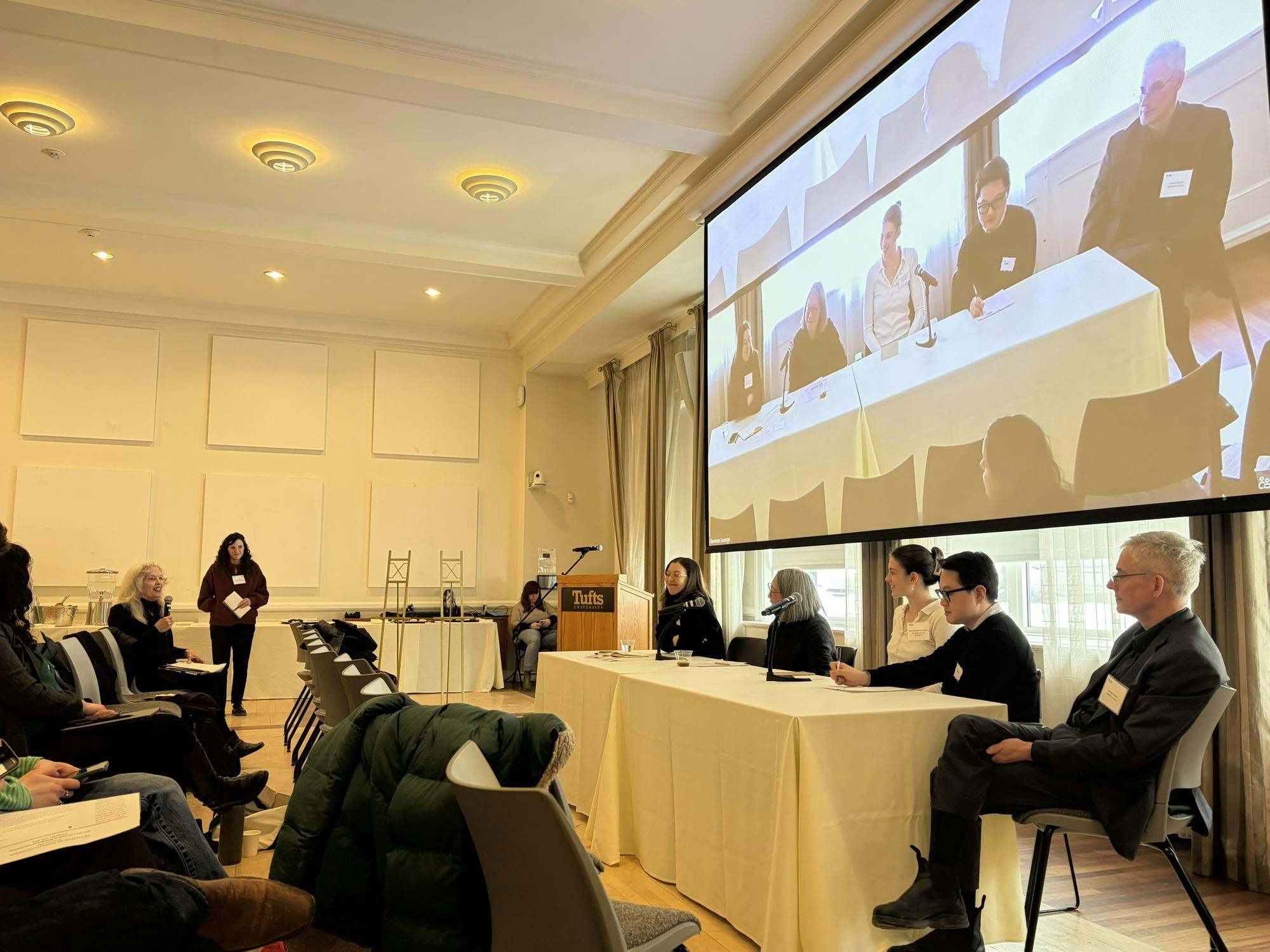
The Tufts literary community gathered in Alumnae Lounge on Feb. 6 to weather the cold with the Department of International Literary and Cultural Studies’ annual symposium. This year’s theme, ‘Transformation Now!’, framed a morning of scholarship where speakers took turns sharing their theses, papers and research revolving around the topic of transformation.
“We brainstormed a few options when our colleague in ILCS, Susan Napier, came up with the idea of Transformation,” Sarah Corrigan, an ILCS assistant professor, wrote in a statement to the Daily. “Professor Napier is a specialist in animation, a medium that emphasizes transformation and fluidity. Napier saw the transformation theme as very appropriate for today’s constantly changing world.”
This year’s ILCS Symposium featured many different speakers. The Coit-Phelps Keynote Speaker was Elaine Scarry, the Walter M. Cabot Professor of Aesthetics and General Theory of Value at Harvard University’s English department. The day featured two main panels after the keynote speaker.
The speakers on the first panel included both faculty in the ILCS and music departments and seniors currently working on their honors theses in ILCS and International Literary and Visual Studies.
The ILCS major allows students to explore the language, culture and literature of seven possible specialized areas: Arabic, Chinese, German, Hebrew, Japanese, Russian and a multicultural comparative track. Similarly, the ILVS major encourages students to explore literature and visual media in an international context.
“Both ILCS and ILVS majors foster a community of intellectually curious, experimental, cross-cultural, and often multilingual thinkers, who are interested in building bridges across broad ranges of literary and artistic canons,” Corrigan wrote. “These are majors where students are trained to think creatively and comparatively, making connections across time, place, and medium. ILCS and ILVS also celebrate the value in studying language, so that students learn to engage with the diverse thought of other cultures and to express themselves in a language and context that once felt foreign to them.”
Elizabeth Merryweather, a senior studying ILCS, spoke in the first panel about transformative dialogue in Leo Tolstoy’s 1878 novel “Anna Karenina.” Her central question was, “Is there any form of dialogue that can truly transform us?” In her talk, which was based on a brief snippet of her larger senior thesis, Merryweather explored the ways in which characters can destroy and subvert the text of a novel in order to discover deeper, hidden meanings from it.
“I focused on … this idea that by learning to read each other through dialogue, we can better understand how to read literature and how to be better literary critics. And that in that way, life experiences inform the way that we read and the way that we read informs life experiences,” Merryweather said.
Other speakers in the morning panel included Joseph Auner, a professor in the music department. Auner’s discussion was called ‘Virtual Arnold: A Schoenbergian AI Origin Story.’ Auner focused on a new AI program known as Virtual Arnold, a large language AI model that serves to educate people around the work and insights of Austrian-American composer and music theorist Arnold Schoenberg. Woven throughout his work was the question of how asking AI models open-ended questions that always produce a different response can transform the way they are used.
The final speaker on the first panel was Dorothy Wang, chair of and an associate professor in the Department of Studies in Race, Colonialism, and Diaspora and an associate professor of English. Wang’s interpretation of the theme of transformation was different from Auner’s, bringing the listeners back to the world of writing to discuss the place of poetry criticism in extreme and difficult circumstances. She referenced the famous line written by Theodor W. Adorno: “To make poetry after Auschwitz is barbaric.”
Wang encouraged the audience, many of whom were faculty or students of artistic disciplines, to dig deep and question how both the genres of writing and criticism function differently in tense and violent socio-political climates. Corrigan further expanded on this idea.
“Professor Wang stated in the Q&A that ‘poetry can save lives,’ and her talk calls us to ask ourselves — as scholars and students of the humanities — if and how our work participates in this vital dimension of art,” Corrigan wrote. “I think that the study of the humanities is needed more than ever because dialogue around art is exactly what can lend depth and resilience to our culture in moments of intense change and conflict.”
Senior and ILVS major Alexander Crété spoke during the second panel. Crété’s work focused on Thomas Mann’s 1912 novella “Death in Venice.”
“The main character … undergoes a violent egoic unraveling, which I style an ‘ego death.’ I argue in the talk that it’s this pursuit of form itself which leads him to formlessness, and this vice-like grip that his artistic discipline has upon his psyche which creates the alterity which returns to undo him,” Crété said.
The ILCS Symposium provided many students and faculty a place to showcase their work and gather to discuss the relevance and power of transformation across literature and visual media.
“The ILCS Symposium is, for me at least, where we put our training in the humanities into practice and to the test. Art, film, and literature provide a shared medium to engage the wide range of thought across campus. The result is that we have conversations we would have never otherwise had. And original thought is embraced, challenged, and celebrated,” Corrigan wrote.



