
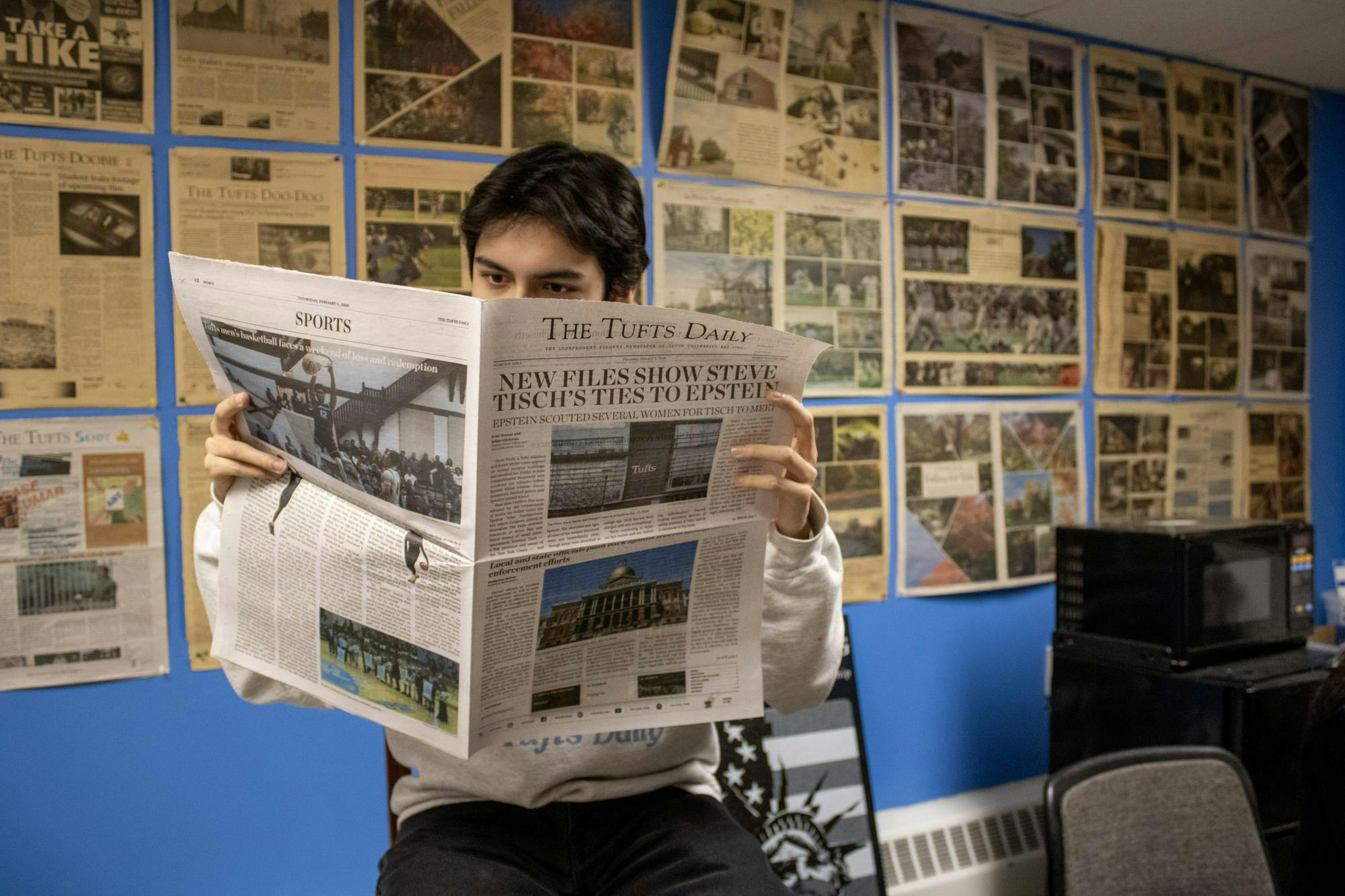
Editor’s note: The Daily’s editorial department acknowledges that this article is premised on a conflict of interest. This article is a special feature for Daily Week and does not represent the Daily’s standard journalistic practices.
What most readers of The Tufts Daily see is only a polished, thoroughly reviewed and fact-checked finished product: the new Daily article in your email, the printed copy in the Tsungming Tu Complex newsstand or a reel on your Instagram feed. What many fail to see is the person (and people) ensuring that everything — from the editorial department to the business sector to the production and distribution of all content — is running smoothly behind the scenes.
Being editor in chief of the Daily is not a role for just anyone. It involves overseeing all parts of the Daily, from the managing board to the executive board to the rest of the contributing staff. It takes a level of commitment, levelheadedness and effective time management that only the most motivated students can achieve. It is at least the equivalent of a part-time job, on top of one’s own studies and extracurriculars. But junior Josué Pérez is handling the responsibilities of editor in chief head-on this semester. What is his secret? I tried to find out.
As expected of an editor in chief, Pérez lives and breathes the Daily. He describes himself as ‘Slacktive,’ constantly receiving and responding to messages on the Daily Slack channel throughout the day from various staff members. Section executives ask questions, editors flag potential issues and new ideas for social media reels come in. If he does not get any messages by noon, he starts to get anxious.
But the real work begins at 6 p.m. Four nights a week, you will find Pérez, along with other members of the managing board, in the Daily’s office. There, they complete a final round of editing and ensure everything is ready for publication the next day, usually leaving by 10 p.m.
In addition to his day-to-day responsibilities, Pérez also works on larger events. This includes organizing DailyCon, a staff-wide training event with a keynote speaker, and creating long-term goals that he would like to leave behind after his time as editor in chief. Among them is his goal to establish a clearer system of institutional memory — the documentation of projects, decision processes and other key information — to provide continuity and greater clarity over semesterly turnover.
When asked about his leadership style, Pérez describes himself as attentive. He approaches his role democratically, treating members of the managing board as equals rather than positioning himself in a place of authority. When issues arise, Pérez presents them to the board for collective discussion and decision-making.
“He explains the situation. He wants our feedback, especially with controversial or potentially upsetting subject matters,” Grace Nelson, associate editor of the Daily, said.
“I don’t like doing things just [by] myself, but [prefer to have] a group of people that can check and balance itself,” Pérez said.
That collaborative approach also shapes the atmosphere Pérez cultivates in the Daily’s office. Staff members describe the environment as welcoming and fun, particularly for new members. First-time attendees are often greeted with warm introductions and a playful question written on the board, with prompts such as, “Where are you on the scale from highly chemical Costco chicken to Whole Foods chia seeds?”
As Nelson put it, “He invites the silliness, but keeps it professional. It’s astounding how he’s able to maintain both.”
But Pérez did not arrive at Tufts with aspirations of becoming editor in chief of the Daily. He joined the Daily on a whim with a friend, writing his first article which he described as “bad on all fronts.” His perspective shifted when he wrote an article that took him to Medford City Hall to interview local officials.
“It felt really cool to just be in City Hall and interview these city officials, one of whom was the mayor,” he said.
That experience led him to apply for a city beat position, covering municipal meetings and local governance.
Through his time on the city beat, Pérez came to understand the value of local journalism.
“There’s talk about loss of trust in democracy. People don’t know what to do and a lot of that is just because they don’t know what their councils, their school committees, their mayors are doing,” Pérez said. “Keeping the public informed about what’s going on [at] state and national levels [is] all really important to the overall function of our democracy.”
He added that the Daily plays a crucial role in communicating local news and politics in the Medford and Somerville area, where there is no widely circulated local paper — a role that became especially significant during last fall’s local elections, when he noted that the Daily’s website had thousands more views than average on Election Day.
At times when the responsibilities of an editor in chief become unmotivating, he falls back on what sparked his interest in the Daily in the first place: reporting.
“When there was an update on the legal proceedings for Rümeysa Öztürk’s case, he was in class, and he was writing breaking news on a Google Doc while actively being in class,” Nelson recalled.
It seems that Pérez’s genuine passion for journalism, combined with his collaborative approach, is exactly what it takes to be editor in chief of the Daily.



