
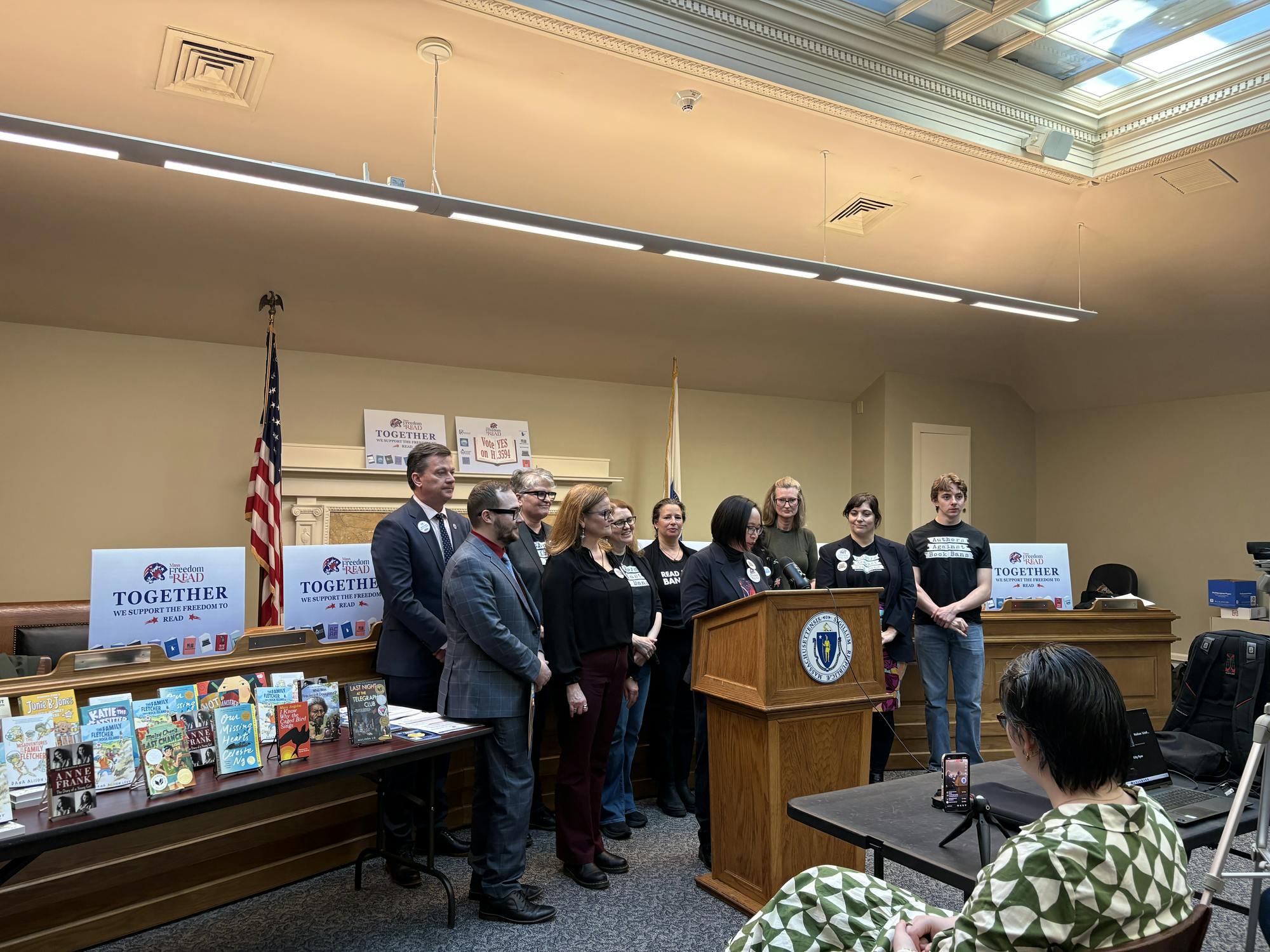
The Mass Freedom to Read Coalition assembled on March 10 in the Boston State House for a day of advocacy, involving a book fair and a press conference with speakers including authors, state legislators, students, librarians and advocates.
The Mass Freedom to Read Coalition consists of Massachusetts families, students, authors, publishers, librarians, booksellers and educators who believe in the freedom to read, as it relates to the First Amendment. The coalition is dedicated to advocating for the passage of Bill H. 3594, an act regarding free expression. It declares that books and materials cannot be removed from public libraries and schools based on personal ideology and protects librarians and educators from retaliation.
Malinda Lo is a member of Massachusetts Freedom to Read and the author of the LGBTQ coming-of-age novel “Last Night at the Telegraph Club,” which was one of the most-banned books of 2024. Lo explained that the passage of H.3594 in Massachusetts is especially crucial at this moment, as restrictive legislation is proposed nationwide.
“With the recent introduction of HR 7661 the United States House of Representatives mendaciously titled ‘Stop the Sexualization of Children Act,’ the federal government is well on its way to telling us what we can and can’t read,” Lo said during the conference. “But we can fight back here in Massachusetts using our state laws to protect Massachusetts residents and to send a message to Washington.”
Lo explained the importance of these books to young readers.
“Books are the keys that unlock minds. They show people what is possible,” she said. “When people feel unsafe, unheard or unimportant, books offer a way for people to see themselves in stories.”
Many of these stories facing bans and restrictions contain marginalized perspectives and identities. Andrea Fiorillo, co-chair of the Massachusetts Library Association Intellectual Freedom and Social Responsibility Committee, elaborated on which narratives most often face censorship.
“When we talk about banning books, we’re really talking about people whose stories are told, whose stories are censored. Recently, it is especially the voices of LGBTQ, Black, Indigenous and Latinx voices who are silenced. Currently in Massachusetts, it’s Palestinian and trans stories who are most often excluded,” Fiorillo said during the conference.
Book banning in Massachusetts is not limited to community members filing complaints against curricula and libraries.
“In Great Barrington, police were called to middle school to investigate a book. In Rockport and beyond, books were hidden or destroyed. … A candidate for secretary of state campaigned on the issue of libraries exposing children to pornography,” Fiorillo said. “Extremists in ski masks have disrupted story times in Taunton, Fall River and Boston, and bomb threats of terrorized library workers and their communities in Reading and Somerville.”
Outside of public libraries in schools and communities, Fiorillo connected the fight against book banning to others regarding censorship and academic freedom.
“The threat to free expression has spread, evident in the suppression of curricula, peaceful assembly, the press, in defunding research … in detaining academics,” she said. “Even when the sensors don’t win at the moment, the impact is that individuals, libraries, museums, schools, municipalities, universities self-censor for fear of the consequences.”
These anxieties around self-censorship are present in writers as well, especially those beginning in their writing careers, as Fin Leary, a program manager at We Need Diverse Books and writing instructor at Emerson College, noted.
As book banning increases, there are more hesitations from educators to teach certain books, publishers to publish certain books and literary agents to promote and advocate for certain books. This all can affect authors, leading them to self-censor.
Leary further detailed their observations around how young adult writers engage and experience censorship outside of self-censorship.
“I think one of the biggest trends is that students are deeply concerned about these issues. Young people are very aware of the impact that book banning and censorship has. They’re passionate. … They don’t want to be censored,” Leary said.
Fiorillo added that the bill is actionable, given it has a specific focus.
“We’re addressing a very specific piece of this censorship issue here. There’s something very actionable. It just makes some small tweaks in existing law, but it also reaffirms our commitment to the First Amendment and to the 14th Amendment,” Fiorillo said.
Lo underlined the importance of this bill during the conference.
“As one of our nation’s founding states, Massachusetts has a responsibility to be a leader and to continue our proud tradition of fighting for freedom during troubled times,” she said.



