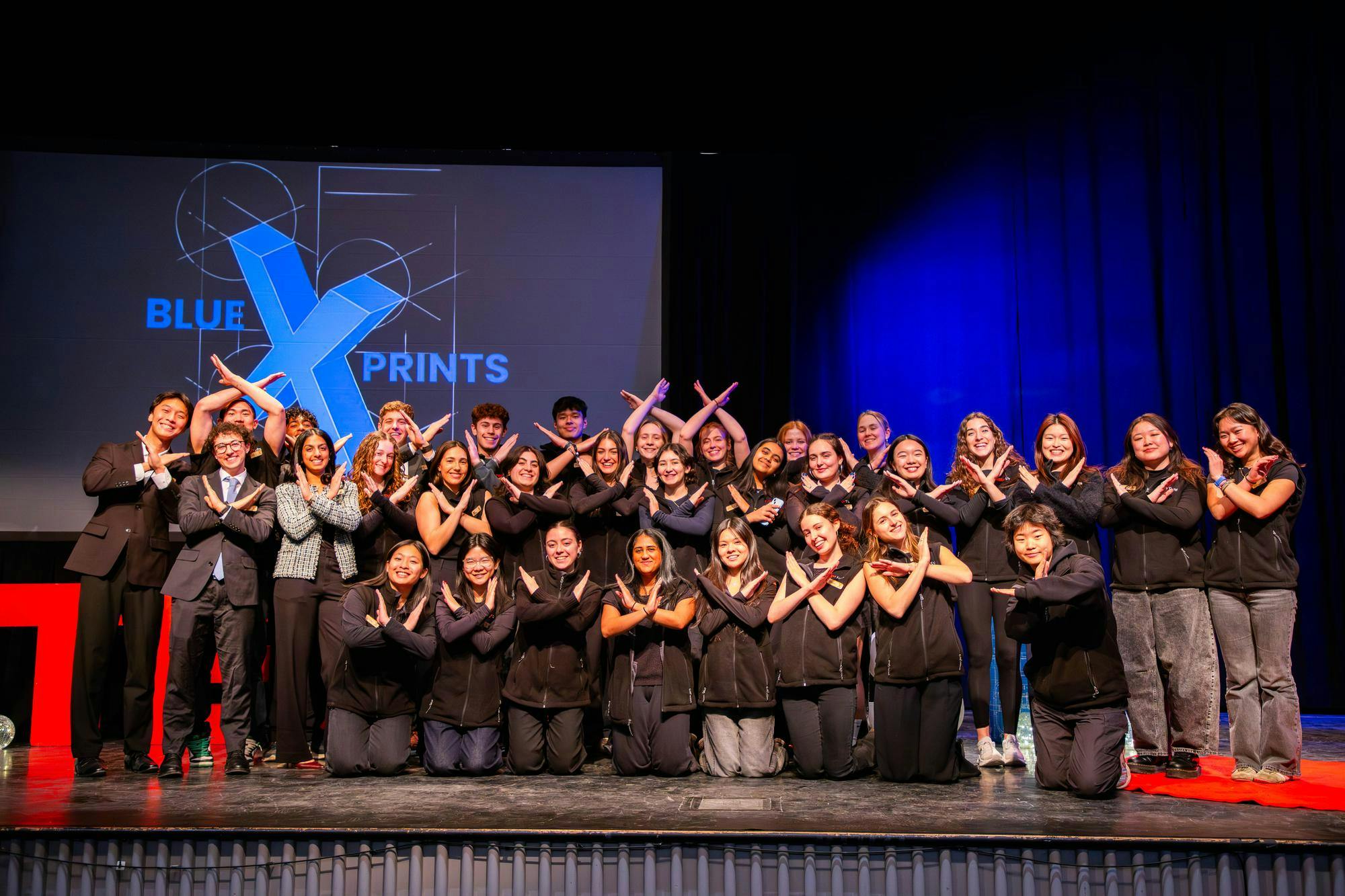
During a time that many would describe as unprecedented and uncertain, perhaps the most important question for us to consider is: Where do we go from here? With its spring conference “Blueprints for the Future,” the student organization TEDxTufts hoped to help audiences make sense of the next steps while learning something new.
TEDxTufts is a student organization that coordinates an annual conference where members of the Tufts community share ideas through a series of talks. The club receives overall guidance from the broader TED organization, but the conference itself is self-organized.
The theme for this year's conference was born in the club’s first fall meeting, during a process that senior Jacob Kao, co-executive director of TEDxTufts, described as “clunky.”
“We come up with as many ideas … as possible [and] write them down on a whiteboard. We literally go through each one and hear from every single member,” Kao said. “It’s a clunky process because we want to hear from everybody, but I think it’s important, because then we can all collectively say we had a say in what the theme was.”
The TEDxTufts team is committed to hearing each member’s contributions. Kao stated that this value came from his own experiences since joining the club in his first year. As a member of the club’s general team, he often felt like a ‘task rabbit’ while leadership worked to complete everything.
“In the past, it felt like leadership just did everything,” Kao said. “I think for us this year, something we tried to do was gain feedback from the team as fast as possible. … I think it helped a lot in terms of letting underclassmen … take a bigger role and gain confidence early on in the year. I think a lot of the first-year members … really grew a lot.”
In the fall, the club recruits members through an application-based process. TEDxTufts is run entirely by undergraduates and is made up of six subteams: marketing and publicity, partnerships, production, web and design, speaker coaching and video. Over the course of the year, these teams work together to bring their program to life, and planning begins almost immediately after the previous conference finishes.
This semester’s culminating conference took place in Cohen Auditorium on Feb. 28 and featured 10 speakers in nine talks ranging from social incivility to humanitarian issues to wellbeing and personal growth. Each speaker at “Blueprints for the Future” had some affiliation to Tufts, whether as a student, alumnus or faculty member.
Jessica Foley, a speaker at the event and a postdoctoral researcher at Tufts’ Jean Mayer USDA Human Nutrition Research Center on Aging, described the speaker application process as a smooth, casual experience. TEDxTufts often recruits speakers by contacting individual Tufts departments like the HNRCA and asking if anyone is interested in participating.
“The application wasn’t very arduous, to my memory. … It was a couple of lines [about] who you are, … [whether] you had previous experience and then it [asked], ‘What would you like to talk about?’” Foley said. “My impression, just from the curation [process], was that they were looking for a diverse range [of topics].”
After being selected, each speaker meets with their speaking coaches, who help with ideation for their final speech. Emily Ruhm, a speaker at the event and current Ph.D. student at the Fletcher School of Law and Diplomacy, said she had known early on that she wanted to discuss her research in humanitarian work and its interaction with gender and intersectionality. Her research was based on her work in the Peace Corps and the United Nations, and she wanted to include these personal anecdotes in her speech.
“You’re paired with [the coaches] from the beginning, and then [there’s] a multi-draft review process,” Ruhm said. “It was three to four drafts, where each round [involved] feedback from your coaches.”
Ruhm noted that she used a mixture of resources to prepare, including dissertation research, presentations for her Ph.D. program and Tufts application essays. When developing her speech, she drew on these materials along with personal experiences that inspired her to pursue humanitarian research at Tufts.
By October, TEDxTufts has completed the process of recruiting speakers. Afterwards, planning shifts toward logistical aspects of the event, such as collaborations. These elements are made possible through the work of the partnerships team within TEDxTufts.
At “Blueprints,” food and beverages were catered by businesses in the local Medford and Somerville area, including Ten One Tea House, Dave’s Fresh Pasta and Semolina Kitchen and Bar. Additionally, several organizations tabled during the event, including Tufts Experimental College, JumboVote and the Tufts University Prison Initiative.
TEDxTufts regularly collaborates with TUPIT, as conferences often feature students from its programs. “Blueprints” included TUPIT student Jody Boykins, whose speech was well received by the audience.
The production team within TEDxTufts assists with set design and creative activities that guests can participate in, many of which correspond with specific talks.
“There was a talk from a cyclist, so there was a smoothie bike. The words-of-affirmation mirror was [connected to] the everyday rudeness talk from John O’Brien,” Kao said. “There’s some pairing and … subtlety in all of the activities that hopefully people saw.”
Despite all these moving parts going into the final day, the event itself was executed smoothly for everyone involved. Foley noted that the club was “very professional,” and Ruhm appreciated the dress rehearsal as helpful preparation for the conference.
Kao acknowledged his fellow co-executive directors, Nick Dohr and Alexandra Rachmat, and stressed that the event would not have been possible without the effort of the TEDx core team.
“[On] the day of [the conference], all I had to do was read off cue cards, but [the rest of the team] were the ones actually running the stage and making sure things were on time,” Kao said. “We had two members literally driving around Boston all day … [and] we had people setting up [from] 9:30 p.m. the day before. … I really can’t take credit for all their work.”
For a conference called “Blueprints for the Future,” it would seem fitting to have some kind of grand takeaway. Reflecting on her own experience, Foley noted that TEDxTufts helped her become a better public speaker.
“It was cool to get an opportunity to speak for such a long time, mostly about my own research, to a bunch of people who probably would never have heard about my research otherwise,” Foley said. “That's an amazing thing for any scientist to get to do.”
Ruhm, who also attended the entire conference, appreciated learning about topics outside of her own field and meeting the people who connected with her speech. This interchange of knowledge highlights the broader learning experience created by conferences like TEDxTufts.
“It was really great to have those kinds of experiences with people that I otherwise don’t generally interact with, because we’re pretty siloed at Fletcher,” Ruhm said. “I think we can always find inspiration for our own work by looking at others who are completely different from [ourselves].”