Boston is, and has for a long time been, a city of nascent artistic talents. Taking the Berklee College of Music alone, which graduates around 1,300 students each year, one would assume that a vibrant and expansive music scene would naturally follow. But, as it turns out, this assumption proves to be at best a half-truth. For as long as Boston has been a city teeming with the talents of clear-eyed and full-hearted college bands, it has likewise been the site of continuous struggle for performance and practice spaces, with most acts being confined to DIY basement shows or backyard gatherings.
It may be difficult to find a group of people better acquainted with the struggles of being an aspiring Beantown musician than Niko Malinowski, David Wright and Ali Tahir, the triumvirate who founded the Boston Progressive Jazz Festival in 2024. The three came together at Berklee, hailing from entirely different regions — Malinowski from nearby Malden, Wright from Virginia, Tahir a native of Toronto and Dubai — yet bound together by a passion for musical expression and a collective dream of reinvigorating Boston’s dormant jazz community.
“It’s always said that the scene in Boston for jazz is actually not that great. It’s kind of hard to find a place to play,” Wright mentioned during an intermission on the festival’s first night. “We’re giving people opportunities to really not only play, but to show their music to a crowd that usually wouldn’t show up for one of their gigs.”
Previous iterations of the festival took place at the Center for the Arts at the Armory in Somerville, but for this year’s installment, which ran on April 3 and 4, the founders opted for Deep Cuts in Medford Square. This more intimate restaurant venue boasts half the capacity of the Armory but perhaps double the charm. Though one may make the trip solely for the music — as they very well should — the other offerings at Deep Cuts, which include a pinball arcade, record store and beer brewed on-site, are more than enough to keep visitors occupied between sets. The burgers, too, prove formidable in their own right.
Opening Friday’s four-set slate was BUND+, an expanded incarnation of Wright’s regular group BUND, augmented by additional instrumentation and a vocalist. The ensemble, usually seven — including Malinowski and other various contemporaries — expands to 11, taking on the spirit of an early swinging big band inhabiting the body of a modern fusion group. Their tunes emerge quietly, a murmured, percussive rhythm or a flickering trumpet, and build until they’re tumbling forward with real momentum. Occasionally they may tumble slightly too far — it’s undoubtedly difficult to keep 11 musicians on the same page — but for the most part, it’s clear that each member of the group is exceedingly talented and capable.
Save for a small crowd in the middle, the room’s empty space was felt toward the beginning of the set. As one tune turned to another, though, people began to flood in from the bar, the record section and every other nook in the space, just to hear what Wright and company would come up with next. Their 45-minute set was, above all, characterized by variety, as they traversed samba, funk and many other musical areas with striking cohesion. Many likely felt that their program elapsed too quickly — a testament to the group’s sheer originality.
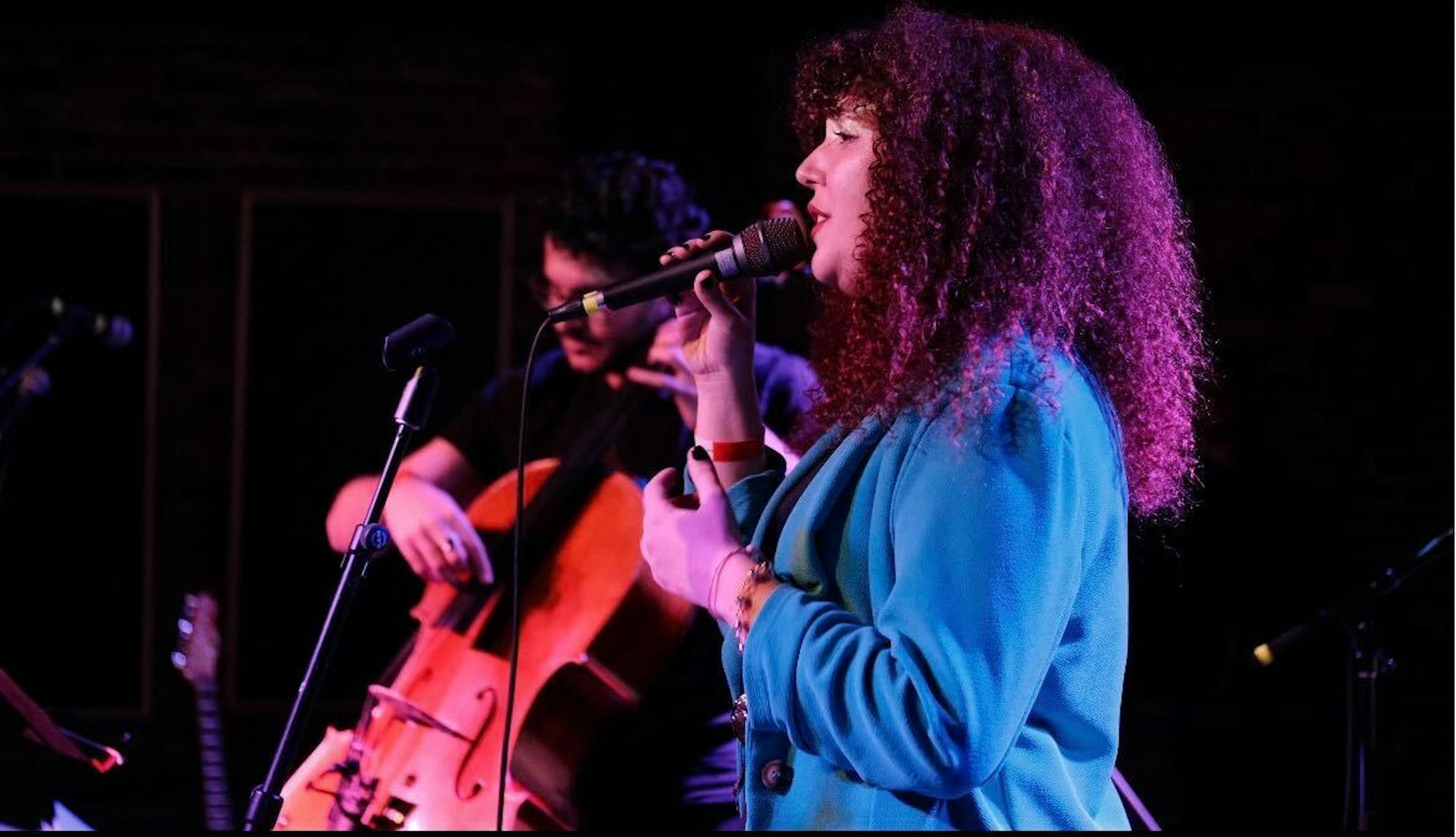
But the show must go on. In this case, BUND+ gave way to a group led by Greek singer-composer Rania Toli. Toli, also a Berklee graduate, specializes in the performance of original and classic works from across the Mediterranean and beyond.
The diversity of the festival’s programming was exemplified by the sensational difference in mood when Toli took the stage. In fact, her first warning — or perhaps promise — to the crowd was that her set would be quieter than her predecessors’. She spoke softly yet invitingly, and soon her group — composed mostly of string players — launched into a variety of works, each shaped by their own quietly dramatic harmonies. As she performed, Toli would glance around the stage at her bandmates, instructing them with her eyes and hands, smiling all the way. It was a sharp yet well-received shift from the first act, and an early sign that the evening had no intention of repeating itself.
The most eclectic group was waiting in the wings. Whatever assumptions their aesthetic initially invited — a beanie seemed to be a requirement to play in this group — the Samuel Cerra Elektric Quartet dispensed with them the moment they began. Cerra, a skilled mallet player who here opted for a device smaller than his usual vibraphone, immediately surrounded the audience with an ethereal soundscape. Soon, saxophonist Alan Villanueva began draping a delicate tune over Cerra’s backing, and the quartet exploded into an engrossing, if highly unusual, composition of quiet complexity. The group continued to captivate its audience in a similar fashion for close to an hour; when Cerra jested that he might not have an encore in him, there was genuine protest.
Closing the night was the Boston-based group Shibui — the festival’s headliner, joined in this instance by vocalist Courtney Swain — which proved a fitting end to an evening that consistently rewarded patience and attentiveness. Helmed by bassist and percussionist Tim Doherty, Shibui is a collective well described by its fluidity. Their music situates itself in a chamber context, but it’s far more likely to transcend thematic boundaries than adhere to them, traversing the spectrum of ambient and experimental sounds across each work. Self-described minimalists, perhaps — but the interplay between clarinet and keys, between keys and Swain’s chorales, carried a quiet impact that grew with every groove.
“We sought them out,” Wright said of Shibui and the festival’s Saturday headliner, guitarist Shubh Saran. “We saw that what they have artistically showcases the best in what Boston has to offer, but also in what this music has to offer.”
In talking to Wright, it was clear that he and his co-organizers have no intention of slowing down. The festival may still be very DIY — self-funded by the trio of coordinators, who finally set up an LLC and bank account for this year’s iteration — but its profile continues to grow. Each year presents an opportunity: for the founders to connect with artists, for the artists to connect with each other and for the local community to experience a new side of the Boston jazz scene. It may not draw the crowds of Montreal, or even the annual festival in Newport, but that was never really the intention. What the Boston Progressive Jazz Festival looks to accomplish is the renewal of Boston as a place where performers and listeners can gather to explore new frontiers, and in that right it’s been more than successful.