
Editor’s note: The Daily’s editorial department acknowledges that this article is premised on a conflict of interest. This article is a special feature for Commencement 2026 that does not represent the Daily’s standard journalistic practices.
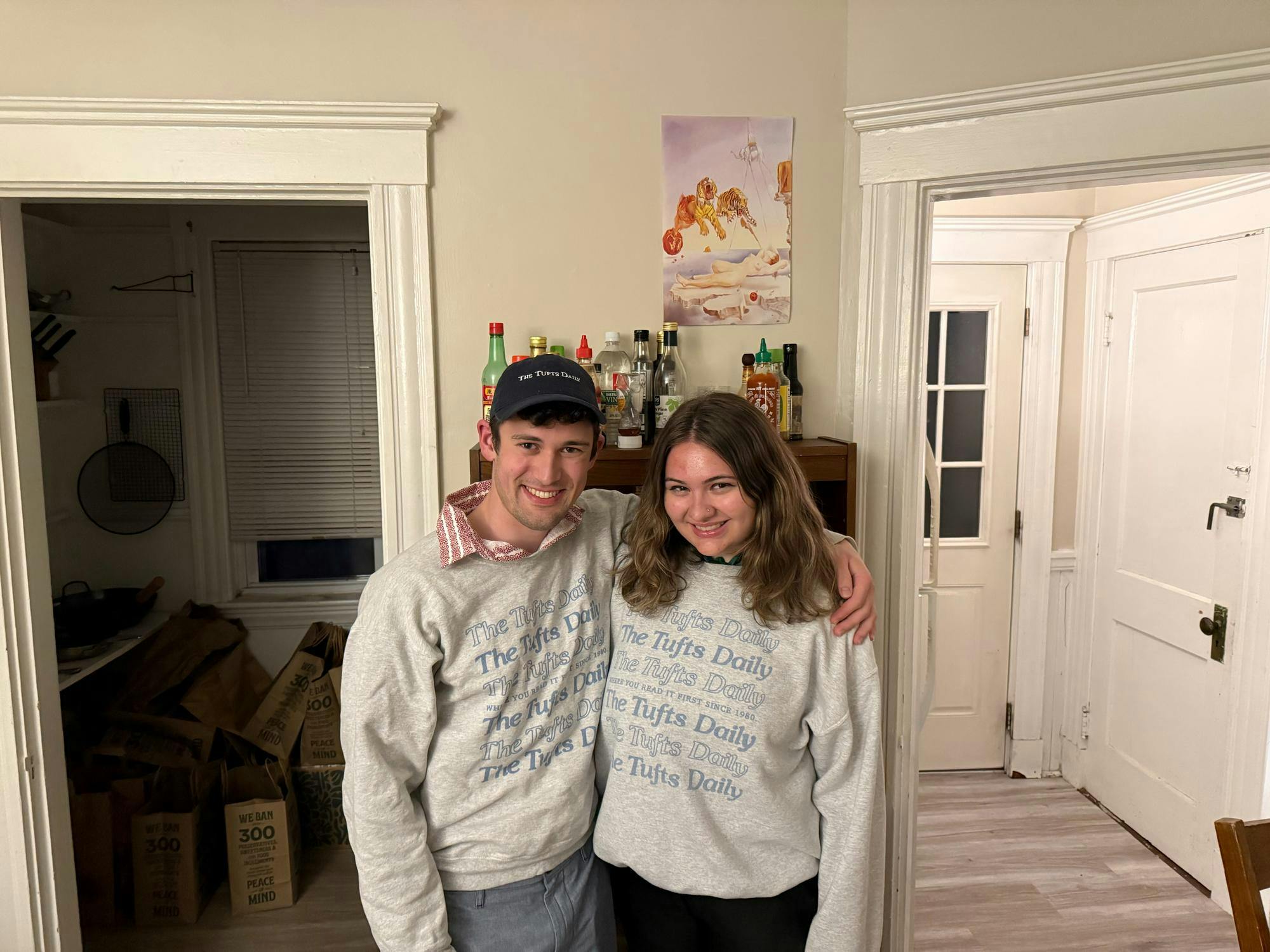
Shannon Murphy and Liam Chalfonte are two Daily graduating seniors whose academic paths paralleled one another and eventually found an intersection in the newsroom — shaping their college experiences, their approaches to writing and the futures they now envision beyond the Hill.
Neither senior initially imagined themselves as English majors. Despite arriving at Tufts with a plan to major in international relations, Murphy instead found herself drawn to writing after taking Creative Writing Journalism with Ravi Shankar during her first semester, inspiring her to join the Daily in the spring of that academic year.
Murphy is now double majoring in English and science, technology, and society, with a minor in film and media studies. She said the combination of majors allowed her to tailor her studies to better reflect her own interests.
“I was never interested in that 18th century literature,” Murphy said. “I was always thinking about the modern applications of an English degree.”
She said that taking STS and English courses simultaneously gave her a good foundation for writing on science and technology and navigating an increasingly technological media landscape.
Chalfonte’s path to the Daily had a bit of a rockier start. He began his college career at Suffolk University, where he initially planned to study political science but quickly felt out of place at the college.
“I filled my schedule with all [political science] classes and I took one English class as a throw-away,” Chalfonte said. “At the end of that semester, [a professor] pulled me aside and said, ‘Liam, you need to be an English major. Go do that.’ And so I went, ‘Okay … I’m gonna be an English major. Please be my advisor. I’m transferring. Please write me a letter of [recommendation],’ which she handled very well.”
The transfer process led Chalfonte, of course, here to Tufts. In his first semester, a housemate suggested that Chalfonte come along to the Daily’s fall general interest meeting. The new transfer didn’t know what awaited him at the paper, but over the course of his sophomore fall, Chalfonte said he had found a community on the Hill and a sense of purpose at the Daily.
Now an English major with minors in political science and music, Chalfonte has wrapped up his Tufts academic career by writing a book-long English thesis.
“It’s about a girl named Rachel who, a few days after her 18th birthday, disappears, and in her place, a new version of her, exactly one year younger, appears, and it’s how she and everyone else in life deals with that change,” Chalfonte said.
Murphy commented on Chalfonte’s 190-page thesis, saying it exemplified the narrative style she has come to familiarly associate with Chalfonte’s writing.
“I feel like that’s your thing in writing: It’s normal until some bull s--- happens,” Murphy said.
This teasing jab is just one example of Murphy and Chalfonte’s joke-filled dynamic, brought about by three years of overlapping academic interests and involvement at the Daily that has naturally brought the pair together as friends and work spouses. Their shared circles became central not only to Murphy and Chalfonte’s friendship, but also to their individual development as journalists and leaders.
Over her seven semesters on the Daily, Murphy “wore a lot of hats” — deputy news editor, arts editor, executive newsletter editor, social media manager — each role shaping her understanding of how a newsroom operates.
Murphy explained that, prior to her time as its executive editor, the newsletter section flew a bit under the radar — recap emails were essentially compiled by only one person. But in the role, Murphy worked to restructure the section, making the process more collaborative and opening it up to a wider range of contributors.
Murphy and Chalfonte also worked together on the Tufts Daily Magazine, of which Chalfonte was the executive editor. He said the magazine was a place for Murphy’s experience as a news writer and his as an opinion writer to come together in long form, exploratory features.
“TD Mag tries to mix hard facts of news with the personal storytelling that ops brings,” Chalfonte said. “Working back and forth to bring both of those sides out with Shannon was really fun.”
In addition to serving as the executive editor of TD Magazine, Chalfonte has contributed avidly as an opinion staff writer and served as a copy editor, executive opinion editor and managing editor. Through these roles, he said, he developed a strong set of management skills that were very formative, but also may have ultimately steered him away from a career in journalism.
He said this was especially solidified during his managing board’s coverage of Rümeysa Öztürk, a story that demanded precision, care and persistence. Chalfonte came out of the semester with a sense of pride for the Daily’s work on Öztürk’s story, but, at the same time, the intensity of that experience helped him realize that a long-term career in journalism might not be the right fit. He now sees himself pursuing work in publishing or teaching.
Chalfonte said his interest in education was especially sparked when he taught an explorations course through Tufts’ Experimental College — a unique opportunity in which current Tufts students can design and teach their own courses to incoming Jumbos. He led 10 first-year students in their first semester at Tufts in a class about speculative fiction.
Murphy, by contrast, remains committed to journalism. Currently freelancing for Boston.com, she plans to continue reporting after graduation. She did acknowledge the common concerns about artificial intelligence encroaching on the field, but remains confident in the enduring value of human storytelling and creativity.
“At this stage, AI cannot replace human writers, I know that,” Murphy said. “I saw a post the other day [that said] ‘AI just gives you the next predicted word … it puts the next good word; a human writer will throw in a word that’s evil.’”
Despite their differing future paths, both agree on the Daily’s lasting impact on their life in college and beyond. Murphy said that, while her journalism courses helped her refine her writing style, the Daily provided something more immediate and transferable: the experience of working on-the-ground in a real newsroom.
The two also reflected on some of their favorite pieces over the course of their writing careers at the Daily. Murphy recalled interviewing one of her favorite bands, the Rare Occasions, for a Q&A article. She remembered it as a great learning experience for her in terms of interviewing skills, as well as an exciting moment for her as a fan of the group.
Chalfonte mentioned a piece that he felt had a great response from the Daily’s readers, as well as other journalists, which he referred to as “the wolves article.” The piece, about political polarization (and wolves, of course), garnered attention and praise from other writers and readers of the Daily.
Looking back, both Murphy and Chalfonte describe their time at the Daily as central to their Tufts experience. The paper offered them a space to experiment, to take risks and, perhaps most importantly, to grow alongside one another. Their paths may now diverge post-graduation, but the foundation they built together at the Daily remains a constant point of connection.



