When asked to introduce himself during the interview, Zhu Keyu — a graduating fifth-year combined-degree student majoring in both fine arts and film and media studies — provided a layered answer.
“My English name is Jack, but that’s just a pseudonym. My Chinese name is Zhu Keyu,” he said while reclining in his worn mesh desk chair.
Looking around the room, one would almost be able to tell Zhu’s character without him even saying a word. It’s likely the only place in Medford where one can find a variety box of Chinese Lay’s potato chips, a set of dominoes from Puerto Rico and a fuzzy leopard print jacket all within feet of each other. Yet, despite all the different elements of Zhu’s life that have been collected in this space, it’s Jack’s room, and Jack may not even truly exist.
Zhu’s true room is more than 7,000 miles away, in the Liangshan Yi Autonomous Prefecture on the Southern border of China’s Sichuan province. He’s been all over the United States — a Jewish summer camp outside of Boston at 13-years-old, a stint at a program in Portland, four years at a high school in Saddle River, N.J. — but none of those places felt quite right.
So when the time came for his senior thesis film, Zhu knew where he had to go: back to the province he grew up in, back to the Mosuo people who surrounded him in his youth.
“I think that this film made me realize that the most personal is the most creative,” Zhu said. “I need to make something that I care about and I have a connection with.”
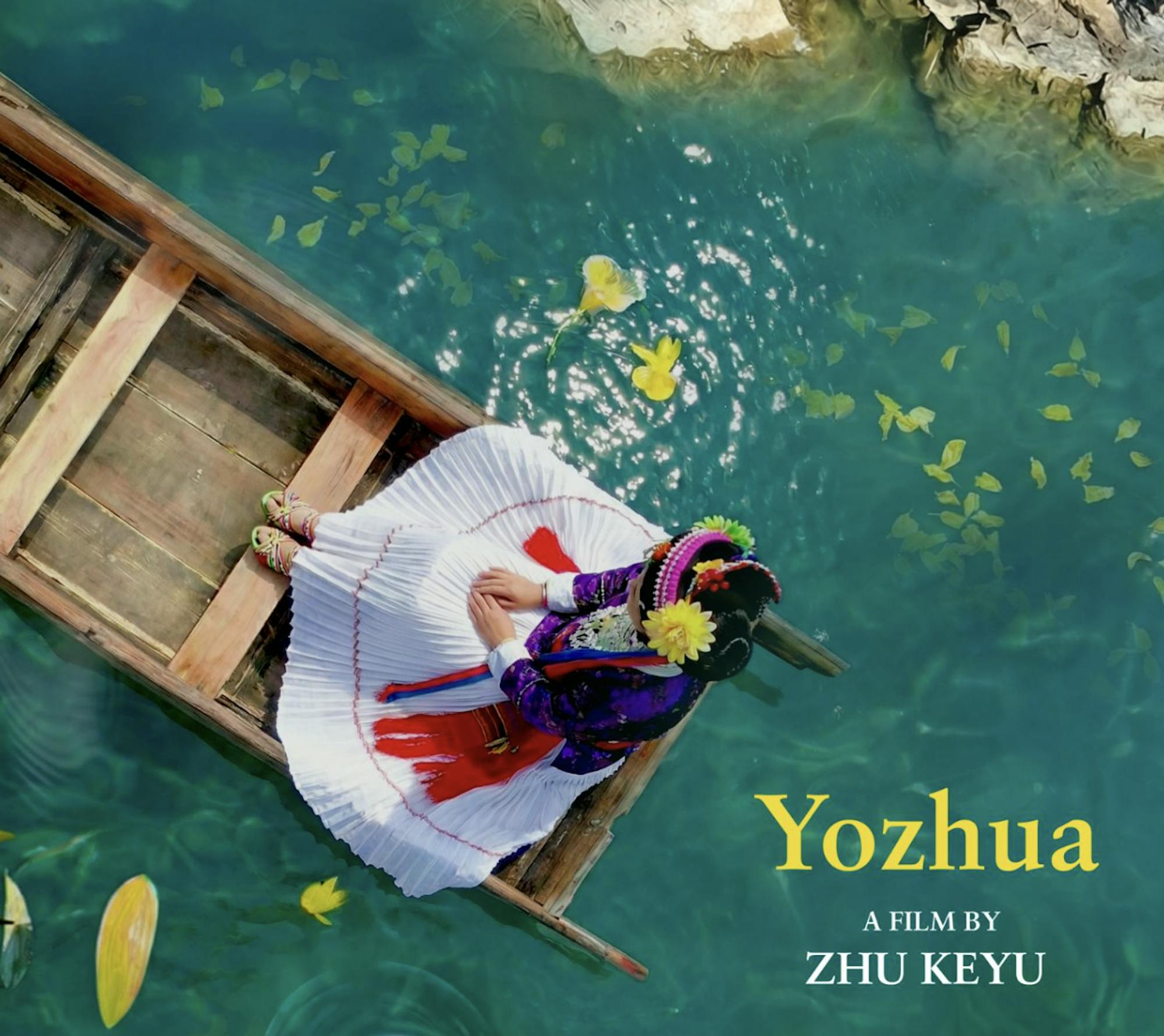
While definitively personal, the resulting film, titled “Yozhua,” is also the product of Zhu’s extensive research into the mythos of his hometown. Its story follows a young woman named Yozhua, a bar waitress and dancer, as well as a tourist boat worker who searches for her.
As Zhu put it, the method stemmed partially from his fascination with stories where “a person [is] trying to find something, or trying to find another person, but that person never existed.” This technique owes much to director Bi Gan, whose enigmatic, slow cinema is grounded in regional tradition and the ethnic groups of his native Kaili province. The parallel is not lost on Zhu.
“I have such a deep connection with [Bi’s] films,” he said. “The province that he lived in is so similar to the place where I lived — and there’s also the minority. Even though they’re very subtle in his films, they’re always present.”
As far as shooting goes, the plan was loose by design. Zhu recruited Doo Min Bang — a fellow FMS student that he’s known since his first year at Tufts — and the two scraped together what money they could find before setting off for three weeks in Liangshan Yi with little idea of what they’d bring back.
Together, the pair spent their first two weeks in Sichuan more as ethnographers than filmmakers, “figuring it out on the spot.” This time was certainly a mixture of work and pleasure — the time they spent in local temples and museums was likely equaled by hours spent in bars — but for Zhu, every experience was invaluable to the research process.
“There’s different methodologies of how each person works,” he said. “There’s the filmmaker way, where you have to go through pre-production, production and post, but there’s also a more artistic way, [where] you have to get to know the people and get to know the environment to put yourself in the surroundings.”
Ultimately, “Yozhua” reflects the complexity of life for the region’s native people. Yet even the mythology wasn’t quite what it seemed. Much of it, Zhu discovered, had been shaped for tourist consumption. A painting a friend made for the film — appearing throughout in cryptic, fleeting moments — is itself a reinvention of that myth, albeit a fitting one.
The work is laced with cultural artifacts discovered during the duo’s fieldwork; however, as much as the project is grounded in Zhu’s anthropology, it is also the synthesis of a collaboration between Zhu, Bang and the local Mosuo. Watching the film, it feels as though it could not have been possible without this multiplicity of perspectives.
“Everyone is bringing something into it, and together it builds this shared emotional space,” Zhu wrote in a message to the Daily after the interview. “What I care about most is that the emotion feels kind of transcendent, almost like feeling there is something larger [that] can’t [be] fully put into words.”
That Zhu feels most at home working in an unconventional, cooperative style may well reflect his history as an artist who experimented with many different mediums before defining himself as a filmmaker. His early experiences with artistic expression came from building knock-off Legos and attending a Kumon-style art school where he learned Chinese landscape painting and calligraphy.
When he applied to the School of the Museum of Fine Arts at Tufts University, his portfolio consisted of paintings and illustrations. Zhu had not been shut out from the world of moving pictures by any means — his uncle had given him a broken Canon, sparking an initial interest in photography, and he had become interested in international film after pirating films like “Oldboy” (2003) and “Cold Fish” (2010) online — but it took some time for him to land on film as his chosen form.
“It just took me a lot of time to make [up] my mind and to dedicate all my energy and effort into this one thing,” Zhu said. “I only started doing film seriously last year.”
However recent his devotion to filmic expression may be, it’s immediately evident in watching Zhu’s work that he has the mind of a seasoned artist. He is wholeheartedly devoted to making the personal feel universal, a commitment reflected not only in “Yozhua,” but also in his SMFA thesis, a three-channel video installation centering on a minivan door he salvaged from a scrapyard. Zhu’s father owned a similar minivan when he was a child, and the exhibition is designed to appear as if each spectator is looking out that same window, seeing what he once saw.
Such is the driving impulse of Zhu’s entire artistic practice: to get his audience to see what he sees, think what he thinks and feel what he feels. Perhaps for a long time, his life has lacked a certain honesty: His name is Keyu, but people call him Jack. Yet when he creates, he doesn’t have to tell anyone who he is. He can show them instead.