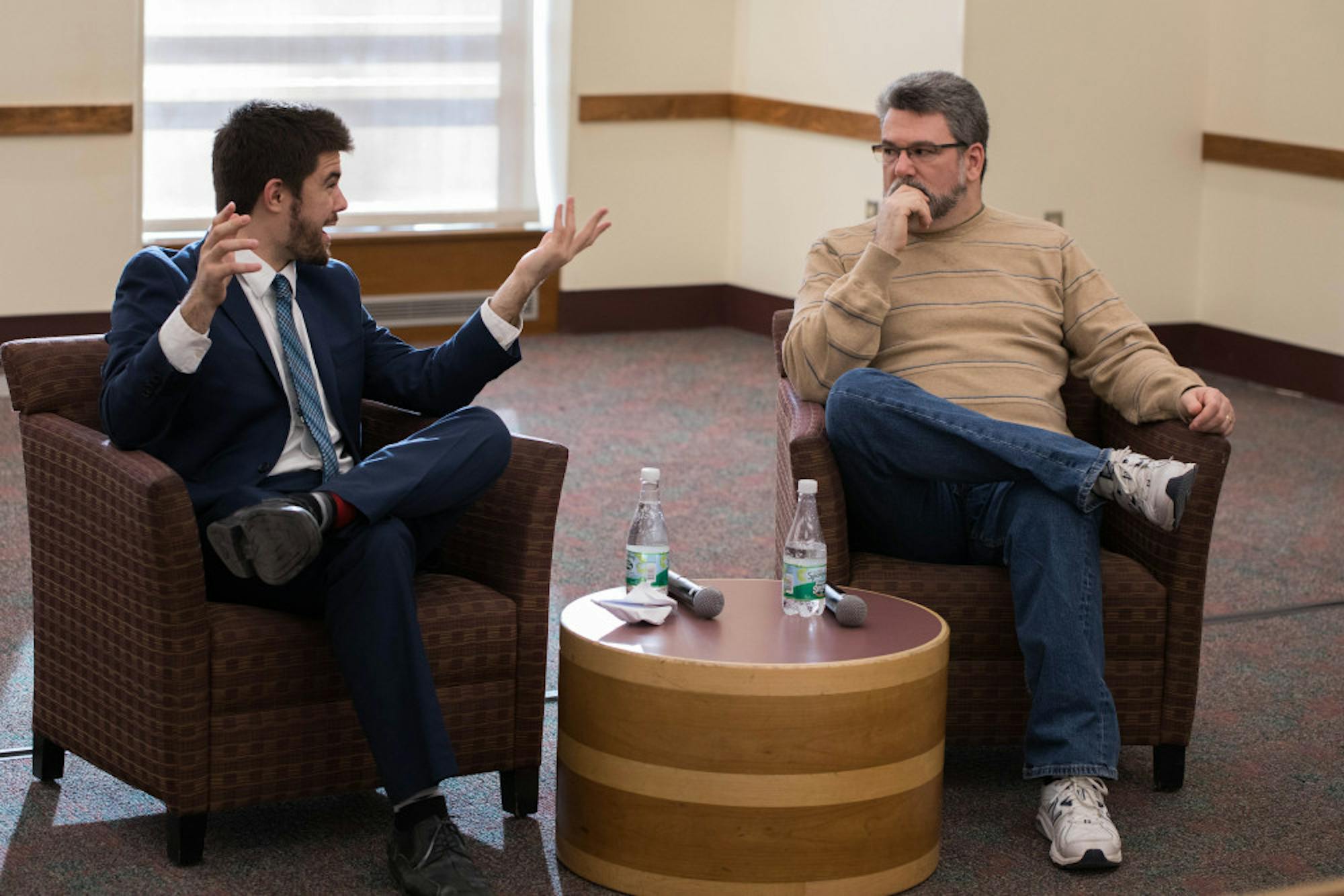
Ray Bradbury once wrote, “You fail only if you stop writing.” The best writing advice is simply to write but, as generative AI has risen, it has soured many people’s taste for putting pen to paper and turning imagination into story. Author Christopher Golden (LA’89) stands firmly against the AI trend.
Golden has written over 100 novels across various genres ranging from comics, screenplays and, most famously, his horror and thriller novels. At Tufts, he took numerous creative writing classes and, by senior year, he had started writing his first novel. Golden had always felt that writing was an instinctual need.
“It’s what’s always [been] in me. This desire to tell stories, to entertain people … I add this sort of fictional tale to whatever we’re talking about. It’s just part of who I am,” Golden said.
More broadly, Golden sees storytelling as something that goes back to the beginning of humanity.
“Our story is a history of stories,” he said. “All you have to do is look at cave paintings to know that. … It’s a desire to entertain and to create art and share what you feel inside.”
He also acknowledges the pressure to commodify writing in today’s society.
“Over the last few decades, there has been this move on the corporate side to codify any kind of art as product, as content. I think that’s made it easier for people to start seeing books as just [products] … but it’s never going to be that for me,” Golden said.
When generative AI came onto the scene, Golden wondered if the undermining of writing education had primed new generations to embrace AI-generated writing.
“What you get is massive percentages of the American population … who can’t put an effective sentence together, but more importantly, who don’t realize it’s a thing that should feel important to be able to do,” Golden said.
In other words, those who were never taught to value the labor of craft see no meaningful loss in bypassing writing. They are the ones who enthusiastically use AI to generate books, focusing on output rather than the process.
Golden believes that a popular novel written by AI will come one day, but right now he cares more about how writing connects us.
“If I pick up a book written by a human author, I am connecting to the life and experience and imagination and heart of the person who wrote that book in some fashion,” Golden said. “Even if the novel was written a century before I was born or it was written by somebody who’s a teenager now, and I’m 58, right? It doesn’t matter.”
For his own works, such as “All Hallows” — a horror novel set in 1980s Halloween suburbia — he has taken inspiration from his own life.
“It sounds like something that would be an easy prompt to put into a generative AI,” Golden said. “But so much of what’s in there comes from my own upbringing, my youth, my life, my people that I knew, my family. There are events, sort of heartbreaking events, that come from my own personal experience.”
His upcoming novel “Carry To My Grave,” out July 21, 2026, follows a Korean War veteran who promises his dying mother he will carry her body from Indiana to Maine by sunrise, a journey which soon turns grim and dangerous. Though nothing in the novel comes directly from his own life, the complicated emotions of a difficult parent-child relationship run quietly beneath the story that many readers can resonate with.
“I think I finally finished writing about my mom and my relationship with my mom. … I think it’s honestly maybe my best book, and it’s my favorite book, the one I was happiest with after finishing,” Golden said. “AI has not had any of the experiences and emotional, fraught days that went into writing.”
Golden’s advice to writers is simple: “If you want to be a writer, you must write. Generating prompts is not writing. … You’re a product manufacturer, not a writer, if you’re using AI to create.”