Massachusetts-based artist Diana Zipeto’s recent additions to her “Fatherland/s” series begin with an invitation.
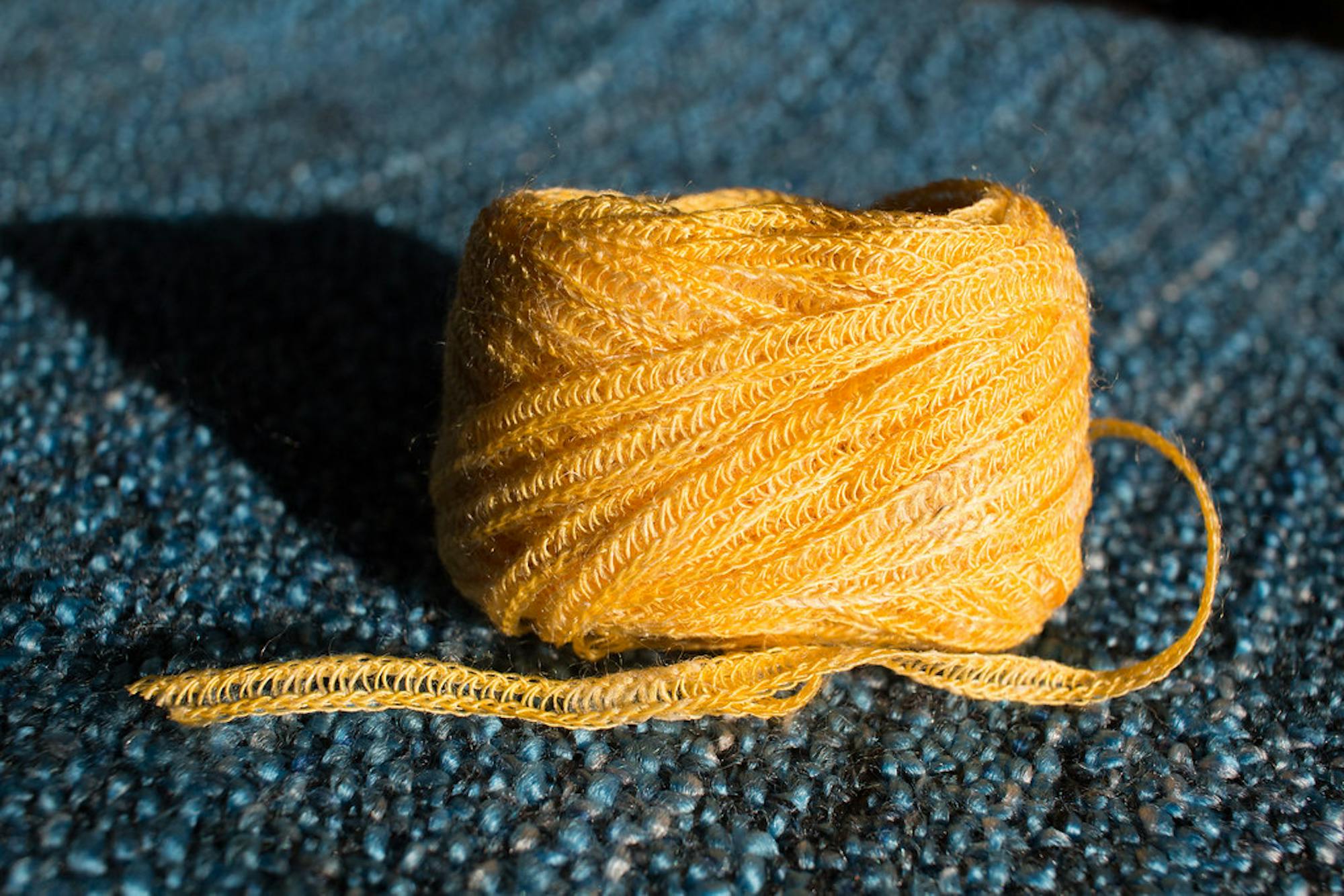
“Two Chairs” is the first piece in an installation of three. As reflected by the name, two chairs sit side by side next to the wall. One chair is tilted precariously, partially resting on a foam mat. The fabric has been cut out in several places, revealing the foam inside. Hollow tubes of yarn in a color matching the foam mat burst from these holes. The second chair is entirely intact and rests solidly on the ground. This is the chair Zipeto allows viewers to sit in and crotchet using the same yellow yarn that threads through each piece.
Zipeto’s “Fatherland/s” is about her processing her father’s dementia. Her work reflects the unraveling and disorder she feels in her home life and comfort zone, with the series featuring many household items torn apart. Currently on exhibit at the Galatea Fine Art Gallery in the SoWa district of Boston are the aforementioned “Two Chairs,” “Curtain” and “Untitled, 2026.”
“Two Chairs” is a sensory experience as much as it is a visual one. Viewers become part of the piece as they sit and partake in the mechanical process of crocheting. With the gaping holes seemingly permeating all the pieces in this exhibit, the act of crocheting in this setting can feel like trying to stitch life back together again.
But what use is that? Zipeto’s works are about her experience looking in from the outside as a loved one declines in their cognitive abilities. Despite wanting to do something, there is ultimately little to be done at the moment in terms of medical care for such an affliction. Perhaps that is why, in the next piece, “Untitled, 2026,” a trail of yarn pools onto the floor beside that work.
For this piece, Zipeto has taken a sofa frame and propped it up in the gallery. Without any upholstery, the object itself is difficult to recognize. Hooked onto the wire springs is a small canvas with a portrait painted onto it. The composition is a simple outline of a head, painted in white pigment on a black background, mimicking the way MRI scans appear. In the center of this head, a hole has been cut out, and from it emerges a tube of yellow yarn that spills over the piece and onto the floor.
This piece is a continuation of the sentiment established in “Two Chairs”: a crochet project left incomplete. One could imagine that the excess yarn in this piece was meant to close the top of the tube protruding from the portrait, yet no one completes this task. There is no invitation for the viewer to sit with this piece and crochet.
The final installation in this series is “Curtain,” a large 90-by-50 inch canvas suspended from the ceiling. The painting follows the same inspiration as “Untitled, 2026”: white on black, holes cut throughout and the same yellow yarn. It is difficult to gauge exactly what is being depicted, but following the logic that these are paintings of MRI scans, one can infer that it is a body part — just missing several pieces of itself.
These pieces represent the dissonance of familiar objects becoming unrecognizable. Zipeto chooses household items symbolizing the comfort of home — two chairs, a sofa, soft curtains — and takes them apart, only to try and fail to put them back together again. The viewer, too, is allowed to make an attempt, but to no avail.
Zipeto’s work is a complex mixing of methodical destruction and audience interaction that triggers deep emotional experiences. The “Fatherland/s” series takes viewers through her mind as she processes her father’s health issues and asks them to sit with her through it.