
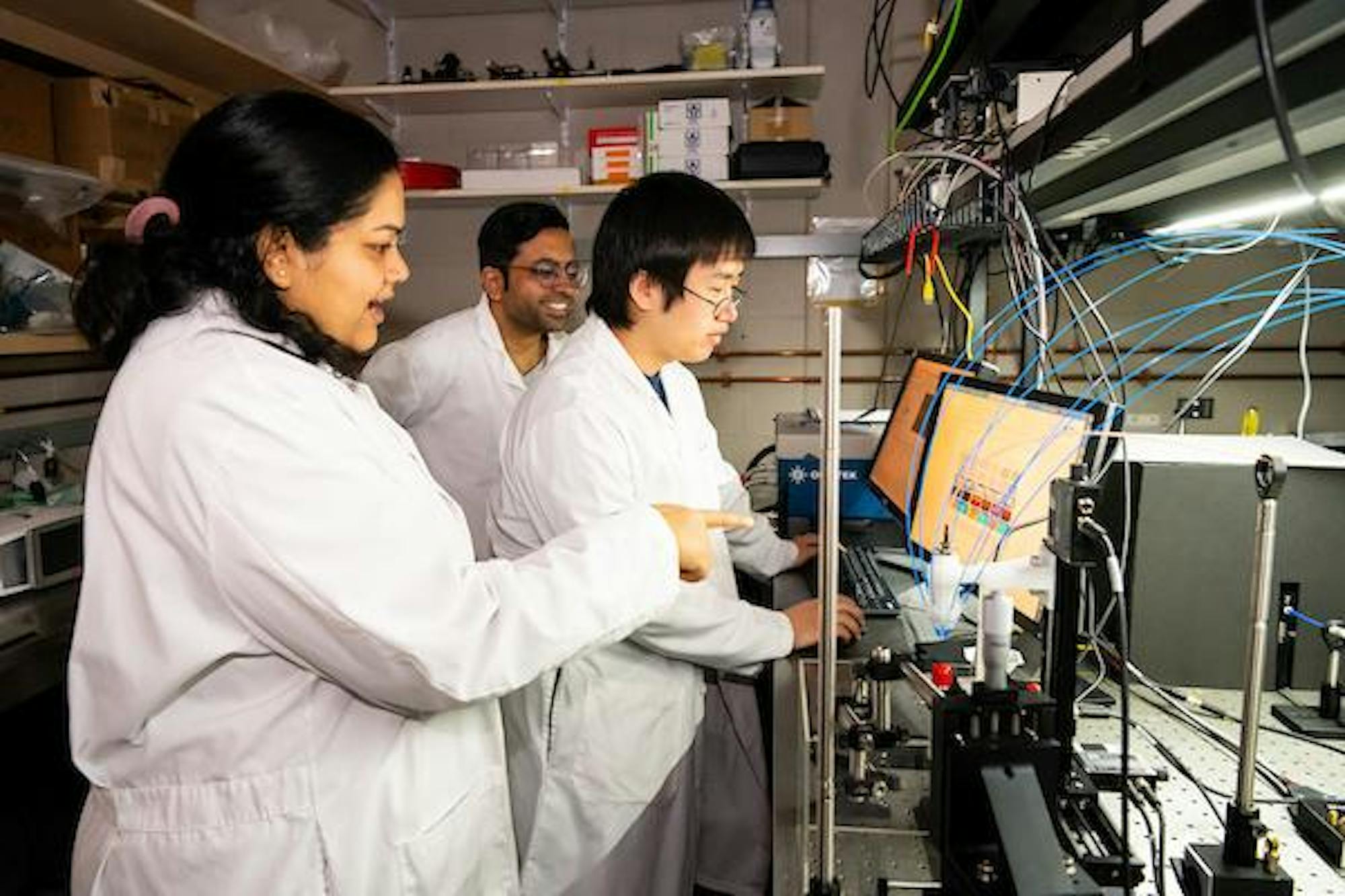
At the heart of the integrated Biofunctional Imaging and Therapeutics Lab at Tufts University is a passion for improving clinical outcomes for cancers using rapidly emerging AI technology. As a result, iBIT is currently transforming the landscape of medicine, pioneering a future where treatment is tailored to the individual biology of each patient.
“Our goal right now is to bring photoacoustics to guide, to design, to predict cancer treatments and also other applications such as in women’s health,” Srivalleesha Mallidi, a biomedical engineer and the principal investigator of the iBIT Lab, said.
At the core of the diverse initiatives emerging from the iBIT Lab is an integration of photoacoustic imaging and photodynamic therapy. The process begins with photoacoustic imaging, using laser-induced ultrasound to provide real-time maps of tumor oxygenation. Guided by this real-time data, physicians can precisely execute a targeted chemical explosion of reactive oxygen species, effectively destroying malignant cells while sparing healthy tissue.
However, this innovative, non-invasive cancer treatment has long faced numerous challenges, deeming it a clinical dead end.
“There is no one-size-fits-all scenario for all the patients,” Dr. Marvin Xavierselvan, a post-doc researcher in the lab who generated the preliminary data required for the project, said. “Tumors have their own genetic makeup and their own other biological barriers that influence heavily on the nanoparticle.”
The nature of the challenge required a shift towards a more dynamic approach utilizing real-time data.
“We are going towards the AI space,” Xavierselvan said. “Where could we combine all our knowledge base … whether it’s an engineering principles, a cancer research [or] cancer biology. Can we bring it to one point where we can use these advanced algorithms? … Could we predict the treatment outcomes?”
The AI solution came in the form of ClAIrVue, the lab’s advanced AI framework utilizing conditional generative adversarial networks to solve the ‘noise’ problem in medical imaging. Photoacoustic signals are often cluttered with biological interference, making it difficult to distinguish between healthy tissue and a tumor.
Utilizing the algorithms within ClAIrVue, these same signals are now processed in milliseconds.
“We don’t have to take as many averages,” Mallidi said. “We can, with a very noisy image, generate a denoised image very quickly so that we can scan a particular area much faster than what was used before.”
According to Avijit Paul, a lead graduate research assistant, ClAIrVue consists of two competing networks: the generator and the discriminator.
“So what happens is I give the U-Net [the generator] a noisy image. … Before training, it just gave me another crappy image. Then, I gave that crappy image to another network, which is called [the] discriminator. And that discriminator is trying to discriminate between real and fake,” Paul said. “When the discriminator is not able to identify that the generator is generating a bad image … [the] discriminator is fooled by the generator, so that’s how the process works.”
However, for the iBIT team, the work is far from over. True to the ‘e’ in ClAIrVue, this culture of explanation is not only evident in its internal code but is mirrored by a commitment to scientific transparency.
“So right now, I am trying to make a model which will explain why,” Paul said. “Like, OK, I failed. But I need to know why I failed.”
According to Paul, the model does more than just produce a noisy image; it identifies and flags the specific areas where it perceives the noise to be.
The iBIT team received a grant from the Tufts Launchpad Accelerator Program last November. What began with the ‘noise’ of photoacoustic imaging has swung open a multitude of doors for clinical application — from real-time scanning to a surgical GPS. However, unlocking the full potential of these new approaches required a shift in perspective.
“Before building a solution, you need to jump out of the building and get to the ground to scratch your head into understanding the problem itself,” Paul said. “I want to advise, search for the problem first, understand the problem, analyze the problem before building the solution.”
Following this roadmap, the team has hit the ground running as they initiate consultations with the transplant department at Tufts University School of Medicine.
“We just yesterday met with the urology department and also radiation oncology as well. A lot of projects are on the way,” Mallidi said.
While many of these initiatives remain under wraps for now, they represent a significant leap towards the next generation of healthcare.
“Hopefully, we’ll get to do some translatable work in the next few years. I’m quite excited to [see] where all of this technology will move next,” Mallidi said.
The iBIT team’s journey serves as a blueprint for the next generation of researchers and innovators.
“I’ve seen the patient’s lives that they have touched,” Xavierselvan said. “I’ve seen the transformation, and then I was like ‘Oh, I want to help in those real-world scenarios.’”
By treating every setback as a data point rather than a defeat, the lab continues to turn today’s obstacles into tomorrow’s clinical breakthroughs.
“Try something quickly. If it fails, learn from it. Try something else. Fail again, but fail fast. That’s how progress happens,” Mallidi said.



